The Tamesis
Three more merchant ships were hit by shells in the Strait of Hormuz on Wednesday, as Iran stepped up its crackdown on neighboring countries and ships exporting crude oil through the narrow choke point.
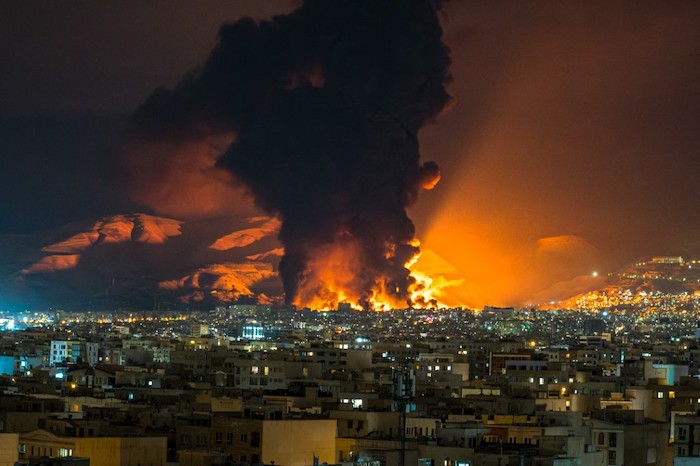
A Thai cargo ship (pictured above) was one of three dry bulk carriers hit and set on fire by two missiles. This brings to a dozen the number of ships hit in the latest conflict, now in its 12th day.
Thai-listed shipowner Precious Shipping said 20 crew members on board the Mayuree Naree were rescued but three were “missing and believed to be trapped in the engine room”. A bulk carrier and a container ship, including one owned by Mitsui Lines, were also attacked in the Gulf near the United Arab Emirates, but suffered minor damage.
Also read: Iran war trumps sanctions, Indian refiners snap up Russian oil
Action against shipping in the strait has plunged the global energy economy into crisis, while Iran’s military command warned the world should prepare for oil prices to hit $200 a barrel.
Benchmark Brent crude surged 5% after reports of the latest ship strike, sending European stocks sharply lower. Earlier, Asian markets were mixed.
Iran’s Revolutionary Guards have said any ship passing through the strait will be targeted, despite U.S. President Donald Trump’s threats to step up attacks if Iran continues to obstruct the strait.
Trump also promised to escort ships through the waterway, but the head of the U.S. Navy told the shipping industry that was not the case. Unable to provide escort It remains too dangerous for ships that want to pass through the sea lane, Reuters reported, noting that only the Strait of Malacca between Malaysia and Indonesia has more tanker traffic.
Saudi Arabia is sending oil to the Red Sea port of Yanbu via an east-west pipeline, although its capacity is limited. The United Arab Emirates is also able to transport oil via pipeline to the port of Fujairah in the Gulf of Oman.
But some refineries in the Gulf, such as Kuwait’s Zour refinery, are unable to transport the crude they produce, while others, such as Bahrain’s Bapco Energies Sitra and Saudi Aramco’s Ras Tanura, have been damaged by strikes.
Here’s Why Oil Prices Are Soaring The market seesawed The Middle East has been plunged into war since the United States and Israel attacked Iran on February 28, killing its supreme leader.
Hundreds of ships remain anchored along the waterway, while oil and shipping executives keep an eye out for signs of when it will be safe to pass through the strait again.
Japan to release reserves
In more positive news, G7 leaders will hold a video conference later today to discuss opening up strategic oil reserves in response to rising oil prices. Ahead of the talks, the group’s energy minister said they “stand ready to take all necessary measures.”
Japanese Prime Minister Takaichi Sanae At 7:20 pm on Wednesday, the country will release oil from stockpiles and cap gasoline prices due to the Gulf crisis.
She said they plan to use domestic stockpiles to prevent supply disruptions of gasoline and other petroleum products as tankers are unable to pass through the Strait of Hormuz and crude oil imports are likely to fall sharply starting at the end of March.
She said Japan is highly dependent on oil imports from the Middle East.
At the same time, the conflict has also affected China’s access to sulfur, a raw material used in the production of fertilizers. China gets nearly half its sulfur from the Persian Gulf, but the war has led to a tightening of its imports from the six Gulf countries “just as the country enters its important spring planting season,” according to the report South China Morning Post.
Analysts say the strait carries 20% of the world’s oil and gas supplies and a third of the fertilizers used in food production, and a long-term closure of the strait would have a devastating impact on the economy, especially for Asian and European countries.
On Tuesday, the Pentagon said U.S. airstrikes destroyed 16 minelayers that could have been used to attack or block traffic in the strait, but drone and missile attacks continued on Wednesday.
Dubai Airport attacked
“If for any reason a mine is planted and not removed immediately, the military consequences for Iran will be unprecedented,” U.S. President Donald Trump said in a social media post.
On shore, the drone crashed near Dubai Airport, injuring four people, Dubai Municipality said.
Emirati officials said about 1,700 missiles and drones were fired at the UAE, and it is estimated that Iran may launch more attacks on the UAE than Israel. abc news Report.
Meanwhile, analysts are skeptical of Trump’s assertion that naval escorts will be able to reopen the Strait of Hormuz to trade, AFP reported.
“Any escort mission is likely to face ongoing threats from Iranian missiles and drones, and the security risk alone could make a single passage through the strait cost more than the profit margin of the oil shipment itself,” the Soufan Center think tank said in a briefing.
“Experts estimate that the Iranian navy’s mine inventory ranges from 2,000 to 6,000, which would further complicate the navy’s plans to escort commercial oil tankers,” the report said.
Iran ‘not seeking ceasefire’
The Israeli and U.S. attacks come weeks after Iranian authorities ruthlessly suppressed mass protests, although the United States and Israel say they are not necessarily seeking to overthrow the Islamic republic.
Iranian authorities have warned against dissent in the country, with the country’s police chief saying protesters will be treated as “enemies” and treated as such.
“All our forces are also ready to pull the trigger and prepare to defend the revolution,” national police chief Ahmed Reza Laden said in comments broadcast by IRIB.
“We are certainly not seeking a ceasefire,” Mohammad Bagher Ghalibaf, speaker of Iran’s parliament and former top commander of the elite Revolutionary Guards, said in an English-language social media post.
In Iran, ordinary people are doing their best to adapt to life under frequent attacks from the United States and Israel.
“We believe in God. Now, there is food in the shops; I go and buy vegetables and bread every day, that’s it,” Mawash, a 70-year-old Tehran resident, told AFP in Paris.
“People are calm,” another resident said. “They are getting used to living regardless and doing their best to adapt to the situation.”
New leader ‘injured’
The United States and Israel launched war on February 28 with an attack that killed senior Iranian leader Ayatollah Ali Khamenei.
His 56-year-old son Mojtaba Khamenei has reportedly been named his successor but has yet to make a public appearance amid reports he suffered a leg injury during the strike that killed his father, mother, wife and son. new york timeswhich quoted Israeli military officials.
“I heard the news that Mr. Moitaba Khamenei was injured. I asked some friends who are connected. They told me that thank God he is safe and sound,” Yusuf Pezeshkian, the son of the Iranian president, said in the post.
Iran’s Ministry of Health stated on March 8 that attacks by the United States and Israel had killed more than 1,200 people and injured more than 10,000 civilians. AFP could not independently verify the figures.
In Lebanon, Israel has launched airstrikes and ground operations targeting Iran-backed Hezbollah, killing hundreds and sending hundreds of thousands fleeing their homes.
Israel reportedly launched new attacks in Beirut’s southern suburbs on Wednesday. Five more people died in the southern town of Cana, the health ministry said.
See also:
Oil falls, Asian markets rise as Trump says war will end ‘soon’
Oil prices top $100 a barrel as Asian leaders rush to limit impact of war
Middle East crisis pushes up oil prices, rout intensifies in Asian markets
War with Iran could hit some of Asia’s biggest economies hard
Russian oil share of India imports falls to lowest since end-2022
Former rapper to form Nepal’s first majority government in decades
China beats U.S. again in global patent battle, Huawei maintains lead