The Tamesis
Colombian painter Beatriz González, one of the most important Latin American artists of the 20th century, died at his home in Bogotá on Friday at the age of 93. Her representative in Zurich, Galerie Peter Kilchmann, announced her death but did not specify the cause.
González’s wide-ranging body of work challenges pictorial taboos and sparks controversy. Using a color palette often considered gaudy or unpleasant to the eye, she first rose to prominence in the 1960s by reimagining art historical masterpieces before turning in the 1980s, a period during which she began to paint explicitly political images that criticized her country’s government and the violence that made headlines.
Related articles

Her art rarely fits neatly into predetermined categories. Her paintings of the 1960s and 1970s, featuring beloved works by Raphael and Leonardo da Vinci, were colorful and sometimes referred to as Pop Art, although she denied any connection to the movement. Her political work from the 1980s has similarities to much of the protest-minded work of that era, but she often stuck to her chosen medium of painting, while others opted for installation or sculpture.
“Yes, sometimes I think of myself as a deviant who didn’t fit in with her time,” Gonzalez said in an interview with Tate Modern. The Tate Modern displayed her art in the 2015 exhibition World Pop, a survey credited with globalizing the Pop Art canon.
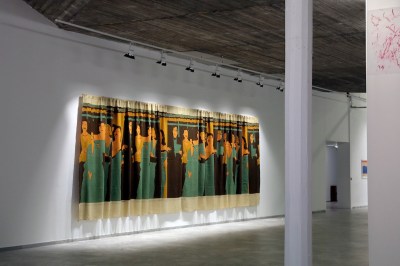
beatrice gonzalez interior decoration (1981) presented at Documenta 14.
NurPhoto from Getty Images
Although González had achieved widespread recognition long before that exhibition, he has since risen to international stardom, appearing at Documenta 14 in 2017 and in a 2019 re-exhibition at the Museum of Modern Art. She had retrospectives in both of those years, and now, after her death, a third. The play premiered last year at St Paul’s Gallery and will be performed at the Barbican Center in London in February. It will also visit the Astrup Fearnley Museum in Oslo.
Beatriz González was born in 1932 in the Colombian city of Bucaramanga, a city she would later credit as having an influence on her art. “I half-close my eyes and I can see the colors of Bucaramanga, just like I saw them as a child,” she once said. “The colors I painted were the colors of the sunsets I watched with my father.” González grew up during a time of violence and civil war and became interested in art in high school, but she chose not to study art in college because she “didn’t want to spend time learning something I thought I already knew,” as she told artist Amalia Pica in a 2017 interview.
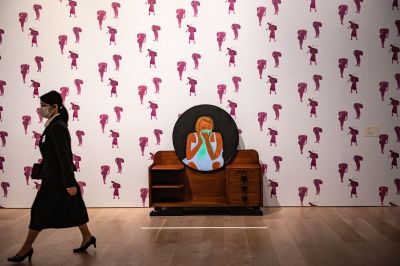
Some paintings by Beatriz González are embedded in the furniture. The picture here is before duel (2019), responding to a photo of a woman mourning someone killed by the FARC.
Photograph: Philip Fong/AFP via Getty Images
Instead, she chose to study architecture at the National University of Colombia. But since she was only required to take one art history class, she found she wasn’t interested and dropped out. She returned to Bucaramanga, where she worked in a series of jobs: in a tobacco factory, as a window display manufacturer, and more. Subsequently, at the urging of her father, she decided to study art more seriously and in 1957 entered the University of the Andes to study graphic design.
Her breakthrough came in the 1960s, when González created works such as the “Suicidas del Sisga” paintings, which are now considered legendary. Created in 1965, these works are based on photographs of a young religious couple who threw themselves into the Sisgah Dam out of fear that they would never achieve purity in this life. Gonzalez’s depiction of the couple was based on images that appeared in the media, sparking her interest in recreating media photographs that would continue throughout her career. The edges of her photo are noticeably blurred, alluding to the loss of detail that occurs when the couple’s photos are printed in newspapers and magazines.
She then turned her attention to pop culture and began appropriating compositions from historical artworks onto her canvases. These masterpieces hang in museums, and González’s remakes are sometimes allowed to penetrate more widely into the world. Renoir (Renoir’s Ten Meters, 1977) involves repainting an Impressionist painting Pancake Mill Dance The scale is grand – especially larger than the original size. She then cuts her own version and sells it to the public by the centimeter.
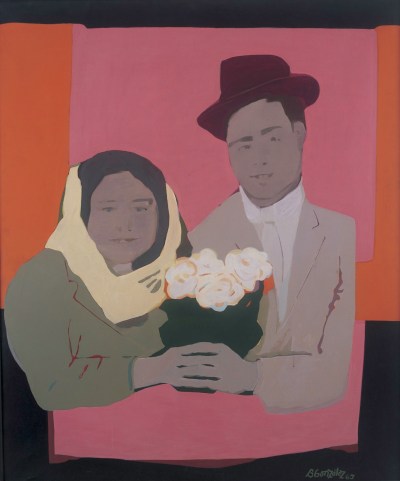
beatrice gonzalez Sisga’s Suicide II (1965) belongs to a series of paintings that recreate photographs of dead young couples that appear in the media.
Photo Oscar Monsalvi
Other works from the 1970s were even stranger. In one series, she embedded her art historical recreations into dressers, bed frames, and other furniture. When they were shown at the São Paulo Biennale in 1971, curator Marta Traba called them “fringe art” because there was no other obvious way to explain them.
“At the beginning, I was interested in how a work rooted in Western art history would be transformed and beautified when it arrived in Colombia,” González said in 2022. “What happens when someone discovers a reproduction of a work of art in a book?”
In the 1980s, she began to translate her fascination with image culture into current events and political unrest, cutting out photos from the media related to the 1978 election of President Julio César Turbay Ayala. She created the following works: interior decoration (1981), a large curtain painting in which Turbay Ayala is seen attending a party with numerous guests. Her work is cobbled together from many different images from the media and sold by the meter, demonstrating the ease with which the president can be commodified and reproduced. It is understood the article was critical of his government. Gonzalez recalled heightened police presence at some of her exhibition openings at the time.
She said the 1985 siege of the Palace of Justice by the left-wing group M-19 brought about a “seismic change” in her work, prompting her to abandon any sense of irony in favor of a more serious sensibility. “What struck me most was how justice itself was killed,” she said, referring to the dozens of deaths caused by armed soldiers trying to suppress the M-19 group, which held the Supreme Court hostage in an effort to hold conservative President Belisario Betancur accountable for his actions.
In the following years, she painted subjects such as human rights advocate Yolanda Izquierdo and a weeping mother after the 1996 massacre in Las Delicias.

beatrice gonzalez color tv (1980) features the image of Julio César Turbay Ayala. The artist said she once received a call from the president’s office because of the work and criticism of him by others.
Collection of Susanne Steinbruch
In 2007, she even produced Matte AuraOne of her most ambitious projects, it involved emblazoning more than 8,000 niches in Bogotá’s cemeteries with silhouettes of workers carrying corpses. “I had made tombstones before and thought I could use hand screen printing to print them, recreating thematic images prevalent in press photography across the country: men carrying bodies, victims of war,” she said. “Through these numbers, I began to construct a symbol that represented what was happening in the country.”
González’s influence in Colombia is widespread, in part because she is more than just an artist. She also served as director of the National Museum of Colombia and for two decades was a consultant to the Banco de la República Art Museum, helping to grow the bank’s collection. She also directs educational programs at the Museum of Modern Art in Bogota.
But her art has proven to be the most enduring. Colombian curator Eugenio Viola wrote in his article during his 2019 retrospective visit to Bogota art forum The review called González “one of Colombia’s most influential living artists.”
Despite her fame, and despite the boldness of her art, Gonzalez often describes herself as a reserved person. But, as she told Amalia Pica, “This is a classic trait of shy people: We’re usually reserved, but when we do want to say something, we go off like a bomb.