The Tamesis
February 23, 2026
Tokyo – Thailand’s House of Representatives vote takes place on February 8 as the country struggles to emerge from two lost decades of political instability. The country’s structural problems have worsened since the 2006 coup that ousted former Prime Minister Thaksin Shinawatra, including an aging and shrinking population and high household debt. The lack of progress on industrial and trade policy has further fueled fears that the economy is in terminal recession.
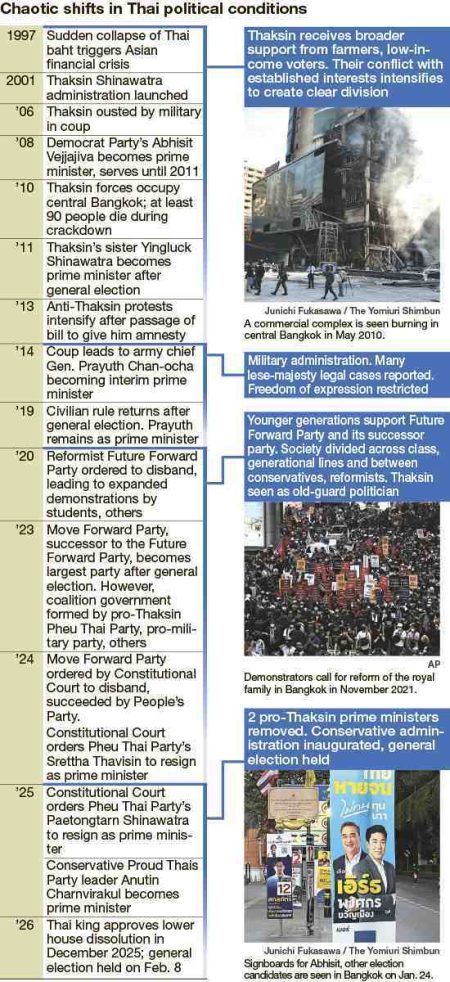
Photo and text: Yomiuri Shimbun
A coalition government centered on the Proud Thai Party, which won the most seats in the election, must work to achieve political stability and address structural issues. Thailand is at an important crossroads – revival or decline.
Since the 2000s, Thailand’s political landscape has evolved into a complex, multi-layered struggle. Fierce “inter-class” struggles between pro-Thaksin and anti-Thaksin factions are compounded by “intergenerational” tensions caused by young people seeking reform, and by broader conflicts between conservatives and reformists.
The conflict with Cambodia has fueled the rise of nationalism and has become a key factor in national politics.
The 2010 riots exacerbated deep divisions within Thai society. It began when Thaksin supporters occupied Bangkok’s main business district, triggering a crackdown that left more than 90 people dead. My first-hand reporting of these events confirms this reality.
Pro-Thaksin faction quickly blocked off the city center with roadblocks, turning three square kilometers into a fortress. Since the Yomiuri Bangkok bureau is located within the region, the office was effectively the frontline of the story for a month and a half.
Through measures such as debt rescheduling for farmers, Thaksin’s government has won enthusiastic support from people long ignored by the political establishment.
His iconic health care system, which offered visits for just 30 baht (about 100 yen at the time), became a symbol of his commitment to those previously ignored by the government.
A political scientist at Chulalongkorn University points out that while Thai people have traditionally accepted a class society and sought a path to coexistence, the Thaksin era has changed farmers’ views. The scholar noted that during this period, farmers began to understand the concept of rights and realized that elections could be a means of achieving equality.
The occupied areas began as “battlefields” for classes demanding elections, but later turned into scenes of civil unrest between armed groups and security forces. The standoff eventually led to security forces forcibly dispersing and burning major commercial facilities.
A farmer who took a long bus ride home said that when he came to Bangkok for the first time, he realized how developed and prosperous Thailand had become.
Thaksin poses a direct threat to the ruling elite in Thailand’s strict class structure. The friction led the military to stage another coup in 2014, overthrowing the government of his sister Yingluck Shinawatra and consolidating military rule over the next five years until 2019.
The Future Forward Party was born out of strong opposition to military rule. The group’s 40-year-old leader, Thanathorn Juangroongruangkit, has won widespread support and captured the imagination of students and younger generations.
Under the banner of “Thai democracy”, factions closely associated with the monarchy – including the military and royalists – have a firm grip on political power. This creates a relentless cycle in which opposition forces are continually ousted by coups or judicial intervention, even after gaining mandate through the ballot box.
The Constitutional Court’s order to dissolve the Future Forward Party triggered a long wave of protests led by the younger generation. History repeated itself when its successor, the Kadima Party (which topped the 2023 election), was also dissolved by the courts.
Thaksin returned to Thailand in 2023 and faced criticism after his proxy Pheu Thai formed a coalition with pro-military parties.
The party’s two prime ministers, Srettha Thavisin and Paetongtarn Shinawatra, were subsequently removed from office by the Constitutional Court. Achieving political stability that respects the will of the people remains the biggest challenge Thailand has faced in the past 20 years.
Thailand’s unstable political climate has led to an overemphasis on short-term populist policies at the expense of fundamental structural reforms, leaving the country facing a growing crisis.
Thaksin’s government, established in 2001, is often said to have left a negative legacy by reinforcing corruption and consolidating a system of vested interests.
On the other hand, it also deserves credit for reviving the economy after the Asian financial crisis through “Thaksinomics”, an economic policy that prioritized the poor and marginalized groups.
However, since Thaksin was ousted in a military coup, it is difficult to argue that subsequent leaders or military governments have pursued policies that strengthened the country’s economy.
Yingluck’s government launched a rice pledge program, in which the government purchases rice from farmers at prices well above market prices. The initiative was widely criticized from the outset as a “handout” that resulted in staggering fiscal deficits. Despite the transition to military rule, reliance on populist policies remains a key feature of Thai politics.
In the 2010s, Thailand became increasingly aware of its declining birth rate and aging population. According to the World Bank’s prediction, the proportion of the population aged 65 and above will reach 15% in 2024, marking my country’s entry into an aging society.
Like neighboring countries such as Japan, South Korea and Singapore, Thailand is undergoing significant demographic changes. It is estimated that the country is expected to enter a super-aging society as early as 2029.
Media reports indicate that the number of births in 2025 will be less than 500,000 for the second consecutive year, a record low in 75 years. The country’s chronic labor shortage – which has previously been offset by workers from neighboring countries such as Myanmar – will worsen as the overall population is believed to have begun shrinking ahead of schedule.
Household debt, driven by mortgages, car loans and living costs, has also reached critical levels. Before Yingluck came to power, the debt-to-GDP ratio had been below 80%. However, after the outbreak, the debt-to-GDP ratio climbed steadily to 90%.
While financial institutions tightened lending, the move had the opposite effect, curbing purchasing power and suppressing private consumption.
A Thai research firm has warned that a recovery in consumer spending could take years.
Thailand’s industrial and trade policies also perform poorly. Traditionally, governments have attracted foreign investment by offering tax incentives to targeted industries.
While Chinese electric carmakers have recently increased their presence in the country, the investments are said to have yet to generate significant orders for local suppliers or significantly boost domestic employment.
Only a few Thai companies can compete on the global stage. Unless the government prioritizes expanding the domestic enterprise base, the industrial structure will not be modernized.
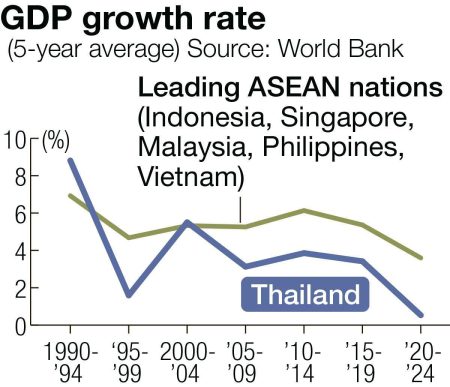
Photo and text: Yomiuri Shimbun
Another urgent task is education reform, as international assessments from the Organization for Economic Co-operation and Development highlight declining academic performance.
The International Monetary Fund predicts that Thailand’s GDP will be surpassed by the Philippines in 2028 and Vietnam in 2030, slipping to fifth place in Southeast Asia. Vietnam’s fast-growing economy may even overtake Thailand’s as early as 2026.
After the World Bank classified Thailand as an upper-middle-income country in 2011, the country’s economic development stagnated and was unable to join the ranks of high-income countries.
Somkid Tangjivanich, director of the Thailand Development Institute, a policy think tank, noted the urgency of the situation, saying Thailand will grow old before it gets rich.
Somkiat warned that at the current slow growth rate, Thailand would not reach high-income status until 2070. He stressed that without fundamental policy changes, the country will still be unable to escape the “middle-income trap.”
Thailand is a major hub for Japanese businesses
Approximately 6,000 Japanese companies operate in Thailand, more than any other Southeast Asian country, making it the third largest Japanese business center in the world, after China and the United States.
After World War II, Japanese companies began expanding into Thailand in the 1950s and 1960s; in the 1970s, they built several assembly plants for automobiles, home appliances, and other products. However, these moves are viewed by many Thais as an “economic invasion”.
Although it’s difficult to imagine, given today’s cordial relations, that when then-Prime Minister Tanaka Kakuei visited Bangkok in January 1974, some 5,000 students and other demonstrators surrounded his hotel, chanting “go home.” The Yomiuri Shimbun reported these developments with headlines such as “Anti-Japanese sentiment is worse than expected” and “Southeast Asian diplomacy is struggling.”
Partly as a result of this incident, Japan began serious efforts to improve its war-scarred relations with Southeast Asian countries. In 1977, then Prime Minister Yasuo Fukuda gave a speech in Manila and announced the “Fukuda Doctrine”, the main pillar of which was that Japan would not become a military power again and would establish true friendship with Southeast Asian countries.
Economic interdependence between the two countries began to deepen in the 1980s. After the signing of the Plaza Accord in 1985, favorable conditions such as a strong yen led Japanese companies to expand their operations in Thailand faster.
In the 2000s, the then Thai Prime Minister Thaksin Shinawatra’s government launched the “Detroit of Asia” plan to make Thailand a center for the automotive industry, prompting a series of Japanese car manufacturers to establish bases in Thailand.
The biggest crisis facing this expansion was the massive floods in 2011 that inundated seven large industrial parks. When I visited the area by boat, only roofs of vegetation were visible above the floodwaters. The impact of the disaster has been felt globally, with hundreds of companies halting operations and even some factories in North America being shut down due to lack of supply from Thailand. This has prompted a re-examination of supply chains from the perspective of disaster resilience and economic security.
Since the 2010s, Japanese dealers have significantly increased their business in Thailand as the Thai consumer market has expanded. They are aggressively expanding their businesses such as restaurants, retail stores and clothing stores, attracting an active customer base even in remote areas.
But it is worth noting that the competitive landscape in Southeast Asia is changing, with Chinese electric vehicle and other companies increasingly concentrated in the region.