The Tamesis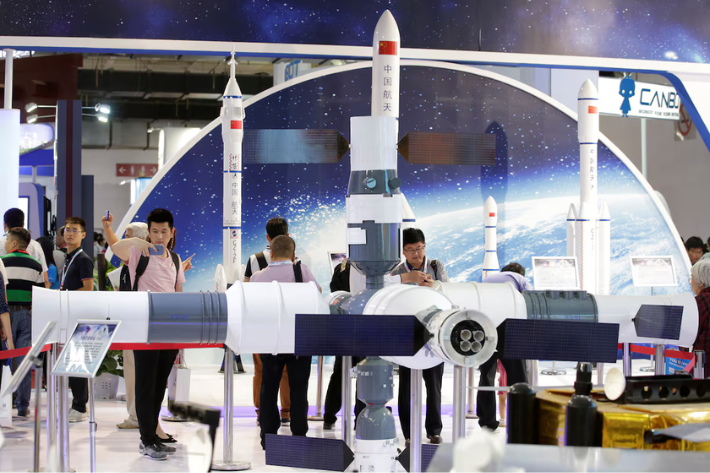
China plans to build artificial intelligence data centers in space over the next five years, state media reported on Thursday, in a sign Beijing will compete with Elon Musk’s SpaceX.
China’s main aerospace contractor China Aerospace Science and Technology Corporation (CASC) has vowed to “build gigawatt-level aerospace digital smart infrastructure” according to a five-year development plan cited by CCTV.
The report states that the new space data center will “integrate cloud, edge and terminal (device) capabilities” to achieve “deep integration of computing power, storage capacity and transmission bandwidth” so that data from the earth can be processed in space.
Also on AF: ‘Ghost tanker’ carrying jet fuel from Iran to Myanmar Air Force
The plan comes as Musk’s SpaceX is expected to use funds from its blockbuster $25 billion IPO planned this year to develop orbiting artificial intelligence data centers to cope with terrestrial energy constraints.
Musk told the World Economic Forum in Davos, Switzerland, last week that SpaceX plans to launch a solar-powered artificial intelligence data center satellite within the next two to three years.
“Building solar-powered data centers in space is a no-brainer…The cheapest place to put artificial intelligence is going to be in space, and that will happen within two years, three years at the latest,” Musk said.
Solar power in orbit can produce five times more electricity than solar panels on the ground, he said.
China also plans to move the energy-intensive burden of artificial intelligence processing to orbit by 2030, using “gigawatt-scale” solar centers to create industrial-scale “space clouds,” according to a policy document released by China Aerospace Science and Technology Corporation in December.
The document cites the integration of space-based solar power with artificial intelligence computing as a core upcoming pillar “15th Five-Year Plan”China’s economic development roadmap.
Reusable rocket challenge
this China Aerospace Science and Technology Group According to CCTV, the plan also promises to “realize suborbital space tourism flight operations and gradually develop orbital space tourism” in the next five years.
China and the United States are competing as they look to transform space exploration into a commercially viable business similar to civil aviation and be the first country to exploit the military and strategic advantages of space dominance.
China Aerospace Science and Technology Corporation has vowed to transform China into “the world’s leading aerospace power” by 2045. But so far, Beijing’s main bottleneck has been its failure to complete reusable rocket testing.
U.S. rival SpaceX’s Falcon 9 is a reusable rocket that gives its subsidiary Starlink a near-monopoly on low-Earth orbit (LEO) satellites. It is also used in orbital space tourism.
Reusability is critical to lowering rocket launch costs and lowering the cost of sending satellites into space. China achieved a record 93 space launches last year, driven by its rapidly maturing commercial space startups, according to official announcements.
Race against America
China Aerospace Science and Technology Corporation’s plans were announced after China established its first interstellar navigation academy at the Chinese Academy of Sciences on Tuesday. Their goal is to train the next generation of space talent in cutting-edge areas such as interstellar propulsion and deep space navigation.
The new agency marks China’s strategic shift from low-Earth orbit operations to deep space exploration ambitions.
“The next 10 to 20 years will be a window period for China’s interstellar navigation field to develop by leaps and bounds. Original innovations and technological breakthroughs in basic research will reshape the deep space exploration pattern,” Xinhua News Agency wrote at the opening ceremony.
For nearly a decade, the United States has faced fierce competition from China in returning astronauts to the moon, where no humans have landed since the last U.S. Apollo mission in 1972.
- Vishakha Saxena Additional Editor, Reuters
Also read:
China and Russia sign lunar power station construction agreement
China reaches the far side of the moon to retrieve historical soil samples
Chinese startup launches most powerful rocket by private company
China’s space station will double in size to compete with NASA
Russia and China plan to build lunar nuclear power plant by 2035
China’s next-generation rocket could send Rocket 7 to the moon and space station
China’s secret spacecraft returns to Earth after 9 months
China will start using lunar soil to build a lunar base in 2028