The Tamesis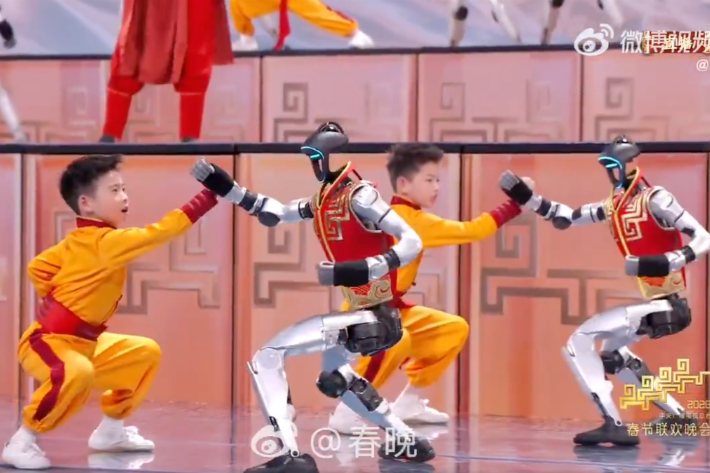
Chinese humanoid robots were once again the stars of the main Chinese New Year event on Monday, performing complex kung fu moves and backflips in what state media described as a “high-risk product launch to an audience of billions”.
The show’s first three performances featured robots, including one in which several Unitree humanoid robots wielded swords, poles and nunchucks near human child performers.
Video of the performance went viral on social media platforms, with many users surprised to note that the robot’s agility and overall capabilities had improved significantly compared to last year, when Unitree Choreographed dance performance.
Also AF: Amid Hollywood outrage over AI video models, ByteDance vows to make changes
Unitree told Chinese state media in a statement that the performance featured robots performing “parkour, a 3-meter aerial flip, a single-leg flip and seven and a half turns of the Airflare spin.”
In addition to Unitree, three other humanoid robot startups – Galbot, Noetix and MagicLab – also showcased their products at the event, Reuters reported report.
Humanoid robots and real actors performed wonderfully at the Spring Festival Gala pic.twitter.com/PDU9DIcgPO
— Chengdu, China (@Chengdu_China) February 16, 2026
The show’s opening sketch also featured ByteDance’s AI chatbot Doubao, while four Noetix humanoid robots appeared alongside human actors in comedy skits. Meanwhile, MagicLab robots performed synchronized dances with human performers to the song “We Are Made in China.”
Chinese state media, while hyping these performances, emphasize that they are intended to showcase the commercial potential of the robotics industry.
State-owned CGTN explain The Lunar New Year event – China’s most-watched TV show – is a “Super Bowl-like stage” for the robots. CGTN said it described them as “autonomous machines driven by powerful stability algorithms.”
Unitree founder Wang Xingxing told CGTN that improving the mobility of robots will allow them to “drive the progress of the entire human productivity.”
Following the success of the show, Wang told Chinese technology platform 36Kr that Unitree plans to ship 10,000 to 20,000 humanoid robots by the end of this year. That would be nearly four times more than the 5,500 units sold last year.
“These technologies are very practical and are conducive to large-scale swarm work of robots in the future,” Wang told 36Kr.
Commercial potential attracts attention
Previously, people expressed doubts about the rapid development of China’s robotics industry.
Last year China held the world’s first competition between humans and robotsstate media hailed it as a “breakthrough.” But analysts at the time questioned whether the marathon was a reliable indicator of the robotics industry’s business prospects.
However, with Monday night’s event, China appeared to be promoting the future of manufacturing.
In an interview with 36Kr, Wang emphasized that the martial arts performance was “not just a performance” but a demonstration of how its “robot swarm control technology” can be implemented in Chinese factories.
Wang said Unitree developed the technology to ensure robots do not require an operator to monitor and control their movements. Robots function with the help of sensors that allow them to “perceive the real environment,” he said.
Wang also said his company is exploring technologies such as physical intelligent robot brains that would use artificial intelligence to power its humanoid robots. He added that such robots have potential applications in tourism, scientific research and education.
Of course, Unitree isn’t the only Chinese robotics company demonstrating its commercial potential. A week before Monday’s event, Chinese startup Agibot shows off its humanoid robot Perform comedy skits and magic shows. Its theme is: Robots in Interactive Entertainment.
Meanwhile, CGTN also noted that companies participating in Monday’s event are “moving from prototype to market.”
IPO worth billions of dollars
China’s boom in its robotics industry comes as major players such as AgiBot and Unitree prepare for initial public offerings this year.
Unitree is considering valuation Up to 50 billion yuan ($7 billion) in its IPO, with AgiBot valued at HK$40 billion to HK$50 billion ($5.14 billion to $6.4 billion).
Experts also point out that supporting the industry could bring huge benefits to Beijing.
“Humanoid robots combine many of China’s strengths into one narrative: artificial intelligence capabilities, hardware supply chains and manufacturing ambitions. They are also the most ‘readable’ form factor for the public and officials,” Beijing-based technology analyst Poe Zhu told Reuters.
According to research firm Omdia, China accounted for 90% of the approximately 13,000 humanoid robots shipped globally last year, well ahead of U.S. rivals including Tesla’s Optimus. Morgan Stanley expects sales of its humanoid robots to more than double this year to 28,000 units.
These prospects mean that Chinese President Xi Jinping has met with five robotics startup founders in the past year, while he has met with four electric vehicle and four semiconductor entrepreneurs in the same time period.
Meanwhile, Georg Stieler, Asia managing director and head of robotics and automation at technology consultancy Stieler, told Reuters that New Year’s parties have been used to highlight Beijing’s technology ambitions for decades.
“What sets this event apart from similar events elsewhere is its direct transition from industrial policy to a prime-time event,” Stiller said.
“Companies that participate in the ceremony receive tangible rewards in terms of government orders, investor attention and market access.”
Also read:
China claims to have won first human vs. robot race
China’s top humanoid robot maker plans $7 billion IPO
China’s “tech economy” trumps its bleak growth prospects
China is keen on technological innovation to drive economic growth
China to promote artificial intelligence and robotics to boost economic growth – South China Morning Post
Chinese scientists’ ‘robotic fish’ could clean up polluted oceans
China and Tesla invest in robotic assembly line workers
Hyundai to use humanoid robots to advance physical artificial intelligence in U.S. factories