The Tamesis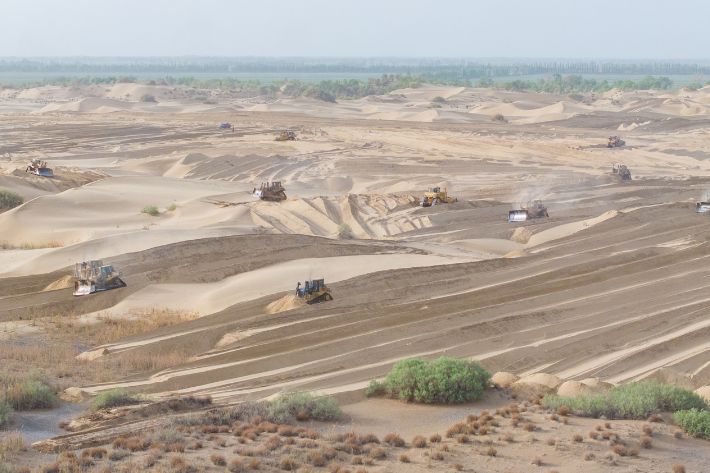
After years of efforts to combat desertification, Chinese scientists appear to have found a way to turn sand into fertile soil.
According to a new study, the process can now be completed in about 10 months earth report Xinhua News Agency said scientists used laboratory-grown microorganisms to help desert sand bond together to form a thin crust, allowing workers to plant shrubs and grasses that can withstand strong winds and high temperatures.
this Chinese Academy of Sciences The progress of experiments near the Taklimakan Desert in Xinjiang was tracked to show how these surface crusts can stabilize the sand after 10 to 16 months.
See also: German Merz lands in Beijing, seeking closer ties with China
cyanobacteria – an ancient bacteria powered by sunlight – is the key ingredient. It is said to help this process by binding the sand together and retaining nutrients and more microorganisms that can hold water near the surface (when it reaches it) and reduce evaporation.
Later lichens and mosses also helped keep the crust intact and became more stable. These are important lessons for fighting sandstorms and protecting roads in China’s arid northwest.
‘Seeding’ deserts with bacterial organic paste
Scientists say the ‘seeds’ that create artificial soil crusts are cyanobacteria inoculumdeveloped by the Shapotou Desert Research Experiment Station of the Northwest Institute of Ecological Environment and Resources.
“It could reduce the time needed to stabilize desert sand from a century-long effort to a three-year timeframe.” Xinhua News Agency Reported on Tuesday (February 24).
“If you spread this [cyanobacteria] Zhao Yang, deputy director of Shapotou Station, said that seeds on the desert surface will form soil crust when exposed to precipitation.
It is said that by injecting cyanobacteria into the sand and using pressurized water spray, the shells can form in one to two years instead of 15 years under natural conditions, with a survival rate of over 60%.
The team then tried mixing the cyanobacteria solution with organic matter and fine particles in specific proportions to create a paste-like inoculum.
“This process is similar to mixing cement and requires optimal proportions and mixing methods,” Zhao said. “Solid inoculants not only overcome the limitations of spray methods, but also greatly enhance the feasibility of large-scale promotion.”
The technology is now being used in much of the new Three-North Shelterbelt Plan, with 5,300 to 6,660 hectares of desert expected to be restored over the next five years, the report said.
NOTE: Minor edits to title and subtitle text were made on February 25, 2026.
See also:
China’s desert greening projects alter groundwater levels: study
If climate warming continues, Asia-Pacific will face $500 billion in annual flood losses
Indonesians blame deforestation for floods, landslides; 700 dead
Wa Army takes control of new rare earth mine in northeastern Myanmar
Myanmar’s civil war intensifies as China plunders rare earth minerals
Thailand plans to build dams to clean up toxic runoff from Myanmar gold mines
World heat records rise, Tibetan Plateau issues warning
China says 30% of land protected through ecological initiatives
Deforestation accelerates tropical carbon loss, study finds