The Tamesis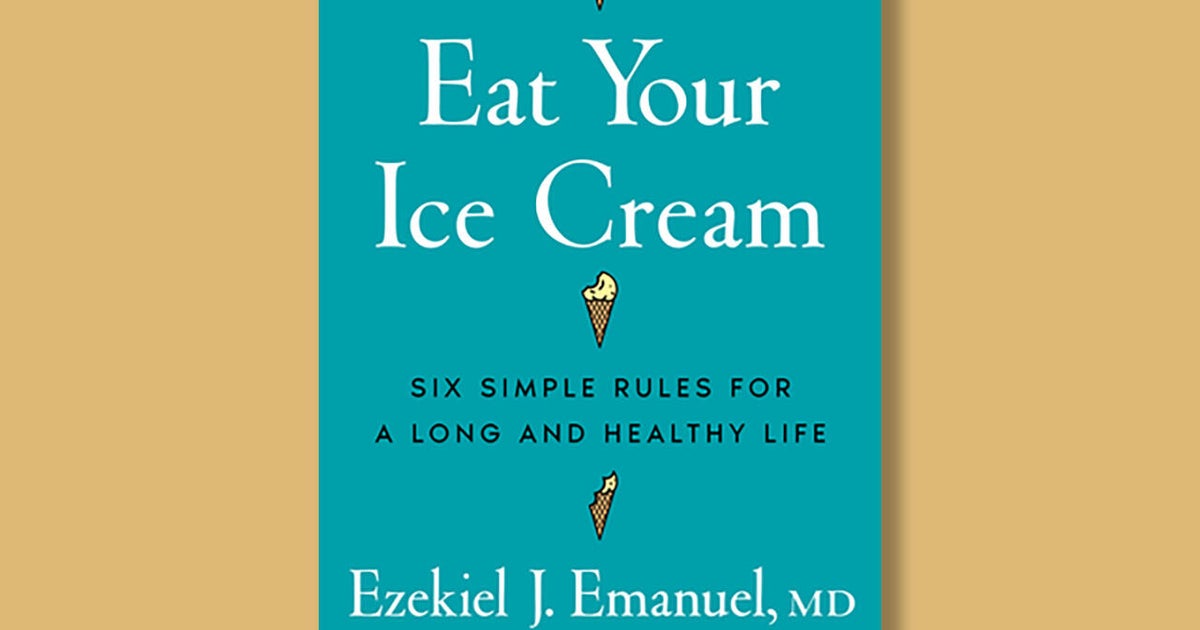
WWNorton 
We may earn an affiliate commission from any items you purchase from this article.
In his new book, “Eat Your Ice Cream: Six Simple Rules for a Long and Healthy Life” (To be published Tuesday by WW Norton & Co.) Oncologist and health policy expert Dr. Ezekiel Emanuel discusses longevity and how best to distinguish valid health and wellness advice from “speculative, deceptive and foolish advice.”
Read the excerpt below, and Don’t miss Norah O’Donnell’s interview with Emanuel on CBS Sunday Morning on January 4!
Eat Your Ice Cream, by Ezekiel J. Emanuel, MD
Like to listen? Audible now offers a 30-day free trial.
Anyone seeking advice on health and longevity is faced with a sea of books, newspaper articles, podcasts, newsletters, and videos from a wide range of sources: scientific experts, medical practitioners, health systems, journalists, patients, influencers, experts, quacks. Traditional media offers plenty of good advice, often in responsibly edited and well-sourced sections dedicated to “wellness.” But the sheer volume can be difficult to keep up with, and sometimes the guidance can be downright contradictory.
For anyone who has browsed the vast amount of health and longevity advice online, it can be difficult to know who to trust. The so-called “must-do’s” online range from the medically unsubstantiated to the wildly unrealistic to the ridiculous advice that baffles doctors like me—testicular tanning, teen blood transfusions, vaginal steaming, “hard” hikes with backpacks full of heavy stuff. Information is constantly being poured at us, spewed at us by an ever-increasing number of hucksters and self-proclaimed saints who amass millions of social media followers (and dollars) by promising so-called miracle cures using medical-sounding language. No wonder so many people are confused and frustrated.
Real doctors and health experts are speaking out, offering sound and sometimes conflicting advice. All this combined can leave even the most health-conscious people overwhelmed. In recent years, dozens of books on health and longevity have appeared, filled with well-intentioned and scientifically accurate information. But they often fall into the trap of pursuing novelty over efficacy, ending up peddling treatments and protocols that are unproven or offer marginal returns at best.
There’s also a steady stream of profiles of tech billionaires who are carefree in their pursuit of maximizing their lives. One of my business school students told me how her “health coach” recommended all sorts of questionable prescriptions, such as eating 200 grams of meat a day. (Don’t ask me why a perfectly healthy twenty-something who isn’t training for a marathon or a triathlon needs a health coach.) There’s also an entrepreneur who’s trying to fight death by taking 100 pills a day, cold soaks, infrared light, and a daily “nut pudding”—a mix of chia seeds, macadamia nuts, and berries. Nuts is right.
There is so much health and wellness advice out there that it is almost impossible to distinguish which ones are correct, reliable, and effective from which ones are speculative, deceptive, and foolish. Even when these recommendations are scientifically sound, they are often irrelevant, misinterpreted, or misused. For example, one health book delves into the basic biology of molecular pathways, such as the mTOR pathway for cell survival, explaining why you should take rapamycin to extend your life. In fact, studies have shown that rapamycin can extend the lifespan of mice, worms, flies and yeast. But you are not mice, worms, flies or yeast. While some studies suggest rapamycin may reduce the effects of aging-related immune and cardiovascular diseases in humans, there is no evidence that it affects human lifespan.
This extrapolation of the lab findings parallels the story of resveratrol, the “magic” compound in grapes and red wine that is said to explain the French Paradox. Yes, resveratrol can extend the lifespan of mice. But do you have a tail and a beard? Scientists have been conducting experiments on mice since the early 20th century, and while this work has led to many breakthroughs, findings in mice often do not extend to humans. As an oncologist, I know that researchers have cured hundreds of thousands of mice with cancer using experimental chemotherapy drugs, but the drugs failed when given to cancer patients. Unfortunately, there is no evidence that resveratrol or rapamycin extend lifespan in humans. Ultimately, biology lessons and “health advice” are a waste of people’s time.
What these smooth-talking figures—legitimate experts, well-intentioned journalists, and cranks—have in common is that their advice comes at a high price. Financially, of course, but also in the expenditure of mental energy and time that is stolen from activities that give meaning to life. Because of the overwhelming amount of advice out there, determining whether the information about rapamycin is correct is practically a full-time job. accuratelet alone whether it is worth taking.
Overall, the health-industrial complex promises us more time to enjoy in the future—but it certainly takes a lot of time now. This requires a ton It takes time and effort to read a 400-page book, let alone an entire library. So what about the countless posts, videos, and articles about the latest supplement, superfood, or exercise that purports to extend your life? Plus the time spent trying to figure out what’s real and what’s trendy. Or based on some microorganisms in a petri dish or studies on worms. Or worse, no evidence at all. Then budget more time to organize your schedule to incorporate the latest workout modifications or dietary recommendations. . . . Congratulations: you now have lost This increases the time the experts commit to you. And you lost it in the prime of your life.
Of course, if your entire focus is years rather than quality, it might be worth the effort. Some “longevity experts” seem to think so too. As one popular author said: “Our only goal is to live longer, to live better—to live longer.” Ours only Target? Life is not a competition, the gold medal belongs to the oldest! Our goal should be no It is to “outlive” as many people as possible. Instead, the goal should be to live a healthy and fulfilling life. Health is only a means to that end, not an end in itself.
Excerpted from Eat Your Ice Cream by Ezekiel J. Emanuel, MD, published by WW Norton & Company. Copyright 2025 by Ezekiel J. Emanuel, MD. All rights reserved.
Get the book here:
Eat Your Ice Cream, by Ezekiel J. Emanuel, MD
Buy locally from bookstore network
For more information: