The Tamesis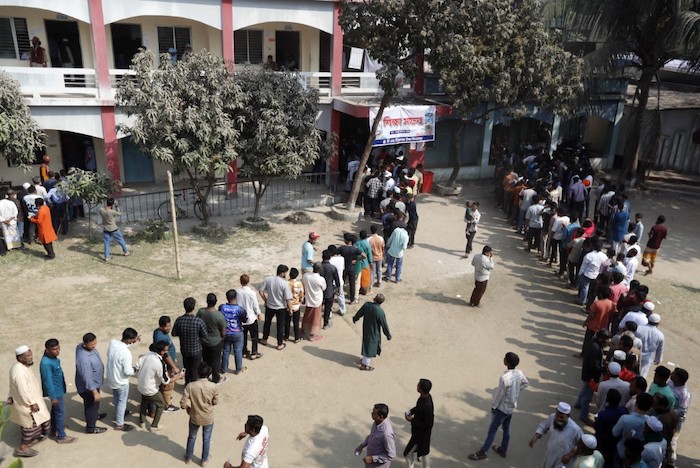
The Bangladesh Nationalist Party (BNP) swept to victory on Friday in the first election since a deadly uprising in 2024, with leader Tarique Rahman expected to become prime minister.
But final official results have yet to be announced, with main rival Jamaat-e-Islami, the largest Islamist party leading the broader coalition, saying there were “serious doubts about the integrity of the results process”.
The US embassy was quick to congratulate Rahman and the BNP on their “historic victory”, while neighboring India hailed his “decisive victory” despite recent rocky relations with Bangladesh. Pakistan’s prime minister praised the people of Bangladesh for “successfully holding elections.”
See also: Thais to seize $420m in assets linked to Cambodia, online scams
At 9.30am, broadcasters predicted the BNP had moved well past the 150-seat threshold to gain a clear majority in parliament, predicting they would win more than two-thirds of the seats.
“Challenges are getting tougher”
Jamuna TV channel projects that the BNP has bagged 212 seats. Jamaat is said to have won 74 victories, a huge leap over its past results but still far from the outright victory it campaigned for. Somoy TV broadcast similar figures.
Rahman told AFP two days before the vote that he was “confident” that his party would be crushed during 15 years of dictatorship. Removing Prime Minister Sheikh Hasina – will return to power in the South Asian country of 170 million people.
Jamaat chief Shafiqur Rahman, 67, has launched a disciplined grassroots movement on a platform of justice and an end to corruption.
His party said it was “unsatisfied with the process of the election results” and claimed there were “repeated inconsistencies and fabrications in the announcement of unofficial results”. It did not immediately give concrete evidence.
The electoral commission said final results from voting in 299 of the 300 constituencies would not be released until later on Friday.
The other 50 seats reserved for women in parliament will be elected from party lists.
Senior BNP leader Ruhul Kabir Rizvi claimed a landslide victory in a party statement but gave no specific figures and called on followers to express gratitude during Friday prayers rather than celebrate in the streets.
“Despite the BNP’s landslide victory, there will be no victory rallies,” the statement said. “Following the Jumma (Friday) prayers across the country, we will hold special prayers in mosques.”
peaceful vote
Party workers spent the entire night in front of the BNP office.
“We will join the nation-building efforts led by Tarique Rahman,” Md Fazlur Rahman, 45, told AFP. “We have gone through a lot of suffering in the past 17 years.”
Heavy security forces were deployed across the country, with United Nations experts warning ahead of the vote of “growing intolerance, threats and attacks” and a “tsunami of disinformation”.
Police records show that political clashes during the campaign left five people dead and more than 600 injured.
But polling day was largely peaceful, with only “some minor disturbances” reported, according to the electoral commission.
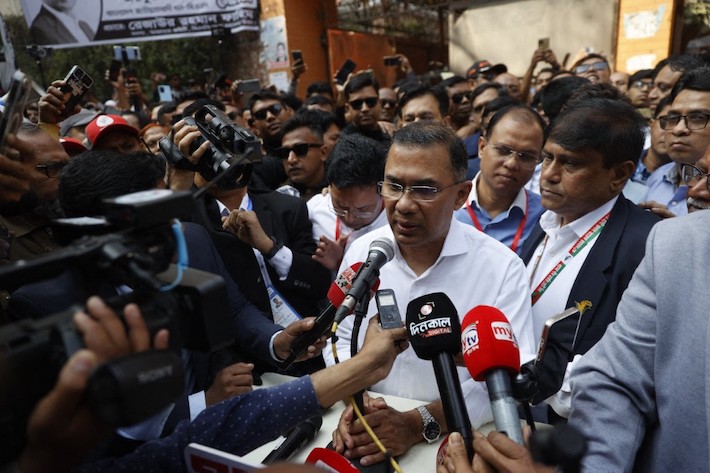
Political heir Tariq to become prime minister
Tarique Rahman, long overshadowed by his parents and the heir apparent to one of Bangladesh’s most powerful political dynasties, is finally stepping into the spotlight.
The 60-year-old leader of the Bangladesh Nationalist Party (BNP) is preparing to take charge of the South Asian country of 170 million people with what he calls his ambition to “do better”.
His rise marks a remarkable transformation for a man who, after 17 years in exile in Britain, was far removed from the political storms of Dhaka.
He was widely known as Tarique Zia, a political name that influenced him at every stage of his life.
His father, President Ziaur Rahman, was assassinated in 1981 when he was only 15 years old. His mother, Khaleda Zia, a three-time prime minister and a prominent figure in Bangladeshi politics for decades, died at the age of 80 just days after his return.
“my country”
Two days before the vote, Rahman vowed to carry on their legacy.
“They are who they are and I am who I am,” he said in his office, where gold-framed portraits of his late parents hang. “I will try to do better than them.”
He described having “mixed emotions” when he returned home in December – the joy of being home was soon overshadowed by the grief of his mother’s death.
“This is my country, I was born here, I grew up here – naturally, it’s a very happy feeling,” he said.
However, instead of celebrating, he had to say goodbye to his mother, who had been ill in the intensive care unit for a long time.
“When you come home after so long, any son wants to hug his mother,” he said. “I didn’t have that chance.”
Within days of arriving in Dhaka, he began leading the BNP and its campaign.
Still devastated, the heir took to the stage, microphone in hand, and a huge crowd gathered.
‘Upsetting a lot of people’
He was born when the country was East Pakistan and was briefly detained as a child during the 1971 war of independence. His party hailed him as “one of the youngest prisoners of war”.
His father, Ziaur Rahman, was an army commander who gained influence following the murder of founding leader Sheikh Mujibur Rahman (Sheikh Hasina’s father) just months after the 1975 coup.
It intensified a rivalry between the two families that would define the country’s politics for decades. Ziaur Rahman himself was killed in 1981.
Rahman grew up in the political orbit of his mother, who later became the country’s first female prime minister, alternating power with Hasina in a long and bitter duel.
“I campaigned in her seat a lot,” Rahman said. “That’s how I started slowly, gradually getting into politics.”
But his career has also been overshadowed by accusations of corruption and abuse of power.
A 2006 U.S. Embassy cable said he “inspired a few and upset many.”
Other cables called him “a symbol of kleptocratic government and violent politics” and accused him of being “extremely corrupt.”
Rahman, who was arrested in 2007 on corruption charges, said he was tortured in detention.
The following year he fled to London, where he faced multiple absentee cases. He denies all charges and believes they are politically motivated.
But he also told AFP he had apologized. “We apologize if any unnecessary errors occurred,” he said.
After Hasina’s fall, Rehman was acquitted of the most serious charge against him – serving a life sentence in absentia for a 2004 grenade attack at a Hasina rally – which he has always denied.
His husband is a cardiologist and his daughter is a lawyer, and he lives a quiet life in England.
That changed with his dramatic return and hero’s welcome in December.
He acknowledged the “difficult” task ahead to rebuild a country he said had been “destroyed” by the previous regime.
“End of nightmare”
Interim leader Muhammad Yunus, who will step down when a new government takes power, urged all parties to remain calm.
 “We may have differences of opinion, but we must remain united for the greater good of the country,” he said.
The 85-year-old Nobel Peace Prize winner has led Bangladesh since Hasina stepped down in August 2024, ending her rule. His government banned her Awami League party from contesting the polls.
Yunus said after the vote that the country had “ended its nightmare and begun a new dream.”
Hasina, 78, who was sentenced to death in absentia for crimes against humanity, went into hiding in India to issue a statement denouncing “illegal and unconstitutional elections” in the country.
Yunus advocates comprehensive democratic reform charter Overhauling what he calls a “totally broken” government system and prevent a return to one-party rule.
Voters also took part in referendums on proposals for term limits for the prime minister, a new upper house of parliament, stronger presidential powers and greater judicial independence.
Television projections showed voters supporting the charter.
- Further editing by Jim Pollard, AFP
See also:
Bangladesh’s ousted PM Hasina ‘fake high growth’: Yunus
Bangladesh’s Hasina accused of looting $17 billion, worse
Bangladesh wants legal help investigating Adani and power deals
Dhaka jubilates after Sheikh Hasina resigns, flees Bangladesh
Bangladesh’s main bank freezes Myanmar regime’s accounts
Bangladesh reaches $4.5 billion bailout deal with IMF
Fuel prices rise 52%, protests erupt in Bangladesh