The Tamesis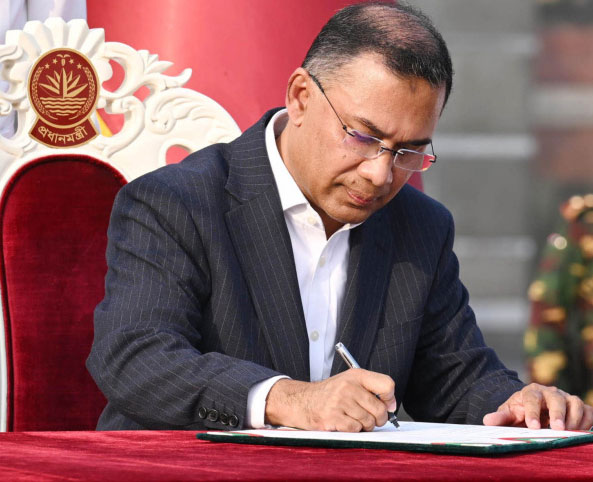
February 20, 2026
Dhaka – A landslide victory often feels like a coronation. As streets erupted and social media aflame, the order seemed uncontroversial. This is no ordinary victory for the Bangladesh Nationalist Party (BNP) and newly sworn-in Prime Minister Tariq Rahman. The BNP won 212 of the 297 parliamentary seats and achieved a certain result, gaining a mandate that few could have imagined a decade ago. Analysts and observers alike attribute this overwhelming success to Tariq Rahman’s strategic vision, disciplined organizational leadership and ability to connect with voters across the urban-rural divide. His leadership transformed fragmented opposition energy into a coordinated movement while mobilizing the party’s grassroots network with stunning efficiency.
Yet despite the celebrations that swept the country, the monumental victory brought both opportunities and burdens. Electoral dominance provides unparalleled authority but also raises expectations, intensifies scrutiny, and attracts the attention of domestic and foreign adversaries. As the BNP returns to power after two decades, Tariq Rahman now faces the challenge of translating electoral success into stable governance and institutional credibility, and maintaining public trust.
For years, the state apparatus—the civilian bureaucracy, law enforcement agencies, and regulatory agencies—has been shaped by partisan politics. As a new political figure, serving as prime minister for the first time in 30 years, Tariq Rahman’s leadership will be tested in maintaining authority while avoiding institutional paralysis. A sweeping purge might satisfy loyalists but risk alienating key public servants, while excessive restraint might frustrate grassroots supporters eager to quickly “rectify” past grievances. Restoring confidence in public institutions requires a clear commitment to the rule of law, judicial independence and merit-based appointments. Here, Tariq will need to balance confidence with caution, signal change while maintaining continuity, and demonstrate that an overwhelming mandate can be responsibly executed.
The opposition remains a huge challenge. Although the Awami League remains weakened, it can still mobilize public demonstrations in the future. Meanwhile, Jamaat-e-Islami, which gained 68 seats to its allies’ nine, is poised to be an outspoken and organized opponent thanks to its strong parliamentary representation and enduring street presence. Tariq Rahman’s ability to manage these dynamics—including parliamentary obstruction, preemptive street mobilization, and confronting the political narrative—will determine the durability of his government. The challenge is again to strike the right balance: showing strength without provoking instability, and showing responsiveness without appearing indecisive.
Even with 212 seats, electoral victory does not eliminate the need for domestic and foreign diplomacy. International observers, particularly in Western countries, remain concerned about policies that could empower activists at the expense of women’s rights, minority protections or counterterrorism commitments. Every major domestic decision has the potential for international repercussions. Tariq needs to reassure foreign partners and domestic voters that Bangladesh will be responsibly governed going forward.
Foreign relations will test the government’s strategic capabilities. Relations with India, Bangladesh’s main partner, must be managed with caution. Past tensions over trade, border management and regional cooperation have made New Delhi cautious. Any missteps could have economic consequences, especially in sectors that rely on regional stability. In addition, being too accommodating may lead to criticism from nationalist supporters at home. At the same time, China remains an important partner, especially in infrastructure and investment under the Belt and Road Initiative. Western governments continue to emphasize democratic governance, labor standards and trade credibility. Tariq Rahman’s ability to navigate these complex diplomatic currents, safeguarding Bangladesh’s interests without alienating key partners, will be central to his legacy.
Economic realities magnify the risks. Inflationary pressures, foreign exchange constraints and global supply chain volatility constrained fiscal operations. Public expectations are soaring – job creation, energy stability and price regulation will be achieved immediately. Structural reforms, including banking transparency, revenue mobilization and subsidy rationalization, are critical and politically sensitive. The leadership of the newly sworn-in Prime Minister will depend on the BNP’s ability to translate electoral enthusiasm into tangible economic results. Managing competition within the party—where senior leaders seek to exert influence over younger reformists advocating modernization—requires political savvy and management skills.
Tariq Rahman’s decades-long political career has been marked by exile, controversy and polarizing rhetoric. Now, as prime minister, his personal transition from opposition figure to head of government will be closely watched. He must demonstrate inclusive leadership, institutional respect and governance. Too much centralization of power can lead to internal dissatisfaction; too much delegation of authority can lead to inconsistency. Striking that balance with the nation watching will test not only his political instincts but also his ability to inspire confidence in Bangladesh’s divided society. In this context, leadership is no longer about electoral rhetoric but about discipline, pragmatic governance and the ability to deliver results under pressure.
If Tariq Rahman can translate his electoral victory into inclusive governance, pragmatic foreign policy and meaningful economic reforms, the victory could mark a major turning point for Bangladesh. If not, this landslide victory could be the opening chapter of yet another cycle of political confrontation — proving once again that, in politics, the bigger the victory, the lonelier and more complicated the path forward.
Zillur Rahman is a political analyst and President of the Center for Governance Studies (CGS). He is the host of Tritiyo Matra on i channel. His X account is @zillur.
The views expressed in this article are solely those of the author.