The Tamesis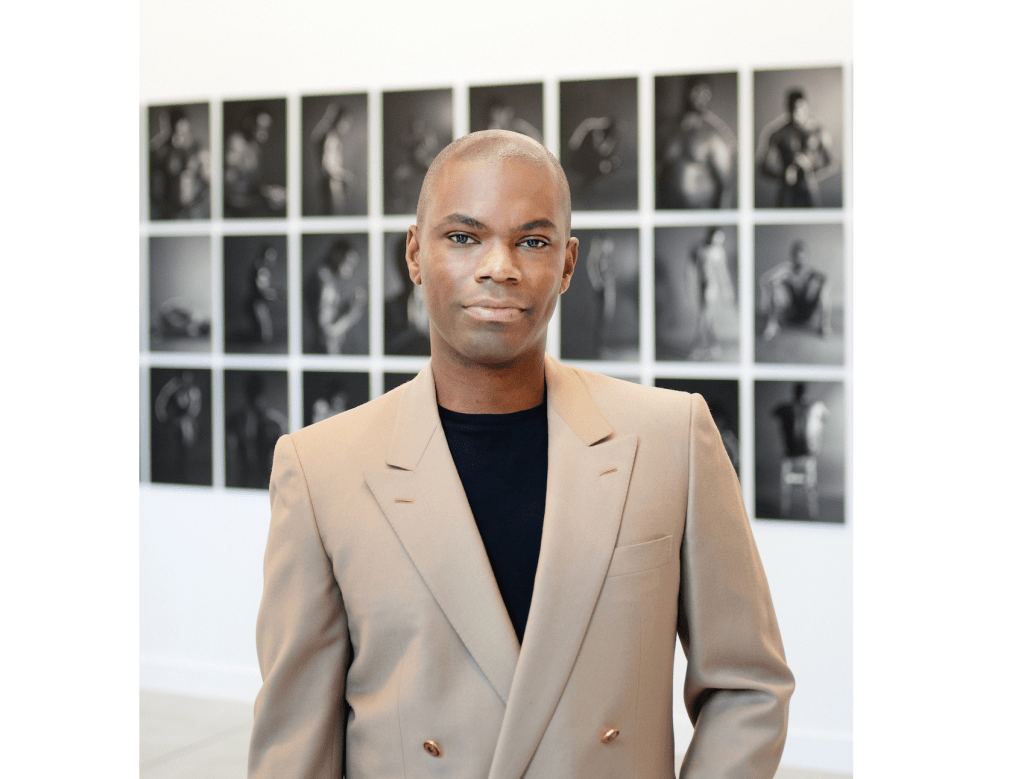
When Jonathan Carver Moore talks about his gallery, he rarely starts with sales figures or artist bios. He starts with a feeling. The feeling of walking into a space without questioning whether you belong there.
This instinct was on display this week at San Francisco’s FOG Design + Art Fair, where Moore presented a solo exhibition of new paintings by Sesse Elangwe, developed during the artist’s recent residency at the gallery. The work is rich and rigorous, full of color and attention, but what Moore really presents is an argument. Art should meet people where they are. The gallery should feel like a conversation rather than an exam.
Related articles
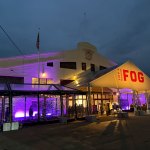
This approach was influenced not so much by the conventions of the art world as by Moore’s own path into it. Before opening her eponymous gallery in 2023, Moore worked in nonprofit communications and institutional development, including roles focused on criminal justice reform and racial equity. He came to San Francisco about a decade ago to do this work with no plans to open a gallery, but he made a habit of collecting, installing and quietly selling art wherever he went. The office became a rotating exhibition. Conversations with donors turned to artists and objects.
Looking back, Moore sees those moments as training. Learn how to read a room. Learn when to speak and when to listen. Understand that people often need permission to ask questions before seeking answers.
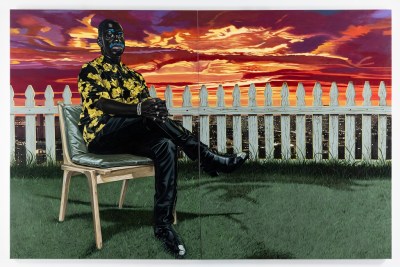
bloom sky (2025) by Seth Elangwe. Photo by Frances Baker
Image courtesy of Jonathan Carver Moore.
That sentiment now defines his gallery at 966 Market Street, on the edge of the Tenderloin and within the city’s Trans Cultural District. This address was important to Moore. The neighborhood is located near the site of the 1966 Gene Compton Cafeteria Riots, an early flashpoint in the fight for transgender rights that predated Stonewall by several years. For Moore, history is something you live with, not something you borrow for atmosphere or cache.
The gallery’s projects reflect this mentality. Moore collaborates with Black, queer, indigenous, female, and other often marginalized artists. But he declined to view the plan as a corrective measure. He focuses on creating environments where artists, collectors and first-time visitors can meet equally. Artists often gain time, space and audiences through residencies next door to galleries, where they live and work for a few weeks before debuting new work.
The resident model feeds directly into the FOG demonstration. Elangwe, a Cameroon-born painter who now lives in San Antonio, spent seven weeks in San Francisco photographing local residents and absorbing the city’s rhythms. The resulting paintings place his subjects within a recognizable Bay Area context, weaving the portraits in place with a steady hand and an eye for exaggerated color that still feels rooted in reality.
For Moore, the goal is not just to introduce an artist to a fair audience, but to give collectors a reason to care about the art, to build a personal relationship, rather than buying works because they are following a trend or what the market deems “hot” at any given moment. “People buy this piece to live with it,” he said in a recent interview. “The things they buy become part of their daily lives.”
This philosophy shaped Moore’s view of the wider collection. He’s open about the importance of welcoming new buyers early, before habits form and anxiety sets in. Pricing was also discussed candidly. The conversation begins with what the viewer sees rather than the artist’s intention. His goal is to see curiosity as a strength.
The long-term view is important to him. Moore often talks about collectors who start with small purchases and grow with the gallery. A couple who once balked at a $4,500 painting became one of his staunchest supporters. Another first-time buyer continues to support institutional exhibitions. Moore tells these stories with humility and caution. It was obvious to him that the only way a relationship would grow was over time.
That sentiment became even more acute when Moore brought his gallery to the Atlanta Art Fair last fall. With a younger, more local crowd than at many more established art fairs, he noticed a change in the room. The audience feels a sense of déjà vu. Cultural reference points quickly fell into place. A painting of a black woman combing her hair with a hot comb in her kitchen resonated without explanation. Moore was struck by how rare this sense of ease was elsewhere.
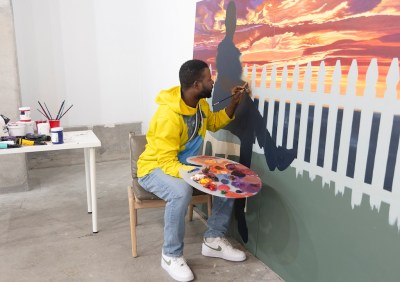
Erangwe in the studio. Photography by Kari Olwick. Image courtesy of Jonathan Carver Moore
Atalanta didn’t change his mind, but confirmed it. The next generation of collectors has emerged. When invited to participate in a conversation, they respond with openness and patience.
This forward-thinking approach also shapes Moore’s perspective on shows like FOG that sit at the intersection of art and design. Rather than resisting this overlap, he leaned toward it. His booth, organized in collaboration with San Francisco design studio Coup D’Etat, brought furniture and paintings into conversation rather than turning presentations into lifestyle vignettes. The purpose is familiarity. Visitors are encouraged to imagine how the piece could exist with them.
“People should be able to see themselves through their work,” Moore said. “It changes the way they engage.”
The clarity of this vision comes in part from Moore’s stance outside of traditional gallery channels. He didn’t apprentice in blue-chip stocks, or inherit an unspoken set of rules. He learned by asking questions and acting instinctively. When he opened his gallery, he moved quickly to establish a residency program. When he wanted to collaborate, he just reached out. Momentum follows.
“I didn’t know there was a chain of command,” he said with a laugh. “So I just kept going.”
This instinct puts Moore in an interesting position in the Bay Area’s arts ecosystem. As Los Angeles galleries face mergers and closures, he talks not about competition but about connections. He talks openly about strengthening connections between Northern and Southern California, sharing artists and audiences, and building networks that are lasting rather than extractive.
For now, Moore’s focus remains close to home. FOG offers an opportunity to showcase what his gallery has built over the past three years: a model based on access, patience and sustained attention. It is not a reinvention of the art fair or gallery system. It’s a quieter thing. Believing that art works best when people feel comfortable enough to stay and watch.