The Tamesis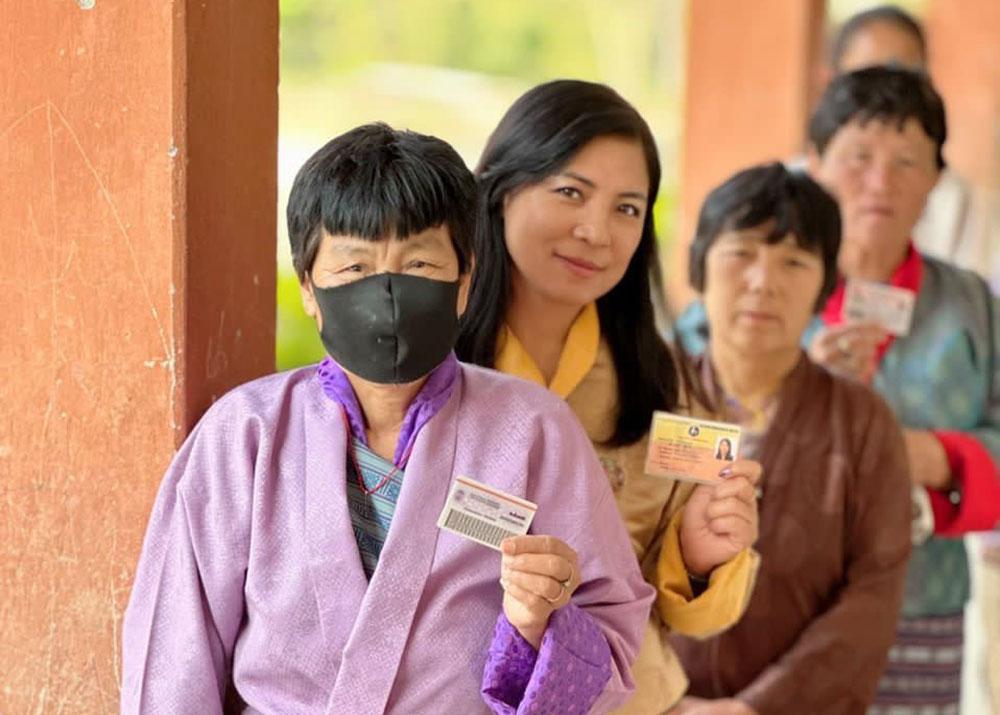
March 19, 2026
Thimphu – In 2016, when Kinley Zangmo was first nominated for the Mangmi post of Talo Gewog in Punakha, many people were still whispering that politics was a man’s domain.
She is running against three male candidates and stepping into a field she once thought was unsuitable for women. Yet when the votes were counted, the villagers chose her.
The victory not only earned her a seat; It reshaped her understanding of possibility. Five years later, inspired by the confidence she has earned and the trust she has built with voters, she is running again in 2021. This time, she said, she wasn’t surprised by the results. She won.
For the 41-year-old, winning back-to-back terms represents more than just a personal milestone. “They mark a quiet shift in voter attitudes,” she said. “People are starting to see that women are capable. But when we get the opportunity, we have to prove ourselves.”
Although women make up more than half of Bhutan’s population, they are largely underrepresented in leadership positions. However, in recent years, women have become increasingly visible in leadership roles, from local government positions to senior public appointments, suggesting that perceptions of women in leadership may be gradually evolving.
What the numbers reveal
Eighteen years into Bhutan’s democratic journey, women’s political representation in politics presents a complex picture of incremental progress and persistent obstacles.
At the grassroots level, women have made some progress.
In the 2021 local government elections, women won 177 of the 1,437 seats nationwide. Among them were 9 guppies, 22 mangomis and 146 Gwogtsoba.
This figure is a slight improvement compared to the 2016 local government elections, when 164 women were elected, including 2 gups, 24 mangmis, 129 gewog tshogpas, 7 thromde tshogpas and 2 thromde ngotshabs.
However, the figures also reveal the scale of the gap. In the same election, 1,275 men won seats.
Women’s participation in national politics remains more limited.
In the 2008 National Council elections, 6 women competed among the 52 candidates, and 4 women were eventually elected. Entry numbers dropped in 2013, when just five women competed against 62 men and none secured a spot.
In 2018, six women ran and two were elected. In the most recent 2023 elections, there were only 5 women out of 89 candidates, with only one woman, Tshering Tshomo, winning a seat.
In 2008, 10 women ran for parliament and four were elected. In 2013, the number of female candidates remained the same, but only three were elected.
In 2018, female participation increased significantly, with 19 candidates and 7 elected. However, this momentum did not fully carry over into the next election cycle.
In the 2023 parliamentary elections, 26 women from 5 political parties participated in the primaries. Only six made it to the general election, and only two were ultimately elected to the National Assembly.
Outside of electoral politics, women remain underrepresented in senior executive positions. According to the Civil Service Statistics 2023, women account for only 23% of administrative-level civil servants. While the overall proportion of women in the civil service has increased from 38.15% in 2019 to around 40% in 2022, the majority of women are still concentrated in the support services category.
The data shows that while there has been clear progress at the grassroots level, national representation has been improving at a slower pace.
For many observers, the upcoming elections will be an important test of whether Bhutan is witnessing a temporary rise in female leadership or the beginning of a deeper structural transformation.
Social barriers remain
Despite growing awareness of gender equality, several social barriers still limit women’s participation in politics. Cultural norms, traditional gender roles and social expectations often prevent women from entering public leadership.
In many communities, women’s leadership abilities are still questioned. Social pressure often prompts women to prioritize family responsibilities over political participation. Limited access to political networks and mentoring further reduces women’s chances of participating in elections and winning the confidence of voters.
Former MP Norbu Wangzon said voters tend to favor male leadership in local government and national parliamentary elections. However, she said parliamentary elections are more influenced by political parties, with candidates chosen mainly based on party affiliation.
“I believe I owe my past victories to the support of my party, but also to my own abilities,” she said.
Norbu Wangzhong has contested national elections four times and won twice – in 2008 and 2018.
For some female leaders, persistence is key.
Dechen Zangmo, 37, ran for the Narang group election for the first time in 2016 and lost by 51 votes. Undeterred by her narrow defeat, she competed again in 2022 and won.
She believes her victory reflects a gradual shift in public attitudes.
“Today, more and more women are coming forward to contest local government elections, and voters are increasingly willing to have confidence in them,” she said. “Leadership is not defined by gender but by ability, commitment and vision.”
Deqin Zangmo’s victory signals a changing perception that women can also lead at the grassroots level and serve their communities effectively.
Kinley Dema, a 39-year-old businesswoman, said: “If Bhutan is to achieve meaningful gender equality in governance, changing mindsets alone will not be enough. Political parties and communities must go beyond token support and create pathways so that women can not only compete, but win.”
role of media
Media coverage also plays a role in shaping perceptions of female leadership. Stories that highlight female leaders and their contributions to community development help challenge the notion that politics is exclusively a male domain.
Increase visibility through newspapers, radio, television and digital platforms so voters see women as capable decision-makers.
Many former female leaders say media coverage over the years has helped shape voters’ perceptions of women in governance. However, they believe women’s voices and achievements still need more attention.
Pema Tshomo has been appointed Ambassador of Bhutan to the Commonwealth of Australia, setting an inspiring example for women and highlighting the impact of female leadership.
Some voters say seeing female leaders in the media and on social media platforms reinforces belief that women are equally capable of holding public office. Others believe women bring strengths such as empathy, collaboration and attention to community needs.
Encourage female leaders
Efforts to encourage women’s participation are also supported by institutions and civil society.
The Bhutan Center for Media and Democracy (BCMD) works to develop women’s leadership skills by raising civic awareness, encouraging inclusive participation and creating platforms for dialogue.
BCMD Executive Director Tandin Wangmo said good governance is stronger when leadership reflects the diversity of the society it serves.
She said when women and men have equal representation in decision-making, it brings a wider range of perspectives, experiences and priorities to the public discussion.
“At BCMD, we focus on creating spaces for dialogue, supporting aspiring female leaders to build confidence and leadership skills, and encouraging greater civic engagement. Through this initiative, BCMD is also building a network of aspiring female leaders,” she said.
Starting in April this year, BCMD will be conducting a series of trainings to prepare and support these aspiring leaders as they consider running in the upcoming local government elections. These efforts are designed to promote governance processes that are more inclusive, responsive, and truly representative of the communities they serve.
The Election Commission of Bhutan has also taken steps to encourage greater participation of women in local elections. The Commission targets women, youth, students and communities in rural and urban areas through its civic education programme.
Measures to promote gender equality, such as policy reviews, allowing candidates to be accompanied during election campaigns, establishing local functional literacy testing centers and holding common forums, aim to reduce barriers that prevent women from participating in elections.
The commission also works with political parties, local government and civil society organizations to provide leadership training and mentoring, while tracking progress through gender-disaggregated data.
signs of change
From Kinley Zangmo’s first hesitant foray into politics to Dechen Zangmo’s narrow victory, stories circulating in villages in Bhutan suggest that attitudes may be slowly changing.
Voters appear increasingly willing to judge candidates on their merits rather than their gender.
However, it remains to be seen whether this marks a temporary rise in female leadership or the beginning of a deeper transformation of Bhutanese politics.
Namgay Tenzin, former Toedpisa Gup, said that in the past, it was not common for women to hold positions such as gup, mangmi or tshogpa. Today, however, this trend is gradually changing, with more and more women taking on these leadership roles.
He said this reflected voters’ growing trust and confidence in female leadership. “While the numbers are still not very encouraging, the lower representation is largely due to fewer women stepping up to compete for these positions.”