The Tamesis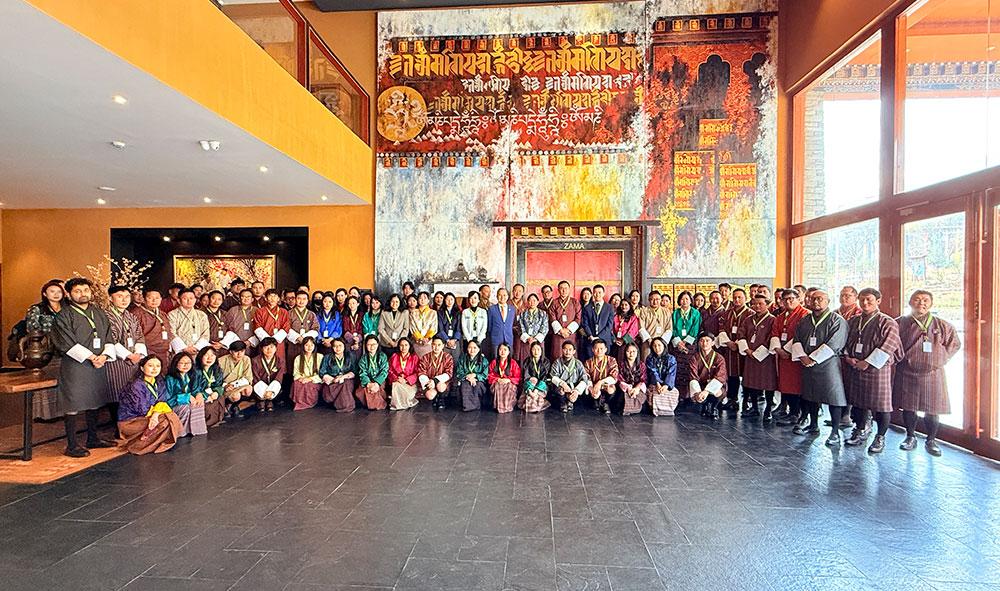
March 5, 2026
Thimphu – Bhutan and Singapore have launched four innovative climate projects under Article 6 cooperation to develop Bhutan’s carbon market and low-carbon pathways.
The projects announced by the Department of Energy and Climate Change (DECC) under the Ministry of Energy and Natural Resources (MoENR) include the National Clean Cooking Initiative, Integrated Cooking and Space Heating Mitigation Programme, Bhutan Rural Biogas Initiative and Thimphu Biogas and Biofertilizer Initiative.
The three-day program titled “From Agreement to Action: Bhutan-Singapore Article 6 – Capacity Building for Carbon Projects” concluded today, during which various discussions were held to bring in more projects.
Nearly 100 participants from the public, corporate and private sectors participated in the program, which was jointly organized by MoENR and TERRAMA PTE. Ltd. from Singapore.
Globally, Article 6 of the Paris Agreement is opening up new pathways for high-integrity, government-backed carbon markets.
In Bhutan, the Clean Cooking Initiative aims to distribute energy-efficient induction cooktops to 20 Dzongkhags, reducing emissions from traditional cooking methods while improving rural livelihoods.
The Integrated Cooking and Space Heating Carbon Reduction Program combines efficient cooking and heating solutions to reduce greenhouse gas emissions in urban and rural homes.
At the same time, the Bhutan Rural Biogas Program will promote biogas technology to convert organic waste into energy and support rural energy access.
In Thimphu, the biogas and biofertilizer scheme will convert municipal organic waste into renewable energy and fertilizer, creating a low-carbon urban solution with direct community benefits.
These projects mark the first tangible steps of the Singapore-Bhutan Implementation Agreement signed on February 28, 2025.
carbon market
Bhutan’s carbon market is built on sound governance and transparency, ensuring that only verified, additional and genuine emission reductions can be traded.
The Bhutan National Carbon Registry now tracks each carbon credit from issuance to retirement or cancellation. Each point comes with a unique serial number containing details such as country, sector and project year, making the system completely transparent.
Zeerie Chhodeon, an analyst at Druk Holding and Investments Limited, explained that the registry allows tracking of each carbon unit. “This ensures transparency, integrity and efficient management of the carbon market in Bhutan.”
She said the Bhutan Carbon Fund (BCF) provides financing and oversight for eligible activities in line with Bhutan’s Nationally Determined Contribution (NDC).
“Sectors such as renewable energy, energy efficiency, low-carbon transport, sustainable agriculture, forestry restoration and livestock management are all supported,” added Zerrie Chhodeon.
The framework ensures local communities and ecosystems receive equitable benefits, strengthening Bhutan’s commitment to sustainable development and climate action.
Article 6
Article 6 of the Paris Agreement paves the way for a high-integrity, government-backed carbon market. It enables Bhutan to trade International Transferred Mitigation Results (ITMO) and mobilize climate finance while supporting low-carbon development.
Tashi Pem, Chairman of the Royal Civil Service Commission and former Director General of DECC, emphasized the importance of Article 6 to Bhutan.
“Article 6 engagement provides a pathway to mobilize climate finance, accelerate low-carbon development, support rural livelihoods, enhance biodiversity protection, enhance ecosystem resilience and safeguard national climate commitments,” she said.
The fee structure under Title VI balances administrative and environmental considerations.
Administrative fees include account creation, project registration, entity identification, ITMO listing, and authorization of letters of approval and letters of intent.
The corresponding adjustment fee is set at US$5 to US$25 per ton of CO2 equivalent, reflecting the opportunity cost of Bhutan’s NDC.
Additionally, 2% of the issued ITMO was canceled to support global climate change mitigation and 5% was contributed to the Bhutan National Adaptation Fund through BCF.
invest
GenZero Assistant Vice President Puar Si Liang said investment decisions take into account political and economic stability, NDC commitments, carbon pricing and carbon market readiness.
“Project-specific risks such as credit requirements, climate impacts, methodology, delivery and integrity risks were also assessed,” he said. “Partnering with a credible entity with a proven track record and stakeholder relationships is critical.”
With a land area of 735.7 square kilometres, compared to Bhutan’s 38,394 square kilometres, Singapore relies heavily on international cooperation to achieve its Nationally Determined Contributions in 2030 and 2035 and its net zero target by 2050. According to the 2024 Biennial Transparency Report, Singapore’s carbon credit demand in 2030 is estimated at 25.1 million tonnes.
The Bhutan-Singapore corridor therefore represents the strategic partnership between the two countries.
In addition, DECC officials said that Bhutan is also exploring carbon trading opportunities with South Korea, Sweden and other European and Asian countries.
climate challenge
Bhutan remains the world’s first carbon negative country and has pledged to remain carbon neutral in its Nationally Determined Contributions. The forest coverage rate is approximately 69.71%, exceeding the minimum coverage rate of 60% stipulated in the constitution.
Bhutan is highly vulnerable to the impacts of climate change and faces huge adaptation costs estimated at up to US$14 billion in areas such as water, agriculture, energy, health, settlements, climate services and disaster risk reduction.
The third Nationally Determined Contribution (NDC 3.0) projects cumulative emission reduction potential of up to 53,865.6 gigagrams (Gg) of carbon dioxide equivalent (CO2e) by 2035, with possible interventions in energy, transport, agriculture, forestry and waste.
In 2022, Bhutan’s net emissions were negative 9.7 million tons of carbon dioxide equivalent, maintaining a carbon negative status.
Bhutan faces multiple challenges, including climate-induced disasters such as floods, glacial lake outburst floods, landslides and extreme weather. Energy and water security, biodiversity loss, human-wildlife conflict, pollution and waste management pressures also pose significant risks. Limited access to climate finance, technology and technical capacity further complicates mitigation and adaptation efforts.
Bhutan’s carbon market offers opportunities in everything from forestry and renewable energy to low-carbon transport and waste management. The country has gained international recognition as the world’s first carbon-negative country and remains firmly committed to carbon neutrality.
DECC Deputy Director Langa Dorji emphasized that Bhutan faces major climate-related challenges.
“The country is extremely vulnerable to the impacts of climate change and faces hazards such as floods, landslides, glacial lake outburst floods and extreme weather events that threaten lives, infrastructure and livelihoods,” he said.
Environmental governance in Bhutan is guided by a sound legal and policy framework. Middle Path – The National Environment Strategy 2020 aims to minimize the impact of development on the environment, while the Environmental Assessment Act 2000 and the National Environmental Protection Act 2007 provide legal mechanisms to assess, prevent and mitigate environmental harm.
“These frameworks ensure that development is not only economically beneficial but also environmentally sustainable. Principles such as the precautionary approach, the polluter pays principle and intergenerational equity guide our decision-making,” Langa Dorji said.
DECC Assistant Environment Officer Dechen Dorji introduced Bhutan’s NDC 3.0, outlining the country’s potential to reduce emissions in sectors such as energy, transport, agriculture, forestry and waste management.
“Our cumulative emissions reduction potential is expected to exceed 53,000 Gg CO2e by 2035. Reaching this target requires international climate finance to support implementation while keeping us carbon neutral,” said Dechen Dorji.
To mobilize climate finance, Bhutan established the Bhutan Carbon Market. This market enables the country to generate high-quality carbon credits while ensuring transparency, environmental integrity and fair benefit-sharing.
“The overall turnaround time depends on how actively both parties participate in the process,” adds Dechen Dorji.