The Tamesis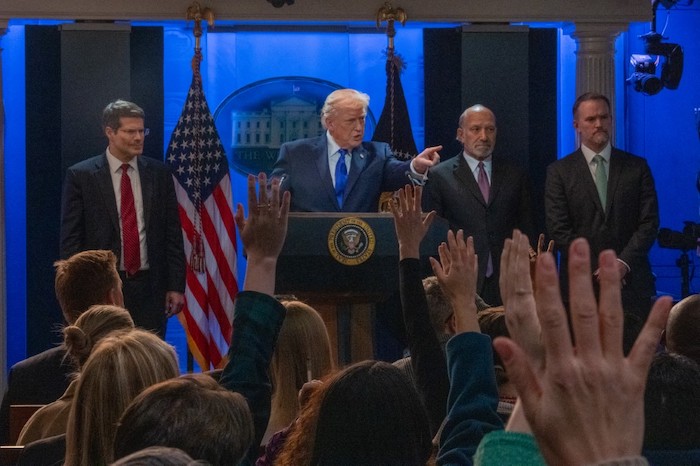
Uncertainty and chaos emerged in Asia on Saturday after the U.S. Supreme Court struck down some of the sweeping tariffs the Trump administration imposed on U.S. trading partners last year.
Friday’s ruling by the U.S. Supreme Court came as no surprise. This was widely expected after judges vigorously grilled government officials on the issue in November. Why they used the Emergency Powers Act of 1977, which didn’t mention tariffs – The only wording on regulating imports during a national emergency declared by a U.S. president.
The court with a conservative majority ruled six to three that the International Emergency Economic Powers Act (IEEPA), which Trump relies on, “does not authorize the president to impose tariffs.”
See also: China exploits Trump’s ‘uncertainty’ to dominate global trade: report
The ruling invalidates a number of tariffs imposed by the Trump administration on Asian export giants such as China, South Korea, Japan and Taiwan.
Analysts said on Saturday that the decision related solely to Trump’s tariffs under the IEEPA law. This means that country-specific tariffs – such as the 15% tariff on Japanese imports – have been eliminated.
But tariffs on certain types of products — such as aluminum, steel, copper, lumber, vehicles, auto parts and furniture — are not affected because Trump used different legislation to impose them.
“Roughly speaking, what you should expect going forward is that there will be tariffs on items, not on countries,” Justin Wolfers, an economics professor at the University of Michigan and a visiting professor at the University of New South Wales, said on Saturday.
Trump vows 10% global import tax
Trump appears Angry and embarrassed about the rulingsaid he was “deeply disappointed” and “absolutely ashamed” of some judges who “didn’t have the courage to do the right thing for our country.”
He vowed to impose a uniform 10% tariff on U.S. imports from all countries for 150 days starting Tuesday under a separate law.
He did this under a provision of trade law that allows him to impose tariffs of up to 15% within 150 days. He also promised to find a solution to permanently reinstate more tariffs.
“Other alternatives will now be used to replace the alternatives that the court wrongly rejected,” he told a news conference. “We have other options. Great options.”
However, analysts later warned that the new tariffs could mean more disruption for businesses in the coming months.
Reduce inflation, cut interest rates?
However, investors have mixed feelings about the results. Wall Street stocks opened lower after disappointing U.S. economic data before moving into positive territory before ending higher in choppy trading. The S&P 500 ended up 0.7%.
Some analysts said they expected the ruling to lead to lower inflation, but others said the situation was fundamentally uncertain.
Briefing.com analyst Patrick O’Hare told AFP that the market was “not surprised by the Supreme Court’s decision, nor by the fact that the Trump administration has touted its ability to make up for lost revenue from the removal of tariffs.”
Mark Malek, chief investment officer at Siebert Financial, said the ruling had “considerable implications for the policy machine” and predicted that policy uncertainty would remain “elevated.”
Jeff Buchbinder, chief equity strategist at LPL Financial, predicted that Trump may turn to a different legal strategy.
“However, if lower tariffs help curb inflation, it could bolster expectations for a rate cut by the Fed later this year,” Buchbinder said in a note.
Tariffs ‘a fiasco’
Reactions have been mixed. A Japanese government spokesman said they would carefully study the content of the ruling and the Trump administration’s response “and respond appropriately.”
In China, where much of the country is enjoying the Lunar New Year holiday, there has been little formal response so far, but A senior financial official in Hong Kong described the U.S. tariff situation as a “dismal failure.”
Trump’s tariffs have strained diplomatic relations with long-standing U.S. allies and ideological rivals.
Now, a huge cloud hangs over the massive multi-billion dollar trade deals that many countries have struck with Washington.
Some of the largest deals involve Japan, South Korea and Taiwan, which have pledged to invest $550 billion, $350 billion and $250 billion respectively in the United States to minimize tariffs on their companies’ exports to the United States.
Regarding Taiwan, the cabinet issued a statement saying: “Although the initial impact on Taiwan appears to be limited, the government will pay close attention to developments and maintain close communication with the United States to understand the specific implementation details and respond appropriately.”
Policy monitor Global Trade Alert estimates that the ruling will nearly halve the average U.S. trade-weighted tariff, from 15.4% to 8.3%.
For countries with higher U.S. tariff levels, such as China, Brazil and India, this would mean double-digit percentage point cuts, although levels remain high. Reuters said.
Some analysts said Friday’s ruling ‘Probably won’t bring much relief’ It warned of looming chaos as trading nations braced for other ways Trump could use the levies to circumvent the ruling.
However, Nantapong Chiralerspong, head of Thailand’s trade policy and strategy office, said the ruling could even benefit Thai exports if uncertainty drives a new round of “front-loading,” in which merchants race to get goods to the United States ahead of new, potentially higher tariffs.
Note: More details were added to this report on February 21, 2026.
See also:
Japan agrees to make first $36 billion investment in U.S.
Indian stocks, rupee soar on US trade deal, despite few details
Canada Carney leads trade shift away from U.S. to China, India and Australia
Modi says huge EU-India trade deal is finalized
India to ‘cut’ EU car tariffs in ‘mother of all trade deals’
Supreme Court defeat adds uncertainty over Trump tariffs
Indonesia’s new finance minister will ease liquidity to boost growth
Trump cuts U.S. tariffs to 47%, Xi Jinping vows to ease rare earth restrictions