The Tamesis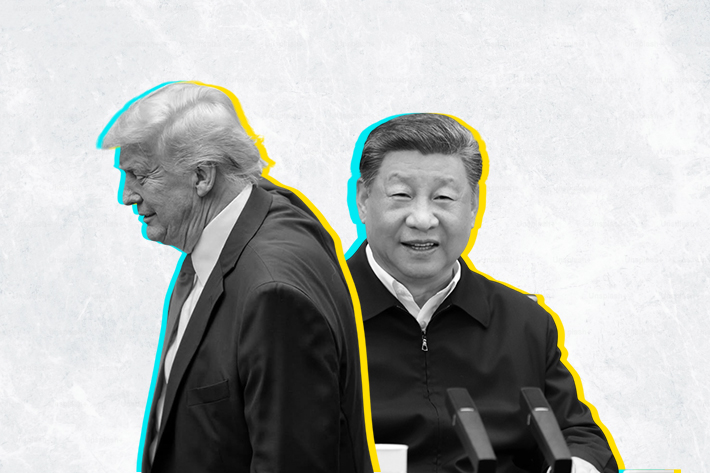
China is exploiting global trade uncertainty caused by U.S. President Donald Trump’s tariffs to pursue its long-term goal of dominating global trade, Reuters reported, citing state-backed scholars and officials in Beijing.
Beijing is considering 20 trade deals to solidify its position as a key partner of the European Union, Gulf states and the Pacific. The report stated.
Its plan has been in the works since at least 2017 by reverse-engineering U.S. trade policy and, if successful, could “insulate its $19 trillion economy from U.S. pressure well into the distant future,” it added.
AF report: China’s potential peak in carbon emissions sparks hope and concern
“When your opponent makes a mistake, don’t interrupt him,” a Chinese official told Reuters, referring to Trump’s destructive trade agenda.
Citing interviews with 10 people, including Chinese officials and trade diplomats, the report said Beijing struck the first deal in January after Canadian Prime Minister Mark Carney visited the country.
As part of the deal, Canada Agree to cut tariffs The tariffs on Chinese electric vehicles have previously been implemented in line with U.S. taxation policies.
Chinese officials are also working to speed up stalled trade talks with Honduras, Panama, Peru, South Korea and Switzerland.
“We are willing to negotiate bilateral and regional trade and investment agreements with interested countries and regions,” Commerce Ministry spokesman He Yongqian told Reuters during Carney’s visit, without elaborating.
Wang Wentao, Minister of Commerce of China Also joined Reuters stated that the Comprehensive and Progressive Agreement for Trans-Pacific Partnership (CPTPP) is a priority.
At the same time, Chinese diplomats are also “traveling around the world” to persuade trading partners to join them and “defend multilateralism and open trade,” the report said.
In one example, China sent its top diplomat Wang Yi to Lesotho, a small country in southern Africa, in January to deepen ties.
on his agenda Strategic cooperation, promoting infrastructure projects, increasing trade in agricultural products, and implementing a zero-tariff policy on exports to Lesotho. Trump initially imposed 50% tariffs on the country.
On Saturday, state media said China would also impose zero tariffs on imports from 53 countries, all of which are in Africa.
“Anti-decoupling agenda”
According to Reuters, Beijing’s motivation for this move is to “integrate China so deeply into global trade that partners cannot decouple under U.S. pressure.”
The focus of the trade strategy paper written by Chinese academics supported by the Chinese Academy of Social Sciences (CASS) and Peking University has been clear, the report added. These universities play a key role in influencing Chinese policy.
“In countering the strategic competition between the United States and China, ‘anti-decoupling’ should become China’s primary focus,” Ni Feng, a researcher at the Institute of American Studies at the Chinese Academy of Social Sciences, wrote in 2024.
In an analysis of the content of these papers, Reuters said that policy insiders generally believe that painful structural changes are a price worth paying for China’s long-term dominance in global business.
For example, Foreign Minister Wang surprised European negotiators November The prospect of a free trade agreement with Brussels was raised during talks with Estonia’s foreign minister.
A month later, Mr. Wang forced gulf cooperation council End long-running negotiations on a free trade agreement. In January, Prime Minister Keir Starmer and Chinese leader Xi Jinping agreed to launch a feasibility study into a services trade deal that could reduce barriers for British businesses.
This week, German Chancellor Friedrich Merz also said He will seek a “strategic partnership” with China during his visit next week.
Still, a senior European trade diplomat told Reuters that Beijing’s push was “purely Chinese propaganda.” He said Brussels had no plans to reach a trade deal.
Promote digital infrastructure cooperation
Another key element of its plan is to gain “first-mover” advantage by becoming an influential partner in key modern technologies such as artificial intelligence.
Reuters said that as part of this push, China has promoted artificial intelligence-driven customs systems to neighboring countries. Taking October as an example, Beijing Upgrade the free trade agreement Partnering with the Association of Southeast Asian Nations to focus on AI-driven and digital trade.
Likewise, it is now working with Vietnamese authorities to upgrade the “Friendship Pass” along the border between the two countries using 5G, satellite navigation and AI-powered vehicles. Chinese state media claim Homegrown AI solutions have reduced port waiting times by 20%, resulting in faster deliveries.
Until then, Chinese advisers believe Beijing should focus on influencing global standards in areas such as intellectual property through initiatives such as Xi Jinping’s Belt and Road Initiative and China’s membership of the Regional Comprehensive Economic Partnership, which covers about 30% of global GDP.
Some Chinese advisers argue in the paper that Beijing should examine how Washington can “weaponize” global institutions to contain China and exploit opportunities created by Trump’s willingness to abandon or sideline multilateral institutions such as the World Trade Organization.
Asked about China’s approach, a U.S. official told Reuters it was not surprising that countries with huge trade surpluses seek to maintain globalization.
“President Trump is addressing the problems that globalization has created for the United States, while other countries are trying to increase their globalization efforts as U.S. free market access is eliminated,” the official said.
Oversupply in China is biggest concern
Two Western diplomats told Reuters that if the move succeeds, Beijing could place itself at the center of a new China-led multilateral order, upending more than a decade of U.S. trade policy.
But for countries seeking to cooperate with China, long-standing issues of oversupply and dumping will be a key issue to contend with. Last year, China’s trade surplus expanded to record $1.2 trillion.
Pascal Lamy, former Director-General of the World Trade Organization and European Union Trade Commissioner, said that Chinese companies exported more goods to Europe than the EU could absorb.
“It’s a mystery, given the nature of the regime, given this collective wisdom, why they haven’t been able to successfully rebalance their economic model?” he said.
Fred Neumann, chief economist for Asia Pacific at HSBC, said Beijing’s trading partners do need China to revive consumption.
China’s Commerce Minister Wang Yi said increasing imports was a top priority as Beijing prepared to launch its next five-year plan in March, in line with a pledge to boost consumption as a share of GDP.
Can China succeed?
The Reuters report also pointed out that trade rebalancing A “long-term” project And it can take years to work. Meanwhile, with three years left in Trump’s term, the next administration is likely to renew alliances to contain China.
Wendy Cutler, the chief negotiator for the Trans-Pacific Partnership during the Obama administration, acknowledged that Beijing has a window to defend trade and multilateralism but said China needed to move beyond empty talk.
“With its huge trade imbalances and some of the coercive measures it’s now taking on countries like Japan, it’s hard to see how they’re behaving,” Cutler told Reuters.
Chinese advisers such as Zhao Pu, a researcher at the Institute of American Studies at the Chinese Academy of Social Sciences, said Beijing’s path forward is to “deeply study the logic of U.S. actions within international institutions and possible next steps to better respond to increasingly fierce strategic offensives in the future.”
It remains to be seen how China’s plan will be implemented and whether it will be favored by countries wary of overproduction and unfair market access. But experts believe this may be the best time for Beijing to take action.
“The Chinese now have a once-in-a-lifetime opportunity,” Alicia Garcia Herrero, a senior fellow at the Brueghel think tank, told Reuters.
- Vishakha Saxena, Reuters
Also read:
Japan agrees to make first $36 billion investment in U.S.
Japan calls China’s dual-use export ban ‘unacceptable’
Seoul yet to resolve investment dispute and US tariff hikes
Seoul vows action on U.S. investment after new tariff threat
Trump’s ‘tariffs on countries trading with Iran’ could kill China truce
Trump’s attack on Venezuela ‘could strengthen China’s territorial claims’
U.S. sanctions force Indian and Chinese refiners to cut Russian oil output
India rejects Russian oil for US deal as protests brew