The Tamesis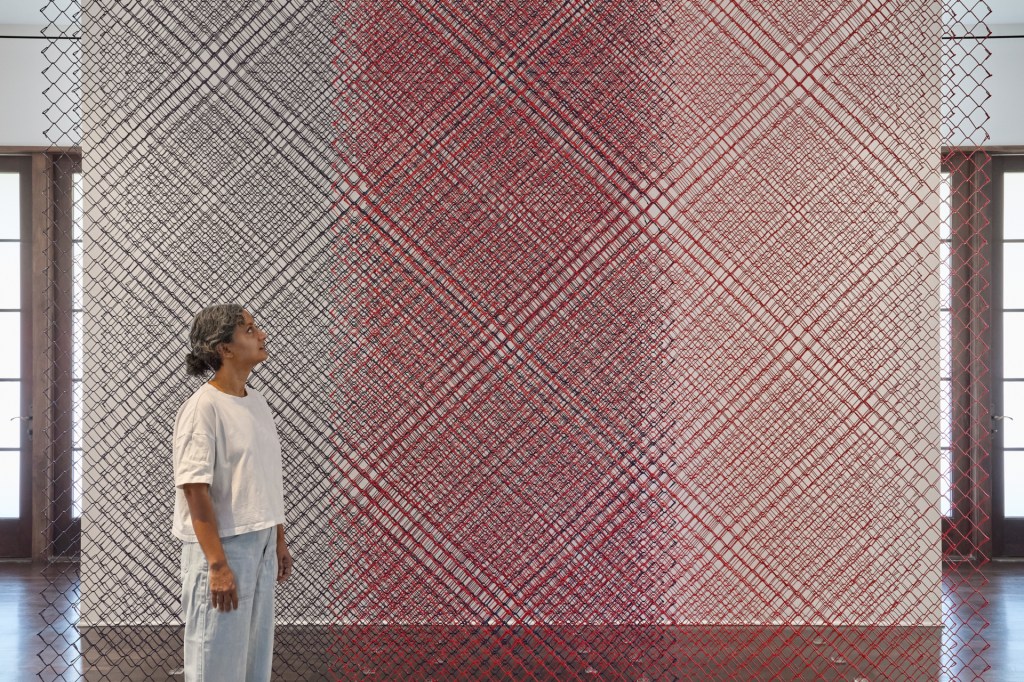
Growing up in Bangladesh and Hertfordshire, England, Rana Begum had no idea that becoming an artist was a possible future for her. Her father worked various jobs to support his family and brought them to England in search of a better life. “I didn’t even know I could draw,” the artist told me recently, but since she didn’t speak English when she arrived in England in 1983, her teacher gave her colored pencils to keep her busy, and it’s just continued. “Art becomes a tool to connect with others,” she added.
Her teachers encouraged Begum’s parents to enroll her in a year of introductory art classes, and the support of a visiting uncle convinced them to agree. When she was invited to audition for London’s Chelsea College of Art, to her surprise, her father hired a man in a van to take her work to the school, where judging sessions stretched from the gallery into the street. (Much of this is described in the Charming 2023 children’s book The Girl Who Played with Color: The Story of Artist Rana Begum.) She received her BA there in 1999 and then her MA in Painting at the Slade School of Art in London in 2002.
Related articles
The connections sparked by Begum’s art have taken her around the world, with exhibitions at Shanghai’s Long Museum in 2015, London’s Whitechapel Gallery in 2023, and participation in the 2016 Gwangju Biennale, among others. She was elected a Royal Academician in 2020. But she says the biggest achievement for her parents came in 2014, when her work was exhibited in Bangladesh as part of the 2014 Dhaka Art Summit.
Begum’s work, which often incorporates industrial materials into elegant abstractions that combine influences from American minimalism and the Islamic architecture and design she grew up on, is currently on display at “Reflection” at Windsor Gallery in Vero Beach, Florida. The exhibition travels from the SCAD Museum of Art at the Savannah College of Art and Design in Georgia to the private commercial enterprise, where it will be on display through May 8, where it will be shown at a U.S. institution for the first time. The museum’s chief curator, Daniel S. Palmer, has followed her work closely since first seeing her work at her Dubai gallery, Third Line, about a decade ago.
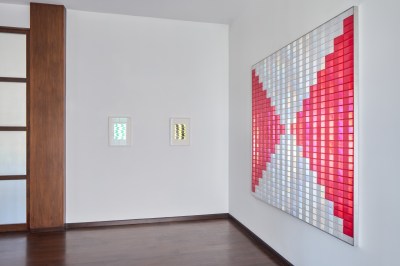
Installation view of “Rana Begum: Reflection”, 2026, Windsor Gallery, from left to right, WP330 (2019), WP334 (2019) and L reflector No. 1473 (2025).
Aric Attas, courtesy Windsor Gallery
Founded in 2002, the Windsor Gallery has hosted exhibitions by globally renowned artists, including Christo and Jeanne-Claude, Peter Doig, Jasper Johns, Grayson Perry and Ed Ruscha. It’s located in Windsor, a 472-acre oceanfront sports club community a few hours north of Miami founded by Canadian billionaires Galen and Hilary Weston. The gallery is open to the public by appointment; donations requested for tickets to Begum’s show will be donated to the Alzheimer’s and Parkinson’s Disease Association of Indian River County.
Windsor co-founder and creative director Hilary M. Weston (also the former Lieutenant Governor of Ontario) was already interested in showcasing Begum’s work, so it made sense for the pieces to make the short trip from the SCAD Museum. (She died in 2025 at age 83.) Palmer noted that it was a fitting location for the exhibition because Windsor was planned based on concepts from New Urbanism, the influential design movement of the 1980s that was partly inspired by cities like Savannah.
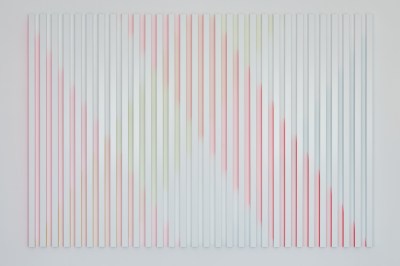
Rana Begum, No. 827 (2018).
Aric Attas, courtesy Windsor Gallery
“It really shocked me,” Palmer told me recently as we stood in front of the piece No. 827 (2018), when he saw it on the third line. At first he thought he was seeing a painted wall, but when the colors started to change as he walked past, he laughed with delight. The piece is actually composed of 30 metal rods, more than six feet tall and two inches deep, hung tightly on the wall. Their tops are painted white, and many have their side sections painted in various colors—pale pink, lilac, powder blue—so that as the viewer walks back and forth in front of the work, the reflected light creates a symphony of subtle color shifts. It’s often said that the viewer completes the work of art, but in this piece, what happens in the viewer’s eyes is actually crucial.
This piece, she told me, brought together two of Begum’s fundamental interests. “I spent years studying color, and I needed the work to change—I needed it to be dynamic, but not moveable.” She says the work surprised even her. “I wanted the colors to change as you moved, but I didn’t expect them to blend. Then I saw the colors blending in the eyes and I went crazy.”
Begum’s work is partly part of the lineage of American Minimalism, Palmer said, pointing to similarities with the work of Anne Albers, Dan Flavin and Agnes Martin, among others. Begum grew up in a Muslim family, so she spent her childhood participating in group readings of the Quran. Repeated readings of religious texts and the repetition that occurs in Islamic art and design are also reflected in her work.
Chapter 1272 Chain Link (2023) consists of a number of bars suspended from the ceiling, covered layer by layer, which are powder-coated in red and blue so that their darker colors combine in varying proportions as the viewer moves around the work. The artist thought of Minimalist sculptor Anne Truitt and Abstract Expressionist painter Mark Rothko and wanted to translate their concerns into materials she encountered in the Coachella Valley when she participated in the 2023 Desert X Biennial.
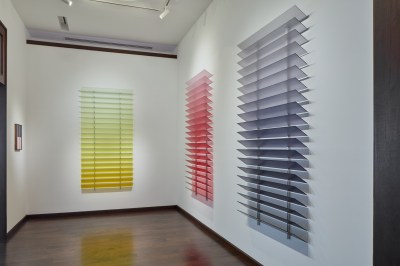
Three works from Rana Begum’s “Louvre” series.
Aric Attas, courtesy Windsor Gallery
Begum often draws inspiration from architecture and design, including the way light falls on building surfaces and the louvers and vents that allow air to circulate, allowing the building to breathe, as she describes it. Three large-scale wall-mounted sculptures from the “Louvre” series in yellow, red, and dark gray hang at the Palace of Windsor, each with 20 translucent horizontal strips; the lower strips are relatively opaque, and the amount of paint gradually decreases, so that each top strip almost seems to dissolve.
In the tradition of great art, Begum sources her art materials from places like hardware stores. Some wall decorations use the same reflective panels found on bicycle spokes that she discovered in a shop in Bangkok during a residency at the British Council; the orange clothing she found reminded her of the cassocks of Buddhist monks she’d seen on the street. As one moves around the debris, the material’s reflectivity waxes and wanes, sometimes looking like tiny lightbulbs glowing inside. Outside the building that houses the gallery stand a number of columnar sculptures, their strict geometric shapes and bright tones contrasting with the lush surroundings.
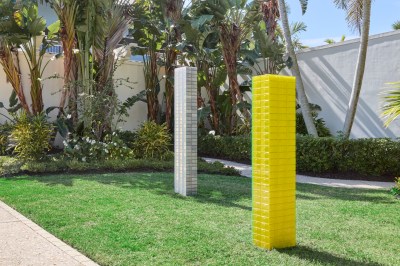
Rana Begum, No. 1262 T Reflector (2023) and No. 1474 T Reflector (2025).
Aric Attas, courtesy Windsor Gallery
From Palmer’s perspective, Begum’s work was “simply impossible” to alienate, but the artist understood that people might feel they didn’t understand the abstract work. But, she said: “You Feel It accompanies how you perceive the world. “