The Tamesis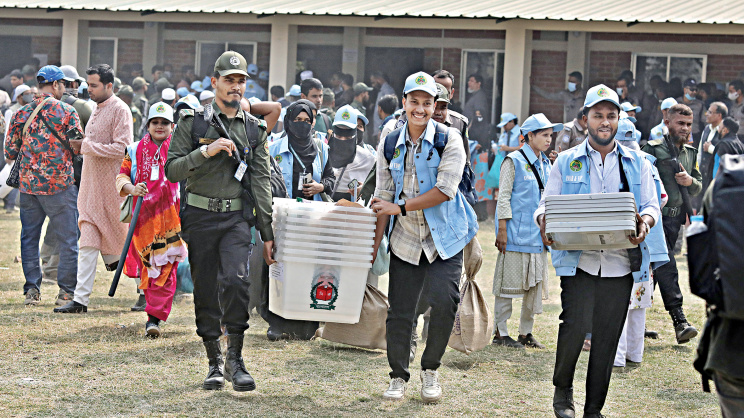
February 12, 2026
Dhaka – Bangladesh has been without competitive elections for so long that nearly a third of the electorate has never witnessed a real poll in which voters elect the MPs of their choice.
That is set to change today as thousands line up at voting centres, some since dawn, to take back their right to vote. In July 2024, these voters took to the streets to overthrow the tyranny. They bled profusely and many others died.
This is a monsoon break. But today, they can usher in the spring of hope.
To ensure peaceful elections, the Election Commission has taken all measures to provide a security blanket to the country. Voters will also be there to celebrate. Many returned to their ancestral homes to reclaim a long-deprived right – the right to vote.
After 17 years, Bangladesh is once again facing competitive elections, and people across the country are waiting in suspense to see who will win.
In addition to the parliamentary elections, citizens will vote in a referendum on constitutional reform, a rare political consensus. The July Charter aims to strengthen democratic institutions and ensure that they operate with greater accountability and efficiency.
Graphics: Daily Star
Memories of past elections still weigh heavily. The one-sided races in 2014 and 2024 were widely viewed as shams, while the 2018 campaign was marred by accusations of ballot stuffing and intimidation. Together, these events destroyed public trust and left an entire generation without the experience of a real campaign.
“It feels like our voices matter again… We have been waiting for this day for so long. I am really excited,” said Raihan Bin Sarwar, a private company executive in Mirpur-15 who will cast his first vote today.
Professor Sk Tawfique M Haque, a policy and governance expert at North South University, said people now feel empowered as they will be able to elect their own representatives.
Regarding the enthusiasm of voters, he said that the scene of people rushing home to vote in large numbers has not been seen for many years. “The turnout is likely to be record-breaking.”
He said even poor and low-income citizens paid out of their own pockets to return home to vote, with some even riding on the roofs of trains to vote.
“Since the mass uprising, people have become more politically confident. There is no fear, no hesitation. The enthusiasm is unprecedented and for democracy it is a major achievement,” he said.
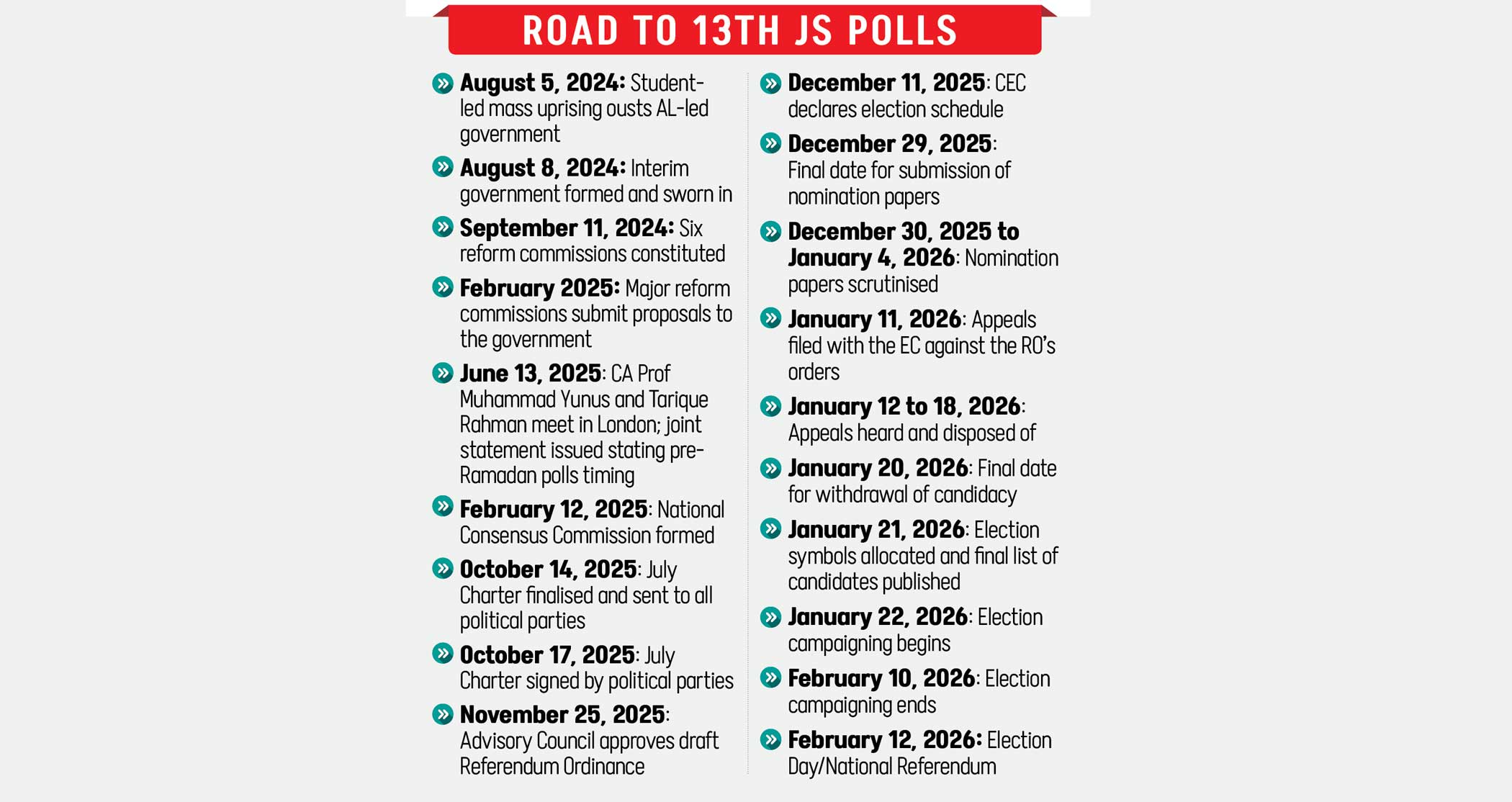
Since the interim government came to power, it has often repeated its priorities – reform, justice and elections. Although elections are usually held every five years, Bangladesh’s 13th election comes just 26 months after the last one, which was triggered by a massive uprising that toppled the previous regime in August 2024.
Graphics: Daily Star
The Awami League was banned from the election for its role in a brutal crackdown that left at least 1,400 people dead. While 50 parties are in the running, the main contest will be between two alliances – one led by the BNP and the other by the Jamaat-e-Islami.
While the BNP has pressed for elections before December 2025 from the early days of the interim government, other parties, including the Congress Party, have said they would go to the polls only if reforms were implemented.
But as calls for swift elections grew stronger, chief adviser Muhammad Yunus announced in June 2025 that if preparations were completed, the vote would be held in the first half of February.
Reform remained elusive until mid-October, when 25 parties signed the July Charter after months of negotiations between 30 parties in the National Consensus Council. Five parties refused to sign, including the National Civic Party (NCP), the natural heir to the July uprising.
In November, the government announced that national elections and referendums would be held on the same day. Subsequently, the Election Commission confirmed February 12 as the voting day.
Chief Election Commissioner AMM Nasir Uddin in his address to the nation yesterday urged citizens to vote, reminding them that it is not only a civil right but also a responsibility.
“I appeal to political parties, candidates and voters; to maintain peace and harmony in a responsible manner,” he said.
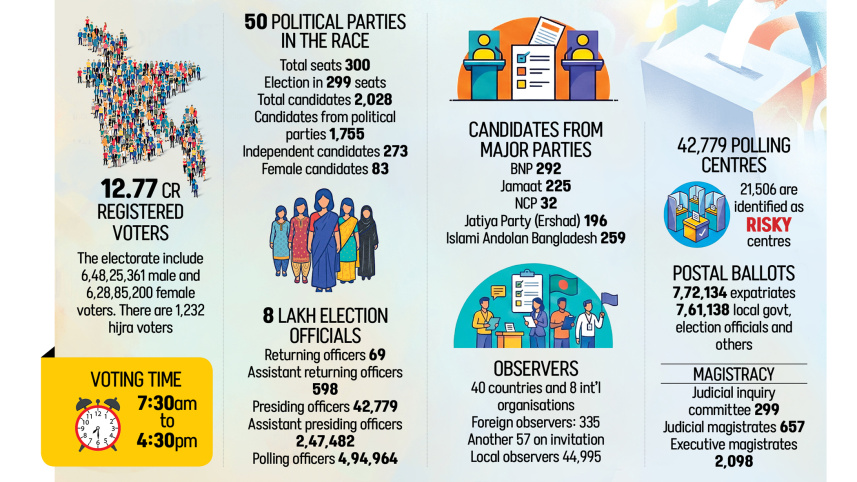
Polling is underway in 299 wards and the elections in Sherpur-3 were suspended due to the death of a candidate. Today, 42,779 polling stations will be open for 12.77 billion voters between 7:30 am and 4:30 pm.
They will choose from 2,028 candidates, 1,755 of whom are represented by 50 political parties and 273 independents. Of these, only 83 are women.
The BNP fielded 292 candidates while Jamaat fielded 225 candidates. Both sides ceded their remaining seats to coalition partners. The NCP, formed by frontline July protesters, is contesting 32 seats as part of the Jamaat-led alliance.
The National Party (Ershad) fielded 196 candidates, while the Bangladesh Islamic Andolan Party nominated 259 candidates.
With the Arab League banned and its registration withheld, the political landscape has changed dramatically, leaving room for the BNP- and Awami Congress-led coalition to seize Arab League strongholds without them ever having the chance.
BNP Paribas, founded in 1978, has been without power for 17 years, its longest period of time. Banned after independence for colluding with Pakistan during the war, the Federation was re-established in 1976 and joined the BNP in 1999 to form a four-party alliance. In 2001, the federation won jointly and two federation leaders became cabinet members.
In 2013, the High Court canceled Jamaat’s registration, ruling that provisions of its charter violated the constitution and electoral laws.
The BNP has distanced itself from the Islamist party amid criticism over its ties to the Congress party. The 20-party coalition dissolved in December 2022 after BNP asked allies not to use the alliance’s name.
The BNP won the 1979 elections and again in 1991 after the fall of His Majesty Ershad in a massive uprising. It also won a lopsided poll in February 1996, but the government was short-lived. Returned to power in 2001.
In 1986, the Congress Party participated in the national elections in its name. In 1991, the party achieved its best result, winning 18 seats and 12.13% of the vote.
While both sides are committed to justice as a founding principle, leaders from both sides have exchanged taunts, barbs and sometimes fiery rhetoric.
BNP’s Tarique Rahman and Jamaat’s Shafiqur Rahman have been locked in a war of words. The BNP has lashed out at the Jamaat’s role during the 1971 Liberation War and accused it of misusing religion to mislead the people and conspiring for “electoral engineering”.
The Congress party, on the other hand, accuses the BNP of corruption, land grabbing, extortion and “neo-fascism”.
While pre-poll violence is not uncommon in South Asia, the incidence of violence was lower this time in Bangladesh.
“In a densely populated country like Bangladesh, emotions run high during elections, but the overall atmosphere remains relatively calm,” Professor Taufiq said.
Political analysts point to another striking feature of the election: growing global interest in Bangladesh’s democratic transition. The vote was overseen by the largest team of local and international observers since 2008 – 335 international observers from 40 countries and 8 representatives from international organizations. A further 57 observers arrived at the invitation of the European Commission.
Badiul Alam Majumdar, chairman of the now-defunct Electoral Reform Commission, said the surge in observers reflected the competitive nature of the election.
“Many international observers have shown little interest in monitoring the last three polls because they were not contested,” he added.