The Tamesis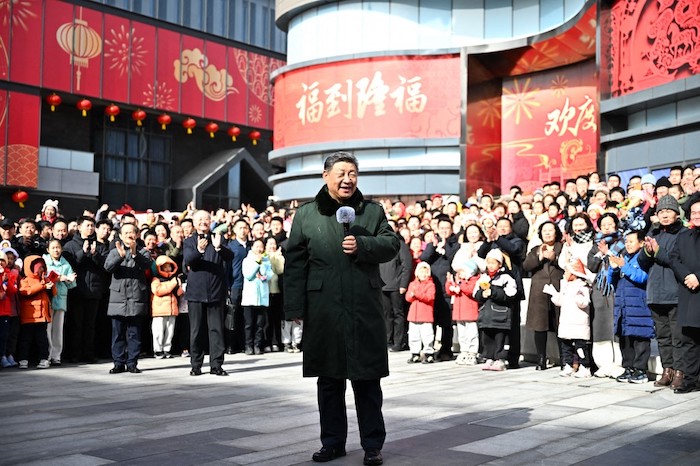
China’s local governments have recently rolled out a series of measures to boost sluggish spending during the upcoming Lunar New Year holiday.
This year, citizens will enjoy a nine-day public holiday, the longest ever, which starts on Sunday and is touted by officials as an opportunity to stimulate consumption.
Official data released on Wednesday showed consumer price growth slowed less than expected in January. The world’s second-largest economy is troubled Consumption downturn Since the end of the Covid-19 pandemic, the country has relied on manufacturing and exports.
See also: Focus on economic growth is killing nature, 150 states warn
China’s Vice Minister of Commerce Sheng Qiuping said local governments across China have allocated 2.05 billion yuan ($297 million) to “directly benefit consumers” during the upcoming holiday season.
According to CCTV, “New Year gifts” will be distributed in the form of vouchers, subsidies and traditional red envelopes.
Data released by the National Bureau of Statistics (NBS) on Wednesday showed that the consumer price index, a key measure of inflation, slowed to 0.2% year-on-year last month. That’s well down from 0.8% in December, which was the fastest in nearly three years.
Despite a historic boom in exports, China’s vast economy has stagnated in recent years. The authorities have taken measures to promote consumption, including Household Goods Subsidy Schemebut the results were underwhelming.
Consumer inflation “is likely to rebound in February,” Capital Economics’ Huang Zichun said. But she added that “we doubt deflationary pressures in China will subside anytime soon as supply and demand imbalances persist”.
Officials vowed to take further steps to encourage domestic spending at a news conference in Beijing on Wednesday.
Restaurant chain closes 10 branches
The operator of a popular restaurant chain specializing in Shanghainese cuisine announced on Tuesday the sudden closure of 10 restaurants in the eastern Chinese metropolis, a clear sign of the damage slumping consumption is taking on the business.
this Shanghai Minnan store closed Shanghai XNG Holdings said in a statement on the Hong Kong Stock Exchange that this was temporary. But it added that the decision was taken due to a “continued lack of profitability” in a “challenging business environment”.
Other government data released on Wednesday showed that persistent deflation in the manufacturing sector has eased recently.
Data from the National Bureau of Statistics show that ex-factory prices have been in negative territory since October 2022 and fell at a slower pace last month.
The producer price index fell 1.4% year-on-year, the slowest pace of deflation since July 2024.
The improvement “is concentrated in non-ferrous metals, which may reflect recent volatility in global commodity markets,” Huang wrote.
PPI increased by 0.4% month-on-month. The growth “suggests that deflationary pressures in the manufacturing sector may have eased,” wrote Zhang Zhiwei, president and chief economist of Jingdian Asset Management.
Official data released last month showed China’s economy would grow by 5% in 2025, meeting government targets but at the slowest pace in decades.
Experts expect leaders to announce the same or slightly lower targets for this year at a major political gathering in early March.
Asian markets edge higher, dollar falls
Asian and European stocks rose on Wednesday while the dollar fell as investors weighed weak U.S. consumer data, which strengthened the case for further interest rate cuts ahead of key jobs data later in the day.
Wall Street was mixed, with technology companies giving up recent gains amid lingering concerns about expanding valuations and huge capital infusions into artificial intelligence.
Markets in Hong Kong, Shanghai, Sydney, Singapore, Seoul, Taipei, Bangkok, Jakarta and Manila all rose, but fell in Mumbai and Wellington. Tokyo is closed for a holiday.
Markets showed little reaction to data showing Chinese consumer inflation slowed last month.
As of the close, Hong Kong’s Hang Seng Index rose 0.3% to 27,266.38 points; the Shanghai Composite Index officially ended trading, rising 0.1% to 4,131.98 points.
In Europe, London and Paris opened higher, but Frankfurt fell.
The prospect of another Fed rate cut also boosted The dollar fell against major currencies. Dropped to 153.10 yen 154.31 yen from Tuesday.
Traders remain wary of developments in the tech sector as they Concerned, hundreds of billions of dollars of companies have invested in artificial intelligence You may not see any returns for some time.
The situation became more complicated on Tuesday when Google parent Alphabet raised more than $30 billion in debt in less than 24 hours to bolster its capabilities.
News that start-up Altruist Corp is launching a tax strategy tool has added to unease on the trading floor as it raises concerns that the software will take business away from mainstream firms.
Meanwhile, prices edged higher on fresh concerns about U.S.-Iran tensions as Israeli Prime Minister Benjamin Netanyahu traveled to Washington for hastily arranged talks as nuclear talks between Washington and Tehran continued.
Trump said on the eve of the White House meeting that he was considering sending a second U.S. “Armada” to the Middle East to pressure Tehran into a deal, although Netanyahu is expected to prompt him to take a tougher stance against Israel’s enemies.
See also:
Chinese solar panel maker shares rise after Musk team visit
China slams Panama port ruling, Hutchison Whampoa files new lawsuit
Nvidia delays sales of artificial intelligence chips to China again due to security review
China’s economy slows in November, calls for reform rise
Mexico approves steep tariff hikes on Chinese and other Asian imports
The International Monetary Fund tells China: Cut exports, increase consumption, and “let go of the zombies”
Foreign companies struggle amid China’s recession and trade war
Chinese companies may soon need to transfer technology to invest in Europe
Overseas investment by Chinese electric vehicle companies exceeds domestic investment for the first time