The Tamesis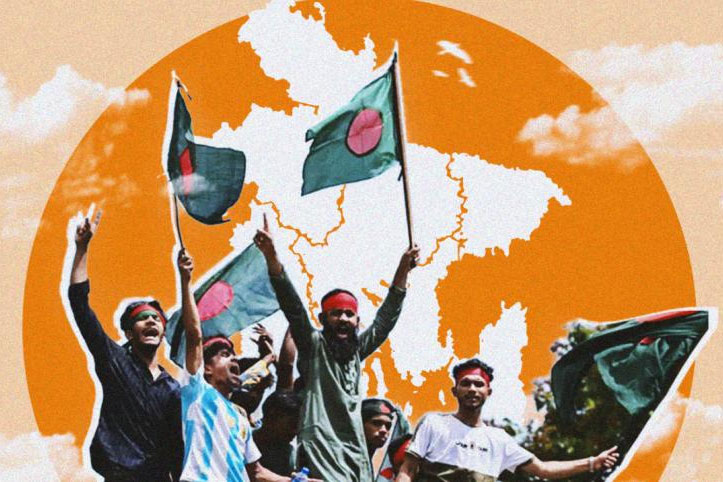
February 11, 2026
Dhaka – Growing up as Generation Z means that politics has always been something we learned secondhand through the series of scandals, memes and news clips scrolling across our screens. We argue about it, joke about it, but often feel powerless in the face of it. For most of our lives, democracy existed only as a concept that we remembered rather than experienced. It’s in textbooks, exam answers and neatly framed quotes taped to classroom walls. We learn that democracy means government of the people, by the people, and for the people, but for years the very concept of “being a human being” has felt abstract, distant, almost ceremonial. Decisions happen above us, campaigns unfold like drama, elections come and go, and outcomes seem predetermined.
Then July came and everything changed. What began as a protest against quotas in public service jobs turned into a nationwide uprising so powerful that it uprooted a seemingly unshakable political order. It reminded an entire generation of what collective existence looked like. It reminds us that people shape moments and moments shape systems. As the country heads toward elections, many of us now find ourselves at a rare intersection of faith and opportunity.
This election comes at a time when faith in institutions feels fragile, but faith in people is stronger than it has been in years. Discussions around voting are often tinged with a familiar skepticism, and it’s easy to ask what exactly one vote can achieve. I’ve asked this question myself. The question, however, assumes that democracy already belongs to others—experienced politicians, dynastic elites, and powerful brokers—and that we are merely spectators, waiting for scraps of influence.
But July taught us that real power lies not just in the hands of those at the top; It occurs when ordinary people claim what is theirs. Elections gain power through participation, and turnout turns procedural activities into meaningful tasks. Crowded voting centers convey legitimacy in a way that speeches cannot. One vote multiplied by millions becomes a statement that leaders and institutions are listening, that presence is valuable and that our generation is ready to fully participate in shaping the life of the nation.
For Gen Z, this election has a different emotional texture. For the first time, many of us are voting in an environment where choices matter. We have grown up watching politics through screens, filtering reality through satire, anger and commentary. We learned early on that systems respond to pressure and visibility. We also learned that disengagement creates space for decisions that shape our lives no matter what. This election provides us with a unique opportunity to turn awareness into influence and influence into impact. Participation feels less like an obligation and more like a requirement. The future we discuss endlessly on social media should also be present in the real world.
The political landscape we are inheriting represents both opportunity and urgency. Every policy debate, every budget allocation, every local council decision ultimately affects our lives, from education and jobs to healthcare and climate action. Participating in the election is the first step in ensuring that these choices reflect the aspirations of a generation that has been watching, waiting and now insisting to be heard. Voting turns abstract ideals into concrete responsibilities, online comments into offline results, and most importantly, frustration into vision. The act of walking into the voting booth is both a personal statement and a collective gesture: This generation is telling its leaders that the future will not be negotiated in silence.
However, this engagement does not end at the ballot box. The act of voting opens dialogue, bridges divides, and builds accountability networks. It requires us to vet candidates not just by rhetoric, but by record, vision and integrity. It encourages discussion among families, communities and online spaces, enriching a culture of debate and critical thinking. When millions of people participate, society reaffirms its shared stake in decisions that affect us all.
The strength of democracy lies not only in its institutions but also in the collective choices of its citizens. The scale of change lies not in single victories or isolated reforms, but in sustained, informed engagement. Our participation in voting reminds leaders that legitimacy is earned, not assumed. It encourages accountability, not complacency. It shows that politics is not a spectator sport but a shared responsibility that requires courage, curiosity and commitment. Decisions made now will impact generations, shaping opportunities, rights and freedoms for years to come.
From this perspective, the simple act of voting transcends ritual. It is an assertion, a dialogue and a claim to relevance. Every act of participation amplifies the promise of democracy: government exists to serve the people, and people exist to guide government. It turns hope into action and conversation into results.
For Gen Z, voting is a step toward weaving our existence into the fabric of national life. Years later, the memory of this day will remain forever. You will remember the issues you cared about, the conversations you had, the changes you wanted to see, and you will remember being involved or hoping to be involved. Everyone who shows up affects what happens. Showing up is simple, but the consequences last far longer than any online debate, any topic, any post.
So I decided that I would not vote for a political party, but for candidates who, to me, had vision, integrity and values. I will take the time, stand in line, and vote with purpose because I know it is my small, thoughtful assertion for the future. I would ask my friends to do the same because every presence counts. I want to remember this day as the day I showed up and took responsibility for the world I live in. I want to look back and know that I added my voice to the chorus that shaped our country and that I didn’t let others decide what I and my generation deserved.
Voting won’t solve every problem, but it’s the first step toward a future we can influence. Years later, when I think of this moment, I want it to remain vivid in the memory, not as a question of what might have happened, but as evidence that I acted, played a significant role, and was fully present when the country called for it.
Maisha Islam Monamee is a recent graduate from Dhaka University’s Institute of Business Administration (IBA) and is a writer for The Daily Star.
The views expressed in this article are solely those of the author.