The Tamesis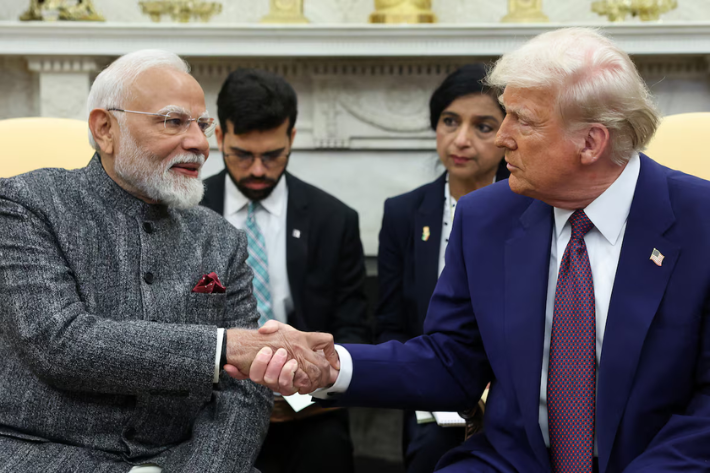
Indian stocks and currency the rupee had their best performance in months on Tuesday after U.S. President Donald Trump unexpectedly announced a deal overnight to slash trade tariffs with New Delhi.
Trump announced the deal on his social media platform Truth Social Monday after a phone call with Indian Prime Minister Narendra Modi.
He said India’s tariffs would be immediately reduced from as high as 50% to 18%, noting that India would now buy oil from the United States and possibly Venezuela.
Also on AF: India’s 20-year data center tax break faces resource crunch
While details of the deal remain scarce, the news boosted sentiment among Indian markets as well as exporters and policymakers.
Indian stocks posted their best performance in nine months, led by oil major Reliance Group and heavyweight financial stocks. Export-oriented stocks also fueled broad gains after the trade deal removed a major hurdle for the market.
India’s two major benchmark indexes were both up about 5% in early trading. At the close, the Nifty 50 index rose 2.55% to 25,727.55 points, while the BSE Sensex rose 2.54% to 83,739.13 points, marking its strongest single-day gain since May 2025.
The company’s shares rose 3.4% as tensions persisted over Mukesh Ambani’s Reliance Group, which has been hit hard in recent days over its bulk purchases of discounted Russian oil since sanctions were imposed on Moscow in 2022. Reliance Group, India’s largest private refiner, has made $6 billion in profits from importing discounted Russian oil. British “Financial Times” report last year.
The U.S.-India trade deal has fueled expectations that foreign inflows into Indian assets will accelerate after sustained outflows last year.
Deal delays, lack of investment in emerging themes such as artificial intelligence and weak earnings are the main reasons for the foreign sell-off in Indian stocks since the beginning of 2025.
At the time, foreign portfolio investors sold about $23 billion worth of Indian stocks, a rare underperformance compared with peers in Asia and emerging markets.
Vineet Arora, managing director of Singapore-based foreign investor NAV Capital Emerging Star Fund, said: “The announcement of the trade deal has really changed India’s near-term outlook and set a positive tone, which will be positive for the stock market in the short to medium term.”
Relief of Rs.
In addition to Indian stocks, the Indian currency, which suffered a heavy hit on Tuesday, also rose sharply. The Indian rupee had its best day in seven years after trading boosted sentiment and spurred traders to unwind speculative bets against the currency.
The rupee rose 1.36% to $90.2650 on the day, its best daily gain since December 2018. A few days ago, the rupee hit an all-time low of 91.9875 as companies hedged against dollar exposure and worried about foreign capital outflows.
“Price Action in NDF [non-deliverable forwards] A trader at a foreign bank told Reuters, “The market is indicating that some long (USD/INR) positions are being unwound, and the spot market is also affected by possible inflows into local equities.” The NDF allows traders to bet on the rupee without holding it.
“Higher tariffs on Indian goods increase balance of payments risks, depreciate the rupee and trigger outflows, creating a cycle of its own,” said Peeyush Mittal, portfolio manager at Matthews Asia. He added that a trade deal should break the cycle and bring stability to the rupee and the stock market.
Rupee Outlook Indicators also improved. Meanwhile, analysts at MUFG Bank lowered their USD/INR forecast to 89.50 by the end of March 2026 from 91.50, and lowered their USD/INR forecast for the end of 2026 to 93 from the previous 94.
Details of the deal are scant
Still, while the market looks optimistic, the fine print of the deal is thin.
India’s pledge to stop buying Russian oil was a key driver of Washington’s previous sharp cuts in New Delhi’s tariffs. This means that the United States will cancel the additional 25% tariff imposed on India to punish Russia for buying oil.
In fact, Indian exports to the United States now only face additional reciprocal tariffs, which Trump reduced to 18% from the previous 25%.
But the US president’s social media posts did not release details of the deal from the White House or the Indian government. Indian Prime Minister Narendra Modi later announced the deal in a post on X, but did not mention any details.
It’s a pleasure to speak with my dear friend President Trump today. I am glad that tariffs on products made in India are now reduced by 18%. On behalf of the 1.4 billion people of India, a big thank you to President Trump for announcing this wonderful news.
When two large economies and…
— Narendra Modi (@narendramodi) February 2, 2026
indian government official told ReutersHowever, India agreed to buy oil, defense products and aircraft from the United States while partially opening up its protected agricultural sector under the deal.
U.S. Agriculture Secretary Brooke Rollins also said on social media that the India-U.S. trade agreement will ensure that more U.S. agricultural products are exported to India’s huge market. He gave no details.
In the past, India’s trade deals have excluded some sensitive agricultural and dairy products as New Delhi insisted on the need to protect millions of subsistence farmers.
Meanwhile, New Delhi has also lowered tariffs on imported cars to meet Washington’s pressing demands, an Indian official told Reuters. Another official said New Delhi agreed to impose zero tariffs on industrial goods entering the country from the United States.
Trump said that India will purchase more U.S. goods, with purchases exceeding $500 billion, including energy, coal, technology and agricultural products, but did not give a specific timetable.
Indian trade officials say India will achieve this goal within five years.
Indian Trade Minister Piyush Goyal said late on Tuesday that the two countries would issue a joint statement “soon” after signing the “final understanding” of the agreement.
Call for caution
Indian government data shows that from January to November, India’s exports to the United States increased by 15.9% year-on-year to US$85.5 billion, while imports were US$46.1 billion.
Moody’s Ratings said in a statement that lower US tariffs on most Indian goods will revive exports to the US.
Indian experts also agree with this view. SC Ralhan, president of the Federation of Indian Export Organizations, told Reuters: “Reducing tariffs will not only improve price competitiveness but also help Indian exporters integrate deeper into the U.S. supply chain.”
But others said caution was needed until it became clear how the deal would work.
“Truth Society Post [by Trump] That leaves some big questions unanswered – what products are covered, what is the timeline, and whether India actually agrees to zero tariffs and zero non-tariff barriers, especially in sensitive areas like agriculture and regulated imports,” Ajay Srivastava of the Delhi-based Global Trade and Research Initiative (GTRI) think tank told bbc news.
GTRI also pointed out that Trump’s statement that New Delhi will increase imports more than tenfold in the next few years needs clarification, considering that India’s current imports from the United States are still below $50 billion.
Srivastava told the BBC: “Until there is a joint statement, a negotiating text and clear enforceability, this should be seen as a political signal rather than a trade deal. Caution is needed, not celebration.”
How India will cut Russian oil imports is also unclear.
Indian refiners need a buffer period to complete Russian oil deals before they can stop imports, which the government has not yet ordered to stop. Reuters reports.
The Kremlin said it had not seen India’s statement on stopping purchases of Russian oil.
Moody’s said an immediate halt to Russian oil imports could disrupt India’s economic growth.
“Given that India is one of the world’s largest oil importers, this could also lead to tighter supplies elsewhere, higher prices and higher inflation,” Moody’s said.
Better interest rates than peers
Still, experts believe lower interest rates will be beneficial for India.
“India’s tariff deal with the US removes its earlier disadvantage vis-à-vis other countries,” said Neelkanth Mishra, chief economist at Axis Bank.
The deal helps affected Indian gems and jewellery, leather, plastics, ceramics and auto components as well as non-technical foreign investments, he added.
Among Asian countries, the U.S. imposes 19% tariffs on Indonesian goods, while Vietnam and Bangladesh impose 20% tariffs.
Indian Economic Affairs Minister Anuradha Thakur said on Tuesday that the announcement of the trade deal has significantly reduced global uncertainty.
This sentiment is reflected in global markets, which view the U.S.-India trade deal and the resumption of U.S. nuclear talks with Iran as signs of easing geopolitical tensions.
The U.S. dollar index, which measures the greenback against a basket of currencies, was flat at 97.5 after two days of gains of 1.5%.
- Reuters, with additional editing and input by Vishakha Saxena
Also read:
Canada Carney leads trade shift away from U.S. to China, India and Australia
Modi says huge EU-India trade deal is finalized
India to ‘cut’ EU car tariffs in ‘mother of all trade deals’
India could face higher tariffs if Russia continues to buy oil
How India-US trade deal talks collapsed
India’s exports to the United States to grow by 22% in 2025
U.S. sanctions force Indian and Chinese refiners to cut Russian oil output
How US visa hike could benefit India
How Trump lost on India