The Tamesis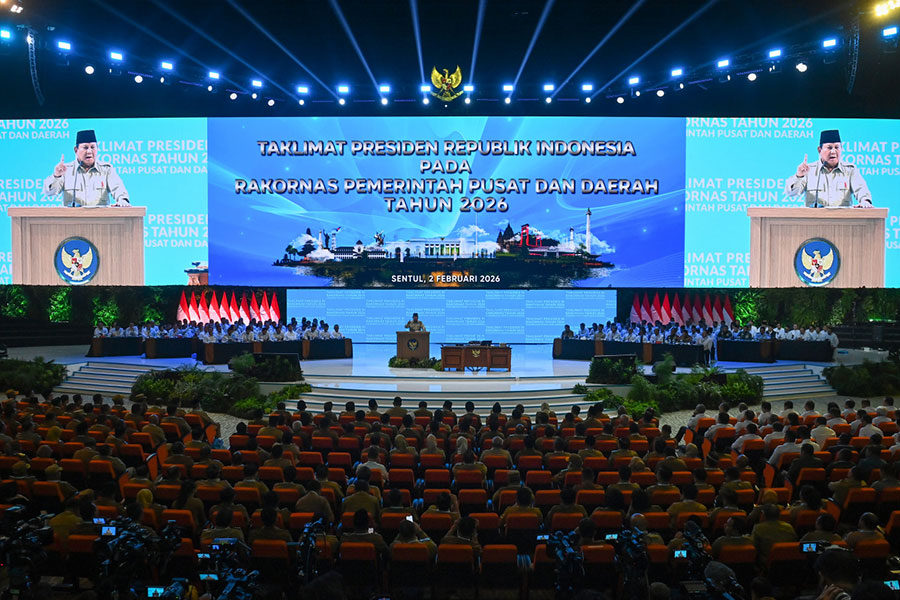
February 3, 2026
jakarta – President Prabowo Subianto maintained Indonesia’s non-aligned, non-aligned foreign policy amid intensifying regional conflicts around the world, but hinted at the harsh realities of global politics that may force him to choose sides on some international political issues.
Prabowo addressed more than 4,000 attendees, including members of his cabinet and regional leaders from Aceh to Papua, for 90 minutes at a national coordination meeting of governors, mayors and regents in Bogor, West Java, on Monday.
In his speech, the president touted his administration’s achievements and goals for the year, including flagship programs such as providing free meals to schoolchildren and nursing mothers across the country.
Citing his recent discussions with world leaders at the World Economic Forum in Davos, Switzerland, Prabowo also warned that Indonesia was in a precarious position amid rising tensions between hostile global powers and the looming risk of a world war.
“There has been concern at the international level [potential] World War III involves nuclear war [weapons]. If this happens, Indonesia may be affected even if we are not involved [in the conflict]”, Prabowo said on Monday, warning that a nuclear winter could affect the country’s environment.
Despite the turbulent world situation, the president reaffirmed Indonesia’s non-aligned and non-bloc foreign policy and declared that the country “will not join any military treaty.”
“My foreign policy philosophy is that a thousand friends are too few and one enemy is too many,” he added.
However, the president warned that strict adherence to non-alignment principles could leave Indonesia vulnerable to attacks by foreign powers, noting that the country must stand alone.
“If we want to be truly non-bloc, if we want to be friends with everyone, that means we are on our own. If we are threatened or attacked, no one will help us,” Prabowo said. “Today’s reality is that the strong [nations] will rule and the weak will suffer […] So, as president, it’s my responsibility to protect this country. “
contradictions
Analysts said Prabowo’s comments appeared to reflect Prabowo’s recent foreign policy strategy, which includes Indonesia’s participation in the Peace Council, a U.S.-led Gaza reconstruction initiative that has faced backlash due to the lack of Palestinian participation.
The move was criticized as “hasty” and analysts questioned whether Jakarta would be forced to adopt such a stance as it continues talks with Washington over an ongoing tariff-based trade deal.
Andrea Abdel Rahman Aziz, an international relations expert at Budirur University, questioned the president’s characterization of non-alignment as strategic isolation, saying today’s international system is multipolar.
“It’s not entirely true that if we are truly non-aligned then no one can help Indonesia, […] Middle powers can be flexible and pragmatic,” Andrea told The Jakarta Post on Monday.
Andrea took issue with Indonesia’s choice of alliances, saying the government should choose “areas that benefit Indonesia’s national interests.”
“The President, through the Peace Council, is actually committing an act that is a clear violation of one of the priorities of our Constitution,” he added, citing the 1945 Constitution’s rejection of all forms of colonialism in the world.
International relations expert Ahmed Rizki Omar echoed similar sentiments, noting that despite Prabowo’s non-alignment statement, the peace commission actually brought Indonesia closer to the United States than most countries opposed to the project.
“In many ways, Indonesia has been under geopolitical guidance and pressure from the United States. [US President] Donald Trump did that through tariffs, making a lot of demands on what Indonesia must do,” Ahmed said.
“Prabowo later said that a thousand friends are too few and one enemy is too many, and that’s the risk that arises,” Ahmed said.
In his speech, Prabowo said that the answer to global uncertainty lies in national self-reliance, noting that if the country wants to “stand on the world, self-sufficiency in food and energy is the foundation of the country’s future.” [its] own feet”.
One of the factors he considers strategic is the country’s palm oil industry, which he says can help wean Indonesia off its dependence on other countries.
“Some groups have been laughing at me, asking ‘What is Prabowo’s? [deal with] Palm oil? “But I have visited several countries in the world, and almost all heads of state have asked Indonesia to help supply palm oil to them,” Prabhawo said. “
Indonesia is the world’s largest palm oil producer, and Prabowo’s government plans to take over up to 5 million hectares of oil palm plantations operating illegally in forested areas this year. Many are worried that these plantations may interrupt production and lead to higher global prices.