The Tamesis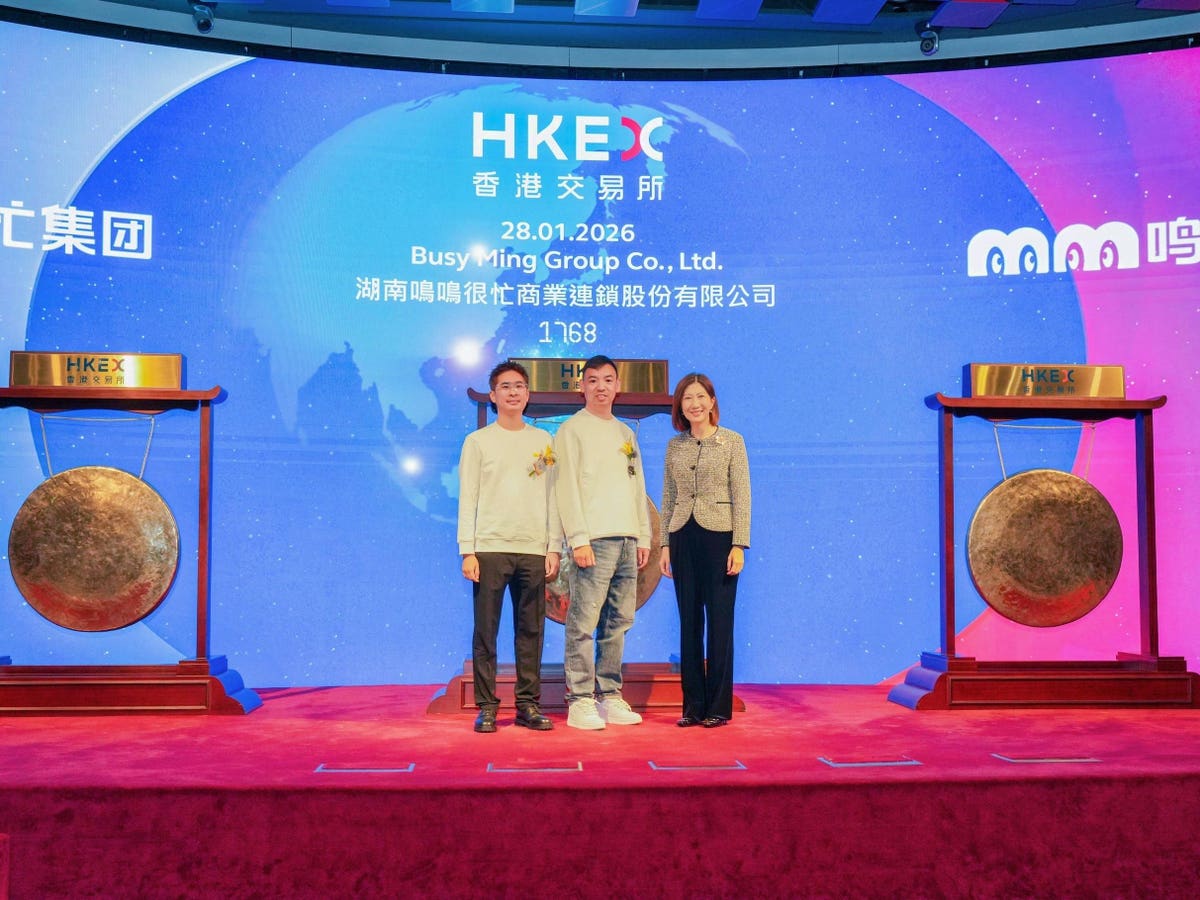
From left are Vice Chairman Zhao Ding, Chairman Zhou Yan and Chief Executive Officer of Hong Kong Exchanges and Clearing, Karen Chan.
Provided by Busy Ming
Baidu Ming Group, a Chinese snack retailer known for its low-priced products, performed well in its Hong Kong listing on Wednesday, with shares soaring more than 70% from its initial public offering price and has spawned two billionaires.
The two new members of the Three Comma Club are Yan Zhou and Zhao Ding. according to Forbes Chairman Yan, 38, is estimated to have a fortune of $3.1 billion, while deputy chairman Zhao, 36, has a net worth of $2 billion. Both men’s fortunes come from stakes in the Changsha, Hunan-based retailer.
Busy Ming raised HK$3.7 billion (US$470 million) in the IPO and sold 15.5 million shares at HK$236.6 each, at the upper end of its listing range. The company plans to use the proceeds to upgrade its supply chain and stores and step up promotional activities, according to its prospectus. The stock issuance attracted cornerstone investors including BlackRock, Tencent and Temasek, and its retail portion was oversubscribed nearly 1,900 times.
The company did not respond to an emailed request for comment on Yan and Zhao’s wealth. Kenny Ng, securities strategist at Everbright Securities International in Hong Kong, said in a message sent via WeChat that investors are optimistic about Busy Ming’s prospects due to its low-cost strategy.
For example, the retailer’s offerings include a 54-gram box of chocolate chip cookies for $2.90 (40 cents) and a 500-gram bag of roasted cashews for $49.90.
Its prices are typically 25% cheaper than supermarkets, analyst Arun George, who publishes through the Smartkarma research platform, wrote in a January research note. Everbright’s Wu said this makes Mangming less vulnerable to China’s consumption downturn as households tighten their belts amid a protracted real estate slump and a weak social safety net.
“Busy Ming has grown exponentially over the past few years,” Ng said. “Investors believe the company has an opportunity to sustain this growth in the near term.”
Wu said the retailer should be able to grow quickly this year and next. According to its prospectus, sales in the first nine months of 2025 increased by 75.2% year-on-year to 46 billion yuan (the latest financial results), and net profit more than tripled to 1.6 billion yuan in the same period. Busy Ming has about 20,000 stores in China, most of which are located in lower-tier cities and towns.
The company may have its sights on a low-cost strategy from day one. Yan founded snack brand Busy for You in Changsha in 2017, while Zhao founded his own snack retailer Chaoming in 2019 in Yichun City, southeastern Jiangxi Province. The two companies merged in 2023 to become Busy Ming, which continues to be sold under both brands.
In an interview with local media in January Evening NewsYan said he wanted to create an affordable snack brand for the masses. The tycoon recalled growing up in a rural village in his native Hunan province and how people there loved small, affordable snacks.
According to local media reports, Zhao saw similar opportunities 36 krypton. According to reports, he started his business after dropping out of high school and started selling snacks as early as 2008. 36 krypton Report. After the merger, Mangming raised funds from investors Sequoia Capital Group (formerly Sequoia Capital China), 5Y Capital and Gaorong Venture Partners, and then went public.
“Our founders, Mr. Zhou Yan and Mr. Zhao Ding, are young and insightful entrepreneurs,” the company wrote in its prospectus. “Through precise positioning of consumer groups, innovative business models and disruptive supply chain systems, they have provided consumers with cost-effective products.”