The Tamesis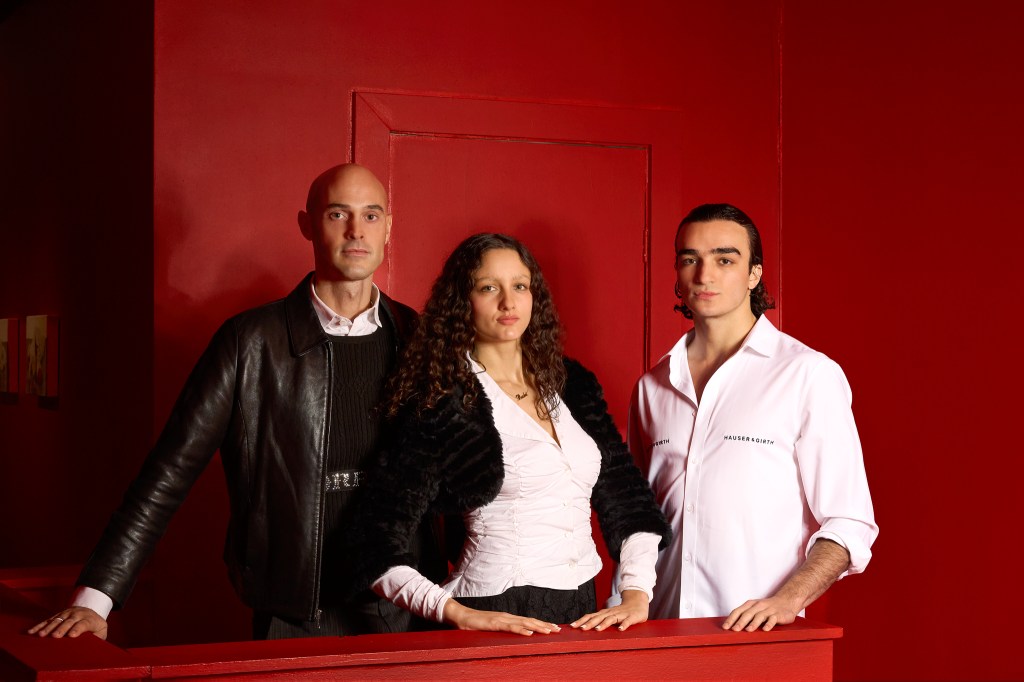
A gust of cold wind swept through lower Manhattan, whizzing past shuttered storefronts that once housed small galleries (some victims of the rental crisis) before losing its force at the corner of Broome and Christie Streets. There, a different kind of market experiment took shape. Last year, the nomadic curatorial project Spielzeug Gallery transformed into a brick-and-mortar commercial gallery tested a model that would be almost anachronistic compared to Tribeca: chaos is not a gesture but the result of combining joy and survival in the same space. After all, the purpose is contained in the name itself. Gallery name It means “toy” in German.
Related articles

“Toys have always come with the idea of control,” said Evan Karas, director and founder of Spielzeug. “Toys are about working with your hands—taking Barbie apart. As children, we rely on objects to understand reality. That intensity never really goes away in adulthood; it just turns into a psychosexual thing.”
Karas’ first exhibition at the Christie Street space, aptly titled “Toys! Toys! Toys!” is a veritable treatise on this idea. It felt less like a showroom than a spatial rift: Strange objects and kinetic devices slumped against or grew out of the crimson walls, while a giant mutant clown by Thomas Liu Le Lann sprawled on the floor, challenging the dense, multigenerational opening-night crowd—friends, family, and New York night crawlers alike—to dodge, duck, or simply back away.
Spielzeug settled at 131 Christie Street through a partnership with 1 Day at a Time, a flexible business that provides nomadic creatives with practical services to ensure they get a foothold in New York City—not so much a guarantee of success as a way to provide what the rental crisis has made all but impossible: space to grow. Jordan Harper White, one of the organization’s founders, describes its behind-the-scenes work as “manufacturing legitimacy,” a way of answering an extremely simple investment question: Will this gallery still be here tomorrow?
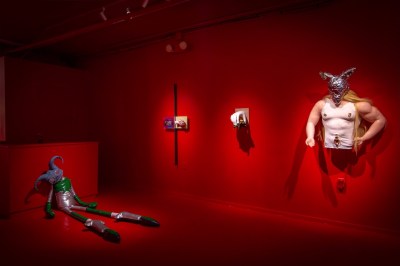
Installation shots include Josh Rabineau’s Nipples Are Windows to the Soul (2025) and Thomas Liu Le Lann’s Mace (2021)
Courtesy Spielzeug Gallery
In a gallery, nothing seems immune to failure. From the wall, emerged the upper half of a silicon figure—half human, half creature—with long blond hair and a chrome deer head. title Nipples are the windows to the soul (2025) by Josh Rabineau invites visitors to peer through a peephole in the chest. On the other side of the room, a small ceramic traffic policeman by Michelle Im faced the obscene door, “a simulated soul trapped in a sign of authoritarian submission,” as Callas described it, trembling. “It’s terrible.”
Karas, 25, who grew up in Chicago, arrived in New York in the summer of 2021. Art fell into his orbit almost by accident: after a brief internship at the Marc Straus Gallery, an encounter with the Hungarian painter Diki Luckerson inspired Spielzeug’s vision. However, it was in the years before art – hopping between the fields of hospitality and interior design – that a sensitivity to the interplay between atmosphere, object and container developed. This sensibility guides Spilzeger’s curatorial model, which he describes as a “fluid fantasy”: venues include a remote Czech bunker, a party bus and a Bushwick apartment (which hosted Dickie Luxon’s “Lychee on the Poison Tree,” a show of stained, semi-abstract paintings of bodies bubbling and bleeding in a prism of color and desire.) There is release, Callas says, and then there is something even rarer: total surrender.
“These objects make me feel less alone in my body,” Karas said. By pairing them with the right place, he adds, “there’s a sense of opening up a whole realm of imagination – a beautiful escapism where one feels re-embodied in the super-materiality of it all.”
Spielzeug’s ethos seems fragile in 2026, but it fits naturally into the lineage of New York’s alternative exhibition spaces. From the loose alliance of artists who converted 112 Green Street in Soho into a temporary venue in the 1970s, to the more pointed comparisons of Colin de Land’s American Fine Arts, Co., experimentation often thrives under deliberately unstable conditions. Deland operates the AFA as an alchemical hybrid – part salon, part gallery, part archive, part intellectual provocation – that operates across liminal spaces to resist the fixity of the art supermarket.
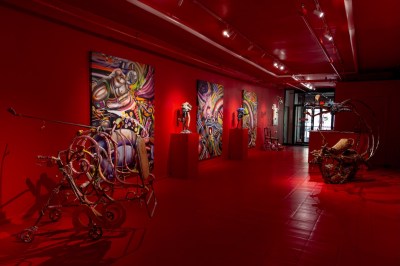
Installation photos from the exhibition “The End,” starring Dickie Luxon, Reka Horvath, Rosalie Smith, Daniel Giordano and Ennio Arroyo Gomez, described as “an unnatural history museum with apocalyptic features.”
It’s not the impulse that changes, it’s the terrain. Today, Callas has peers—he cites the Alyssa Davis Gallery among the many personality-driven, conceptually flexible spaces—but according to some, the space for wandering or improvisation is shrinking. allergic It’s estimated that New York has lost about 60 small venues in the past three years, including Clearing, JTT, Queer Thoughts and the nonprofit Canal Projects.
Harper White and his professional collaborator and partner Isabelle Rose Basha say 1 Day at a Time operates within this chaos. He is a trained graphic designer; she is a performance artist. They combine the fluidity of logic with an intuitive sense of how artists actually come together and support each other.
“The idea is to share resources with curators and artists without gatekeeping or putting our egos first,” Basha said. “The more we can break down these walls, the more empowered everyone in the art world will be.”
Today’s organization grew out of a Covid-era digital art consultancy that produced 3D walkthroughs of gallery and museum exhibitions, carefully representing the ephemeral and material qualities of art in a moment when physical access disappeared. Nearly six years later, it’s hard to imagine, but that’s how virtual walkthroughs came to be, and Harper White played a role in making it what it is today: an industry expectation. (For example, “Toys! Toys! Toys!” can be explored virtually here .) His early clients included the Brandt Foundation, The Shed, and later Art Basel Miami Beach.
But his and Basha’s career priorities eventually shifted, when participation in New Inc, the New Museum’s mentoring program for digital experimentalists, opened the door to artist management: at one point they were consulting with about 40 artists at a time. Today, One Day at a Time develops a residency and exhibition program that guides an otherwise porous practice toward professionalization. Spielzeug has always had a keen eye for talent—Sophie Jung’s Wahrzeichen (2023), which was on display at the Basel Social Club, was acquired by the Kunstmuseum Basel—but even a stint working in a brick-and-mortar store, rather than purely touring, proved to be an illuminating learning curve.
“It’s resolving a paradox,” said Harper White. “Teach out-of-the-box projects business frameworks so that they can reach a certain level of market appreciation.” In addition to commercial uses, Harper-White adds, virtual walkthroughs can also serve as an access tool — opening the exhibition to visitors who might never walk through the door — and as a tool for reflection. For curators like Callas, new to the room, revisiting decisions after the party has become a reality.
What ensues is a familiar New York paradox: Can ad hoc practices be given more time in the world without losing the spontaneity that makes them noteworthy? No matter what happens, this is a game Spielzeug will play.