The Tamesis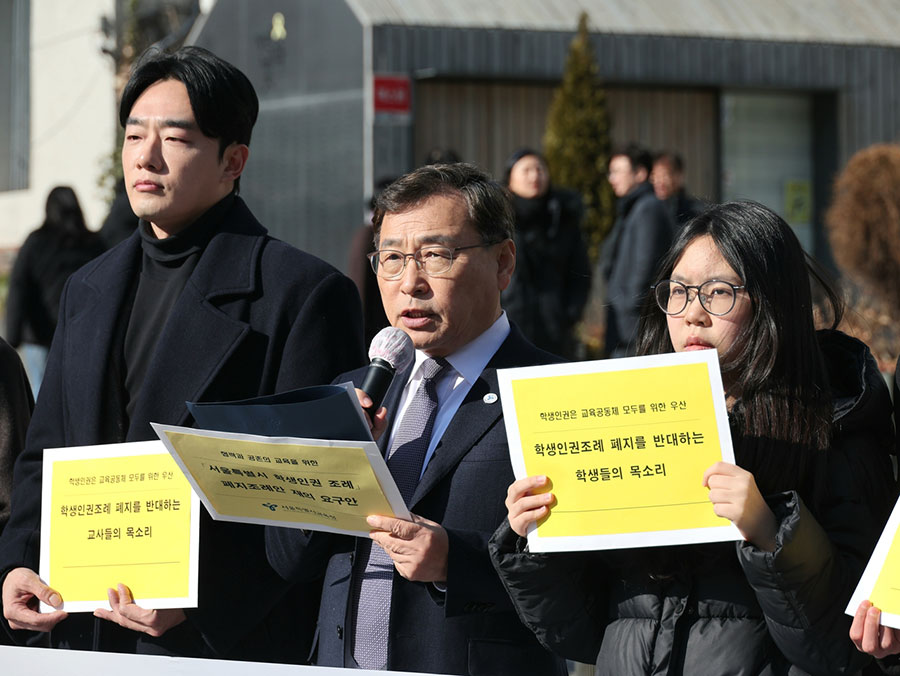
January 26, 2026
Seoul – The location of the Seoul Metropolitan Office of Education’s annual Student Rights Memorial Day event has become the subject of political controversy, with accusations that city council members exerted what they called “unfair pressure” to change the location.
Members from the Seoul City Council’s conservative People’s Power Party, the majority party, reportedly requested that the event be moved from the assembly hall’s auditorium. Due to last-minute complications, SMOE told reporters three days before the event that “the venue will be confirmed later”.
Local online outlet OhmyNews reported on Sunday that officials from the education office and city council confirmed the alleged pressure.
A coalition of 200 education and human rights groups in South Korea, which share the common goal of protecting the Seoul Student Human Rights Ordinance, issued a statement on Sunday condemning what members of the People’s Power Party board of directors called unfair administrative interference. They called on the Conservatives to apologize for the encounter and urged SMOE to move forward with the event as planned.
The controversy comes amid a long-running impasse between the Office of Education and the Board of Governors over the repeal of the Student Human Rights Ordinance, a municipal code that protects students from discrimination based on gender, religion, family structure, gender identity and sexual orientation.
While the decree itself has been widely debated, the latest controversy signals a shift in the way the conflict unfolds: away from legislation and towards the realm of civic activity and symbolic space.
Why Conservative Members of Parliament Oppose
The Seoul Metropolitan Office of Education decided to hold the event at the Assembly Hall for the first time this year, away from previous venues such as the Education Office itself, the Seoul City Hall Building and the Seoul Museum of History.
Although the Department of Education did not explain why the board’s auditorium was chosen as the venue, the decision came a month after the board voted to repeal the Student Human Rights Ordinance for the second time on December 16. On the same day, Seoul Education Director Jung Geun-sik visited the committee in protest.
On January 5, Jung formally asked the council to reconsider its decision to repeal the decree, warning that the move violated the constitution and higher-level laws. The committee must now pass the repeal bill again with a two-thirds majority.
“The Seoul City Council and the Education Office have been cooperating so far, but considering that the repeal ordinance has passed the plenary session, shouldn’t they ask for our understanding before hosting this event here?” a People Power Party council member named in the accusation told local media.
“What about this pressure? It’s within a reasonable range.” the committee member added.
Meanwhile, members of the liberal bloc have also expressed concerns.
“The auditorium does not belong to members,” one Democratic lawmaker said. “I can’t understand why they would do this, especially when so many students will be attending the event.”
“Members of the People’s Power Party council felt the event was inappropriate because the ordinance has been repealed,” said Democratic Rep. Kang Min-jung, who plans to run for Seoul education director in the June election. “But students have human rights whether that regulation exists or not.”
Politics outside the chamber
The move by the conservative bloc is widely seen as an expression of opposition through administrative leverage, exerting direct and indirect control over licenses and venues, similar to similar situations in other countries.
In March 2025, a North Carolina school board faced a lawsuit for banning a student club from hosting a trivia night aimed at raising awareness about sexual minorities.
The University of Hong Kong recently drew criticism after it refused to provide students with a place to mourn victims of a deadly apartment fire that killed more than 160 people over concerns about “social instability.”
Similar controversies have arisen in South Korea. In 2023, authorities in Seoul and Daegu sparked an international backlash when they refused to provide venues for LGBTQ+ Pride events and imposed fines.
Some political scientists accuse this use of legal and institutional prerogatives—exercised without mutual restraints—as a way to erode democracy.
In a 2023 fireside chat hosted by the University of Chicago Harris School of Public Policy, Harvard political scientist Steven Levitsky said democratic backsliding often begins not when institutional power disappears, but when politicians lose restraint in using power.
“We see political leaders systematically using the letter of the law to subvert its spirit,” Levitsky said. “To prevent this from happening, it is critical that politicians on both sides of the aisle share a commitment to restraint.”
Legal scholar Ozan Varol, a professor at Lewis & Clark Law School, made a similar point, arguing that seemingly legal actions can be used to deter political opponents and their agendas.
“[Politicians]cover repressive actions under the mask of law, giving them a veneer of legitimacy and making anti-democratic behavior harder to detect,” Varol wrote.
However, members of the People’s Power party council said the liberal bloc failed to show mutual restraint.
“(The Seoul Education Office) needs to show mutual respect, but it is inappropriate to hold such an event at the city council,” said a party member.
The Seoul Metropolitan Office of Education informed reporters on Friday that it intends to hold the event at the Seoul City Council as planned. The Office of Education reiterated that there would be no change of venue to local media on Sunday.
Since the auditorium is managed by the Seoul Metropolitan Government, the city council has no power to force a change of venue. The Office of Education has confirmed that it has obtained the necessary permissions to use the space.