The Tamesis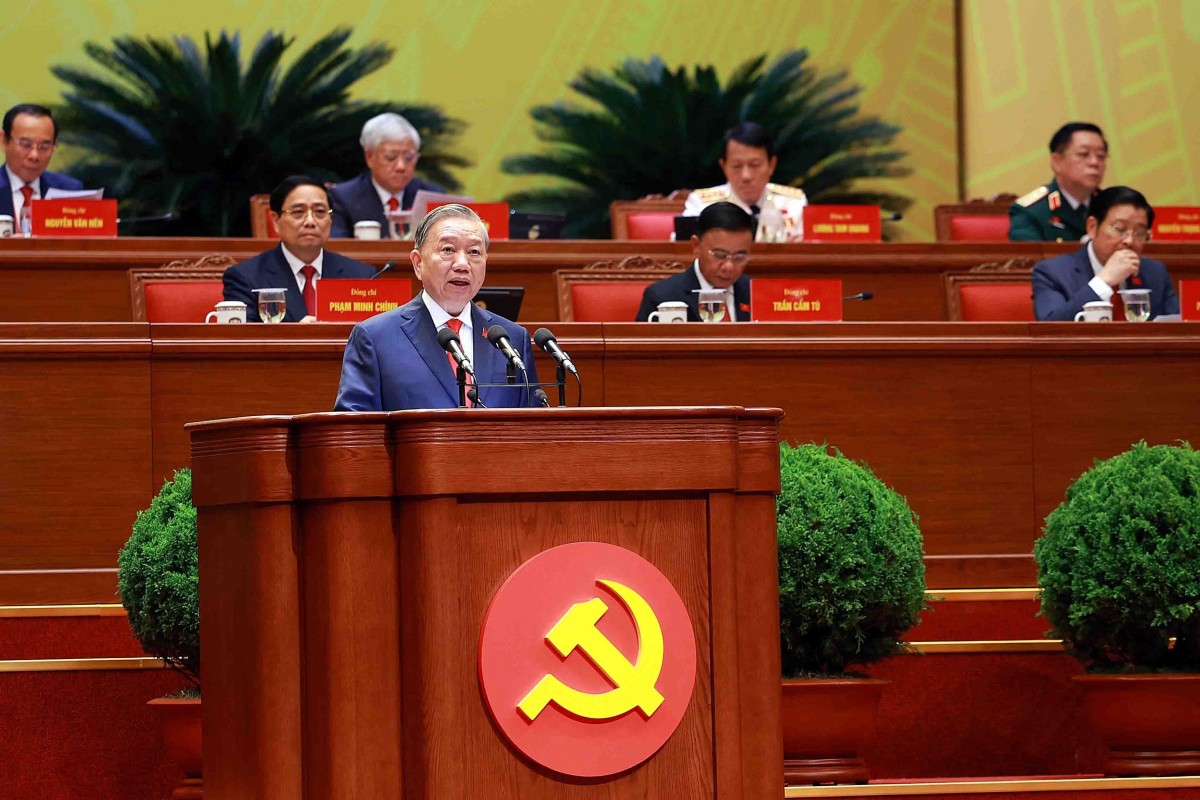
Promoting a “self-reliant economy”
A central figure at the congress is current Communist Party General Secretary To Lam, who was elevated to the country’s top leadership in August 2024 following the death of former leader Nguyen Phu Trong. Lin Dulin is currently seeking a full five-year term in the current General Assembly.
He is widely regarded as a risk-taking leader. Since taking office, To Lam has launched Vietnam’s most sweeping bureaucratic reforms in decades – merging provinces, reducing the number of ministries and slashing tens of thousands of public sector jobs to speed up national decision-making.
While the overall impact will take time to assess as civil servants adjust, approval times for some investment projects have been significantly shortened.
At the same time, he has pursued a new economic strategy that promotes the private sector as the country’s main growth engine while reducing reliance on foreign direct investment and purely export-led growth.
The ultimate goal of these reforms is to elevate Vietnam to a developed country by 2045. The government aims to achieve economic growth of “at least 10%” between 2026 and 2030, following growth of around 8% last year.
Speaking at the conference, To Lam said that Vietnam regards science, technology, innovation and digital transformation as the main driving forces for future growth.
He also outlined Vietnam’s ambition to become an international financial center while accelerating the development of ports, logistics centers and airports, as well as strengthening self-reliance in technology and supply chains, especially strategic industries.
He emphasized that “modern security” transcends borders and territorial sovereignty and includes political systems, culture, ideology, economy, finance, data, energy, water and food security.
Echoes of the China Model
Assistant Professor Morragotwong Phumplab, deputy director of research and academic services at Thammasat University, previously told Krungthep Turakij that Vietnam’s economic strategy is increasingly similar to that of China, especially in terms of balancing domestic and foreign markets rather than over-reliance on any single pillar.
She said Vietnam was clearly trying to upgrade its industrial base – from contract manufacturing of basic goods such as clothing and footwear to high-tech production including semiconductors and artificial intelligence – following the path China had taken.
However, Vietnam still differs from China in terms of state control. The Vietnamese government maintains stricter supervision of the economy and has established strict joint investment laws and conditions. This underscores the state’s continued grip on power despite welcoming foreign investors.
From cheap labor to value creation
In recent years, Vietnam has become a key node in global supply chains as multinational companies shift production away from China to reduce the impact of the Sino-US trade war. The U.S. market currently accounts for nearly one-third of Vietnam’s total exports.
However, the Trump administration’s tariffs have accelerated Hanoi’s need to rethink its traditional economic model.
“Vietnam needs to add more value to its exports rather than rely on cheap labor and foreign capital,” said Carlyle Thayer, a Vietnam expert at the University of New South Wales in Canberra and the author of several books on Vietnam. He described the shift as a “structural transformation of the economy and society.”
Possible move towards single leader rule
Vietnam currently implements a “four-pillar collective leadership” system, including the Party General Secretary, the President, the Prime Minister and the Speaker of the National Assembly. Media reports said Lin Tao may seek to serve as both general secretary and chairman.
Analysts pointed out that Dulin has continued to consolidate political power in recent years. Before becoming party leader in 2024, he served as public security minister and spearheaded a broad anti-corruption campaign that triggered unprecedented political unrest and saw hundreds of officials, including senior party officials, arrested and prosecuted.
Internal power games and rumors continue
Despite the party’s efforts to achieve unity, Vietnam’s one-party system – characterized by state secrecy and restrictions on media freedom – has fueled persistent rumors and speculation at home and abroad.
Dr. Hai Hong Nguyen, senior lecturer in politics, social change and international relations at VinUniversity, said rumors have been spreading in recent months surrounding the political futures of several top leaders, including Surin. Chairman Luong Qiang; Prime Minister of the Government of Vietnam Pham Minh Zheng; and Minister of Defense Phan Van Giang.
Under new party rules, leaders who meet the age threshold are expected to step down when the congress convenes. To Lam and Luong Cuong are both 68 years old, while Pham Minh Chinh is 67 years old. All three meet the retirement criteria. Phan Van Giang is 65 years old and is still eligible to continue competing.
However, an unofficial list leaked ahead of the 15th plenum paints a different picture. One list omitted Luong Cuong and suggested To Lam, Phan Van Giang and Pham Minh Chinh as general secretary of the Communist Party of Vietnam, president and prime minister respectively.
Another list retained Su Lin and Pan Wenjiang in their current positions, but replaced Fan Mingzheng with Liming Hsiung, a 17-year-old party leader with a financial background.
There has also been speculation that Dulin could serve as both party general secretary and president, echoing China’s model under Xi Jinping.
If such centralization occurs, the party may face resistance from conservative factions and may need to amend its rules and constitution to create clearer inspection and accountability mechanisms.
Stability as a ‘premium’ for investors
A clearer power structure is not necessarily a negative for foreign investors.
“The way Vietnam is currently managed is akin to a multi-stakeholder partnership. Centralization of power could make decisions similar to those of a CEO, which some investors don’t see as a bad thing,” said Dominic Scriven, founder of Dragon Capital. “The real enemy of economic ambition is uncertainty, not authority.”
After more than 40 years of reform and opening up, Vietnam has escaped poverty and become one of the largest economies in ASEAN. Trade volume will exceed US$930 billion in 2025, while the poverty rate has dropped to around 1.3%.
However, party leaders are keenly aware that legitimacy in today’s world is measured not by manifestos on paper but by tangible results for citizens.
As former General Secretary of the Communist Party of Vietnam Central Committee Nguyen Phu Trong once said: “The Party Congress can be considered a success only when its resolutions are translated into prosperity and better living standards for the people.”
This is the ultimate test facing Vietnam’s next generation of leaders.