The Tamesis
January 21, 2026
HANOI – The 14th National Congress of the Communist Party of Việt Nam opened in Hà Nội on Tuesday with a solemn ceremony that brought together national leaders, former senior officials and 1,586 delegates to chart the country’s development direction for the coming decades.
After the flag-salute ceremony, Politburo member and Permanent member of the Party Central Committee’s Secretariat Trần Cẩm Tú announced the agenda and introduced distinguished participants, including former General Secretary Nông Đức Mạnh; former Presidents Nguyễn Minh Triết and Trương Tấn Sang; former Prime Minister Nguyễn Tấn Dũng; and former National Assembly Chairmen Nguyễn Văn An, Nguyễn Sinh Hùng and former NA Chairwoman Nguyễn Thị Kim Ngân.
The Congress also welcomed Heroic Mothers of Việt Nam, 16 representatives of intellectuals, artists, religious dignitaries and outstanding young Vietnamese, along with ambassadors, heads of diplomatic missions and representatives of international organisations in Việt Nam.
In his opening address, President Lương Cường emphasised the significance of the 14th National Congress as a momentous political event for the country, marking a historic turning point as the country looks ahead to the centenary of the Communist Party of Việt Nam in 2030.
The President noted that during the last tenure the country successfully fulfilled the goals set by the 13th Congress, including revolutionary breakthroughs in 2025. He highlighted major achievements in socio-economic development, culture, human development, strengthened national defence and security, and more dynamic foreign affairs and international integration. The Party’s efforts in building and rectifying a clean, strong political system, and in combating corruption, wastefulness and negative practices, have consolidated public trust and social consensus.
The President stressed that the 14th Congress was taking place amid rapid, complex and unpredictable global and regional developments, including intensified strategic competition among major powers. The fourth industrial revolution, particularly the explosive growth of artificial intelligence, digital technology, quantum technology and emerging innovations, was reshaping every aspect of economic and social life.
“These trends create urgent demands for new development and growth models, higher labour productivity, enhanced national competitiveness and new approaches to social governance, defence, security and external relations,” he remarked.
Looking back on 40 years of Đổi mới, the President affirmed that Việt Nam had achieved monumental, comprehensive and historically significant progress, though major challenges remain. Growth had yet to reach its full potential and lacked long-term sustainability; labour productivity and economic competitiveness remained limited; and a portion of the population continued to face difficulties. Climate change, natural disasters, disease and cybersecurity threats also posed complex risks, he said.
The 14th Congress carries a profound and historic mission: not only setting orientations for 2026–2030 but also deciding strategic issues that will shape the nation’s future over the coming decades, according to the President. It will review the implementation of the 13th Congress’s Resolution in tandem with 40 years of đổi mới, affirm key accomplishments, identify shortcomings and their causes and draw major theoretical and practical lessons. Delegates will debate and adopt development objectives and strategic breakthroughs for 2026–2030, with a vision to 2045, emphasising transformative measures for rapid, sustainable development and the steadfast protection of the Fatherland.
The Congress will also undertake a comprehensive review of Party building and rectification to strengthen the Party and the political system in a clean and robust manner. Finally, it will elect the 14th Party Central Committee, whose members must exemplify revolutionary ethics, intellect, mettle and leadership capacity, worthy of leading the effective implementation of the demanding tasks entrusted by the Party, the State and the People in the new term.
“The 14th Congress marks the beginning of a new era of national development. It reflects the unwavering resolve and collective will of the entire nation to strive for a Việt Nam that is peaceful, independent, democratic, prosperous, civilised and happy,” President Lương Cường affirmed.
Key orientations for Việt Nam’s next development phase
Presenting the key documents submitted to the Congress, General Secretary Tô Lâm underscored the historic significance of the Congress, calling it a landmark event for the entire Party, people and armed forces. It would mark the start of a new phase of national development amid new contexts and goals, reflecting strategic autonomy, self-reliance, patriotism, national pride and an unwavering belief in the path chosen by the Party, President Hồ Chí Minh and the Vietnamese people.
The General Secretary highlighted that the Congress was taking place at a deeply meaningful moment as the Party and nation unite in advancing toward two strategic milestones: the centenary of the Communist Party of Việt Nam (1930–2030) and the centenary of the founding of the Democratic Republic of Việt Nam, now the Socialist Republic of Việt Nam (1945–2045).
He called for an honest and accurate assessment of the situation, renewed thinking, institutional reform and enhanced national governance, alongside bold and effective action to build a peaceful, independent, democratic, prosperous, civilised and happy Việt Nam moving confidently towards socialism.
The set of draft documents includes the Draft Political Report of the 13th Party Central Committee; the Draft Summary Report on theoretical and practical issues after 40 years of socialist-oriented Đổi mới; and the Draft Report reviewing 15 years of implementing the Party Statute (2011–2025) with proposed amendments. Notably, the Draft Political Report integrates three major reports on political, socio-economic, and Party building into a unified, concise and coherent document.
The action programme for implementing the 14th Congress’s Resolution is described as a “breakthrough”, specifying responsibilities, timelines, resources and goals.
A defining feature of this Congress’s documents, the General Secretary said, was the emphasis on action: words must be matched with deeds; goals, responsibilities and outcomes must be clearly defined; breakthroughs must align with sustainability; and accountability must be linked with public satisfaction.
A nation rising: Việt Nam’s achievements draw global attention
The General Secretary reviewed the extraordinary challenges of the 13th tenure, including natural disasters, pandemics, traditional and non-traditional security risks, global supply chain disruptions, and long-standing internal issues.
In times of adversity, he said, the Party demonstrated strong leadership, unity, innovation and decisive action.
The 13th tenure recorded “very important, comprehensive and groundbreaking” results, the Party leader said.
Việt Nam weathered difficulties, maintained macroeconomic stability, sustained growth, strengthened resilience and created a foundation for stronger, more sustainable development ahead. Major breakthroughs in institutional and administrative reform opened new development space, while the anti-corruption campaign achieved significant progress, reinforcing public trust and political discipline.
Human development advanced, with improvements in material and spiritual well-being. National independence, sovereignty and territorial integrity were firmly safeguarded; peace and social stability maintained; defence, security and order guaranteed; and foreign affairs and international integration expanded in breadth and depth. Việt Nam’s global standing continued to rise.
“Public trust in the Party, State and regime continues to strengthen, forming a solid basis for the next phase of development with renewed momentum and aspiration,” he said.
However, he also emphasised that challenges and bottlenecks remained, particularly institutional shortcomings, limited resources and infrastructure, and inadequate enforcement capacity in some areas.
Reflecting on 40 years of đổi mới, the General Secretary outlined five major lessons, including steadfastness in national independence linked with socialism, ensuring stability through development and vice versa; improving people’s well-being, safeguarding national interests, and proactive integration into global political, economic and cultural life.
He stressed building a streamlined, efficient political system; combating corruption, wastefulness and negative behaviour; and developing a strong cadre contingent, especially at the strategic level, grounded in morality, competence and public trust.
“We must thoroughly grasp and fully uphold the principle that the people are the root, promoting their central role and agency. We must continue to strengthen and harness the power of the people and the great national unity bloc,” the General Secretary said, stressing the need to respect objective laws and guard against subjectivism, voluntarism, dogmatism, opportunism and conservatism.
Profound shift in development mindset
Emphasising that the drafting of the documents must embody a spirit of openness, scientific rigour and action, General Secretary Tô Lâm outlined core principles.
The documents reiterate absolute loyalty to the Party’s line and Platform, and the creative application and development of Marxism–Leninism and Hồ Chí Minh Thought. They stress the importance of inheriting and promoting the nation’s millennia-old cultural heritage, as well as the achievements and collective wisdom of the entire Party, people and armed forces in the cause of building, developing and safeguarding the Socialist Republic of Việt Nam.
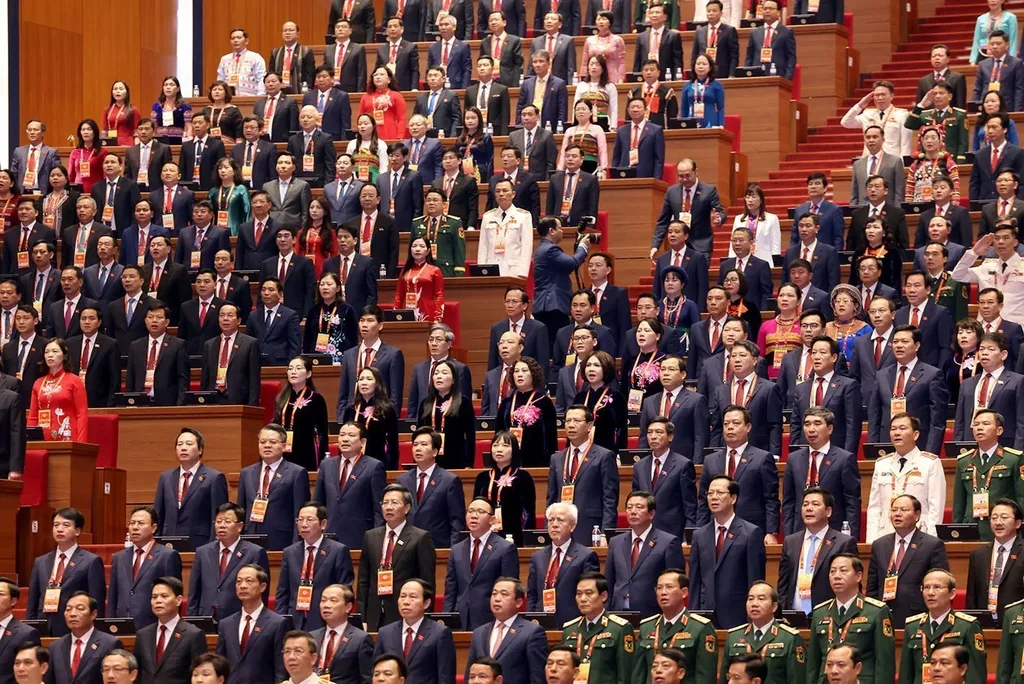
Delegates attend the opening session of the 14th National Party Congress.
They reflect strong renewal in thinking regarding development, identifying science, technology, innovation and digital transformation as central drivers; modern institutions and high-quality human resources as foundations; and green, sustainable and efficient development as essential requirements.
Effective implementation is highlighted as a decisive factor. Even the most well-designed policies, he warned, would remain “on paper” if execution is slow or inconsistent. The documents therefore prioritise action plans, monitoring mechanisms and performance evaluation, emphasising data and public feedback as key tools for policy adjustment.
The documents also underscore the need for Party members, particularly leader, to set examples; uphold discipline; persevere in combating corruption; and foster an environment encouraging innovation and responsible action for the common good.
Việt Nam to establish a new growth model
The General Secretary outlined Việt Nam’s overarching goals for 2026–2030: to maintain peace and stability; pursue rapid and sustainable development; enhance living standards; consolidate strategic autonomy; and move confidently into a new era of national rise. The aim is to become a developing country with modern industry and upper-middle-income status by 2030, and a developed, high-income nation by 2045.
He stated that Việt Nam would strive for average annual GDP growth of at least 10 per cent from 2026 to 2030, with GDP per capita reaching approximately US$8,500 by 2030.
To realise the goals set out, the Draft Political Report identifies 12 major orientations, 6 key tasks and 3 strategic breakthroughs. The action programme translates these into measures ready for immediate implementation. Its core spirit is distilled into eight essential points, centred on the requirement to choose correctly, act swiftly, complete decisively and measure by results.
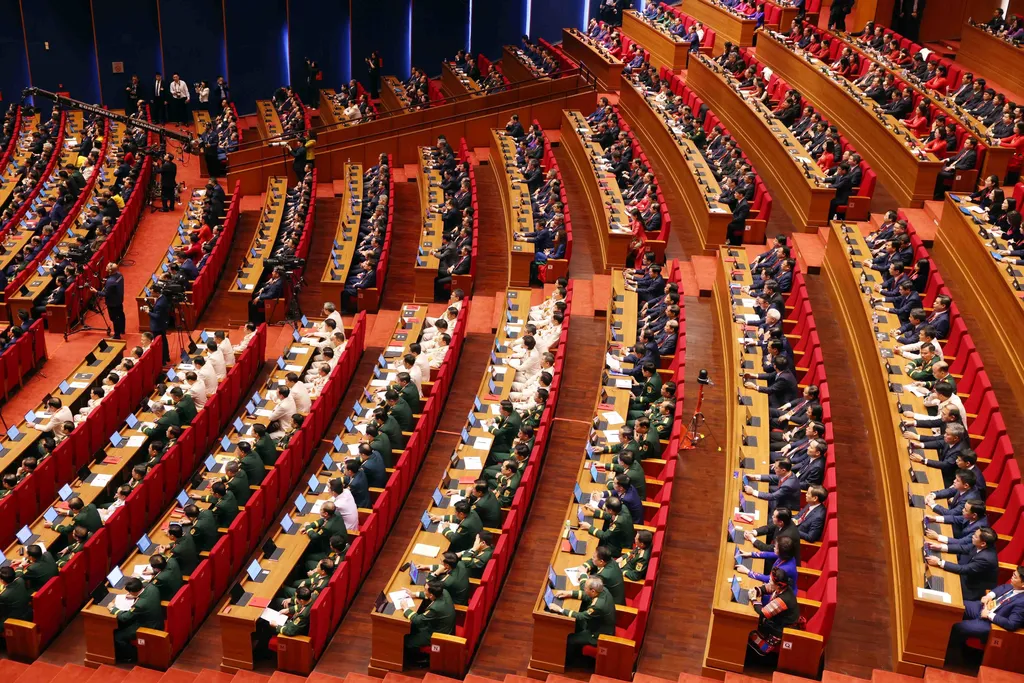
Overview of the opening session of the 14th National Party Congress.
Competent authorities must improve the institutions for development and the socialist rule-of-law state, with implementation as the primary yardstick.
“We must resolutely abolish the ‘ask–give’ mechanism and minimise administrative procedures,” the General Secretary said, stressing that the time and costs borne by citizens and enterprises must be the key indicators of reform quality.
Alongside institutional reform, the documents call for strict legal discipline and discipline in enforcement. They demand decisive action to overcome chronic problems where “the law is sound but implementation is difficult”, “smooth at the top, obstructed at the grassroots”, “leaders determined, executors indifferent”, “much talk, little action”, and “correct policies implemented too slowly”, wasting resources and eroding public trust.
Việt Nam will establish a new growth model grounded in the knowledge economy, the digital economy, the green economy and the circular economy.
“Future growth must rely primarily on productivity, quality, efficiency and innovation, gradually reducing dependence on natural resources and low-cost labour,” the General Secretary affirmed.
The Report sets out to fully harness the strengths of all economic sectors: the state economy retains its leading role in ensuring macroeconomic stability, major national balances and strategic orientation; the private sector is recognised as one of the most important drivers of the economy. A favourable business environment must be ensured, along with the protection of property rights and freedom of enterprise, fostering strong domestic firms with international competitiveness and the adoption of knowledge and technology in production and business.
Science, technology, innovation and digital transformation are identified as the central engines of development.
“To achieve breakthroughs in technology, we must begin with people and institutions. We cannot be subjective or will-based. There must be mechanisms to attract talent, evaluate performance by output, allow flexible financing, encourage public–private partnerships and place scientific missions in direct service of development needs. Science and technology must permeate daily life, serve the people, lift labour productivity, reduce social costs and drive economic growth,” he said.
Culture and the Vietnamese people are defined as the spiritual foundation of society, a source of internal strength and a vital driver of national development. National defence, security and external relations are tasked with safeguarding peace for development and enhancing national strength through development. Party building and rectification must continue to ensure a clean, strong and comprehensive political system, while cadre work remains “the most critical of all critical tasks”.
The General Secretary also stressed the need to select the right personnel for the right positions, with performance and public trust as the basis for evaluation, calling on the strict implementation of the principles and measures that protect officials who dare to think, dare to act and dare to take responsibility for the common good. Opportunists or those seeking to buy positions or influence must not be allowed to infiltrate the political system.
Việt Nam aims to build a healthy, disciplined, civilised, safe and progressive society.
“For our nation to develop sustainably, we must cultivate a society with sound ethics, legal discipline, cultural behaviour, civilised governance, safety in daily life and progress in development,” the Party chief said.
Greater determination for breakthrough development
The General Secretary stressed that the three strategic breakthroughs identified at the 13th Congress would remain vital throughout the 2021–2030 period. Yet as the new tenure begins, he emphasised that they must be pursued with far greater intensity, speed and determination, as they constitute the decisive levers for Việt Nam’s breakthrough development.
The first breakthrough concerns institutions and implementation: building a coherent and modern legal framework, improving the quality of policymaking, strengthening enforcement discipline, ensuring every decision is accompanied by a clear roadmap, adequate resources and effective oversight, while accelerating administrative reform and decentralisation. He underlined that the true measure of success must be the quality of services delivered to citizens and enterprises.
The second breakthrough focuses on human resources, particularly high-quality personnel aligned with science, technology and innovation. This requires a fundamental and comprehensive reform of education and training; closer alignment between training systems and labour market needs; the enhancement of digital capabilities; and the development of a skilled workforce of competent managers, experts, scientists, entrepreneurs and technicians able to meet the demands of rapid national development.
The third breakthrough involves developing modern, synchronised infrastructure. This includes prioritising strategic transport networks, energy systems, urban infrastructure and telecommunications, especially digital and data infrastructure, alongside climate-resilient development. Expansion of development space under the national master plan must also ensure strong regional connectivity, domestic linkages and global integration.
“These three breakthroughs are organically linked,” the General Secretary said. “Institutions pave the way; human resources determine the speed and quality of progress; and infrastructure creates the space and momentum for development. If they are implemented synchronously, we will create a new position and new strength. But if we act halfway, we will squander our opportunity,” the Party chief said.