The Tamesis
Yangon — Sitting in a restaurant, business leaders resigned. Before the 2021 coup, the entrepreneur’s company employed 600 workers. Now, that number has dropped to less than half.
“We are facing an acute shortage of skilled workers. The lack of economic prospects and the impact of conscription are forcing many young professionals to leave the country.”
The Myanmar national puts it bluntly that “the multiple crises of inflation, brain drain and inland conflict are reaching tipping points”.
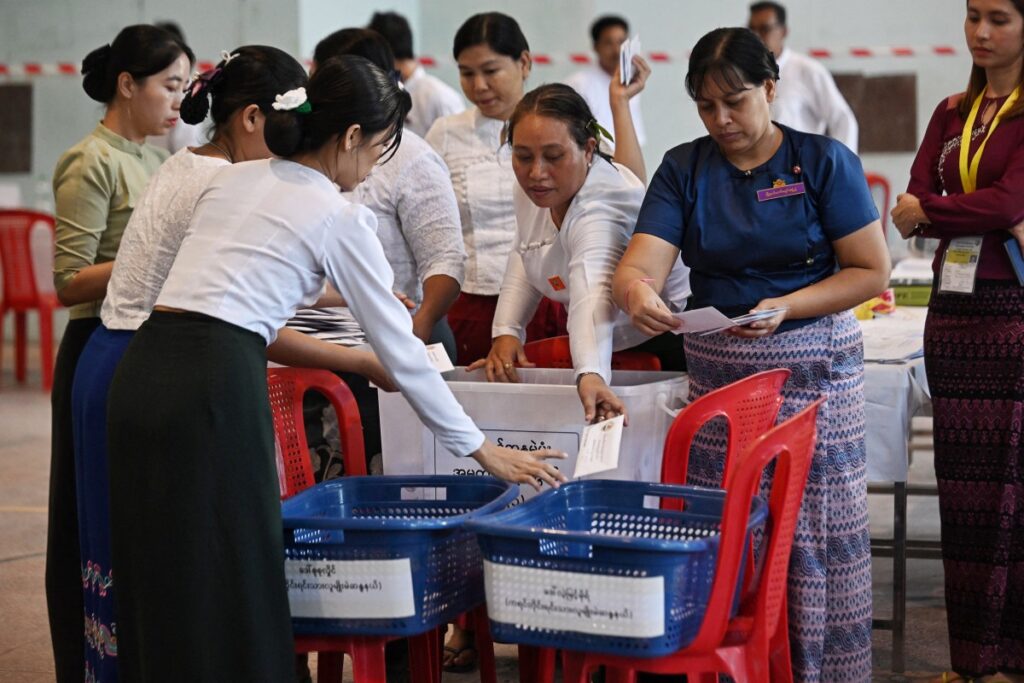
That’s why business owners are harboring a glimmer of hope that Myanmar’s ongoing election, albeit restricted, might be a sign of better things to come.
“While an election may not be a perfect solution, it is a practical step towards a stable government that can engage with the world and develop firm policies to protect the value of our currency.”
Many Myanmar citizens have flatly rejected the elections held by the country’s military junta – the first since the coup – calling them a sham.
But as the politically beleaguered country faces thorny operational challenges, five industrialists interviewed by The Straits Times offered a different perspective.
They said they saw the polls as an opportunity to revive the country’s struggling economy. All spoke on condition of anonymity for fear of reprisals from the junta.
One business owner of 30 years said the election “can serve as a step towards restoring operational stability”.
“For the business community, this is about human and economic survival, not political approval,” the entrepreneur insisted.
“We have a responsibility to our employees and their families. To ignore any possible path to a permanent administrative structure is to accept continued poverty and brain drain.”
However, analysts are skeptical that Myanmar’s economy will improve after the election.
Dr. Wai Yan Phyo Naing, a research consultant at the Myanmar Institute for Strategy and Policy, said investors would be wary of investing in the country if the new government formed after the election is composed of the same people with ties to the military regime.
“Any economic recovery that does occur under these circumstances is likely to be narrow, limited and relatively fragile,” he added.
Myanmar held the first of three-phase elections on December 28, with the remaining phases to be held on January 11 and January 25. Only 265 out of 330 towns and villages across the country participated.
Much of Myanmar is controlled by ethnic armed groups such as the Kachin Independence Army, which controls much of the north, and the Arakan Army, which controls Rakhine state in the west. Civilian resistance also seized territory from the military.
The election, condemned by critics as unfair, is expected to be won by the military-linked Union Solidarity and Development Party, which has fielded the largest number of candidates. The National League for Democracy (NLD), which won a landslide victory in the 2020 polls, was disbanded after it failed to re-register as a political party with the Military Electoral Commission.
The country of about 50 million people has suffered multiple setbacks since the coup, including widespread armed conflict and a struggling economy.
“Operating has become a test of extreme resilience,” said a local business owner who deals in essential goods, adding that the country’s currency depreciation has led to persistently high inflation. A United Nations report in January noted that the currency has plummeted from 1,330 kyats to the U.S. dollar in 2021 to 4,520 kyats to the U.S. dollar in 2025.
“Extremely strict import controls and onerous licensing requirements make coping more difficult. The central bank’s foreign exchange restrictions, including forced conversion of export earnings, make our exports uncompetitive,” the business owner added.
Myanmar’s inflation rate has soared from 2.2% in 2021 to an expected 31% in 2025, according to the International Monetary Fund.
The World Bank estimates Myanmar’s real gross domestic product (GDP) will shrink by 2% in the fiscal year ending in March 2026, but there are some encouraging signs of recovery, driven by post-earthquake reconstruction and continued targeted aid to the hardest-hit groups.
The World Bank said in June that a magnitude 7.7 earthquake struck the country in March 2025, affecting more than 17 million people, of whom 9 million were severely affected.
Since the 2021 coup, many foreign investors have fled the country. These include Norwegian telecommunications company Telenor, US multinational energy company Chevron and Singaporean investment holding company Emerging Towns & Cities Singapore.
Myanmar also faces a shortage of skilled workers. In light of ongoing clashes between civilian resistance and the military, as well as a 2024 national conscription law for men aged 18 to 35 and women aged 18 to 27, many young citizens have fled the country.
Political instability has also disrupted education, with a United Nations Development Program report in October highlighting that a quarter of Myanmar’s young people, or nearly 4 million, are unemployed.
Another long-time business owner also hopes for greater stability after the election: “Effective governance and the rule of law will help create a stable environment, encourage investment, promote industrial growth, and contribute to the long-term development of the country.”
But Dr Sean Turnell, a senior fellow at the Lowy Institute, told The Straits Times: “I’m sure business people themselves know that it is extremely unrealistic to expect the junta to improve economic policies.”
Dr Turnell, special economic adviser to National League for Democracy leader Aung San Suu Kyi, said the military regime had “effectively halved Myanmar’s expected gross domestic product” during its five years of rule, despite opportunities to implement good economic policies.
Dr Yan added that whether the economy will improve depends on factors such as investment conditions, or if there are clear, measurable improvements in the rule of law and regulatory framework.
Still, entrepreneurs interviewed by ST remain hopeful.
“We are advocating for a functional environment where the economy can finally start to reopen,” one person said.