The Tamesis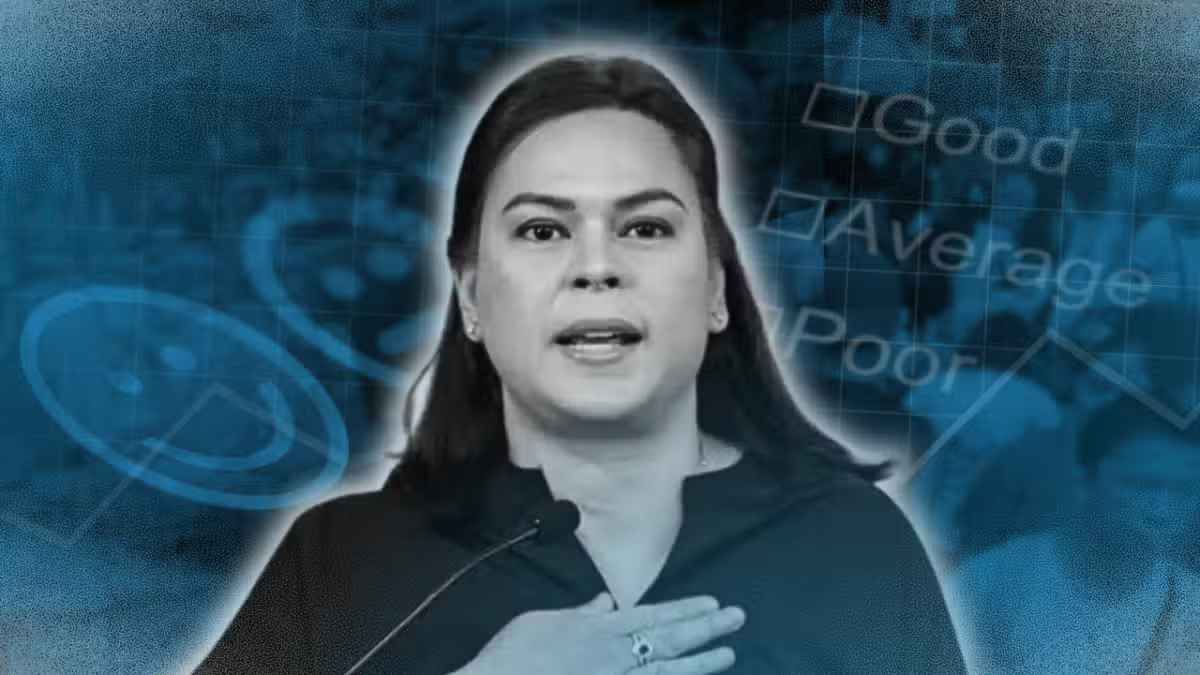
May 21, 2026
Manila – As the Senate prepares for the impeachment trial of Vice President Sara Duterte, new survey data suggests that public distrust of her is not driven by the same concerns across income groups.
An analysis conducted by Inquirer data scientist Dr. Rogelio Alicor Panao in a Pulse Asia survey conducted from February 27 to March 2, 2026, found that while corruption remains the leading cause of distrust across classes, poorer Filipinos and middle-income respondents are divided on what issues will plague them next.
“Corruption (‘Corrupt/Sangkot sa korapsyon’) is the main cause of distrust among all groups,” Panao said in his analysis, citing data from the Pulse Asia survey.
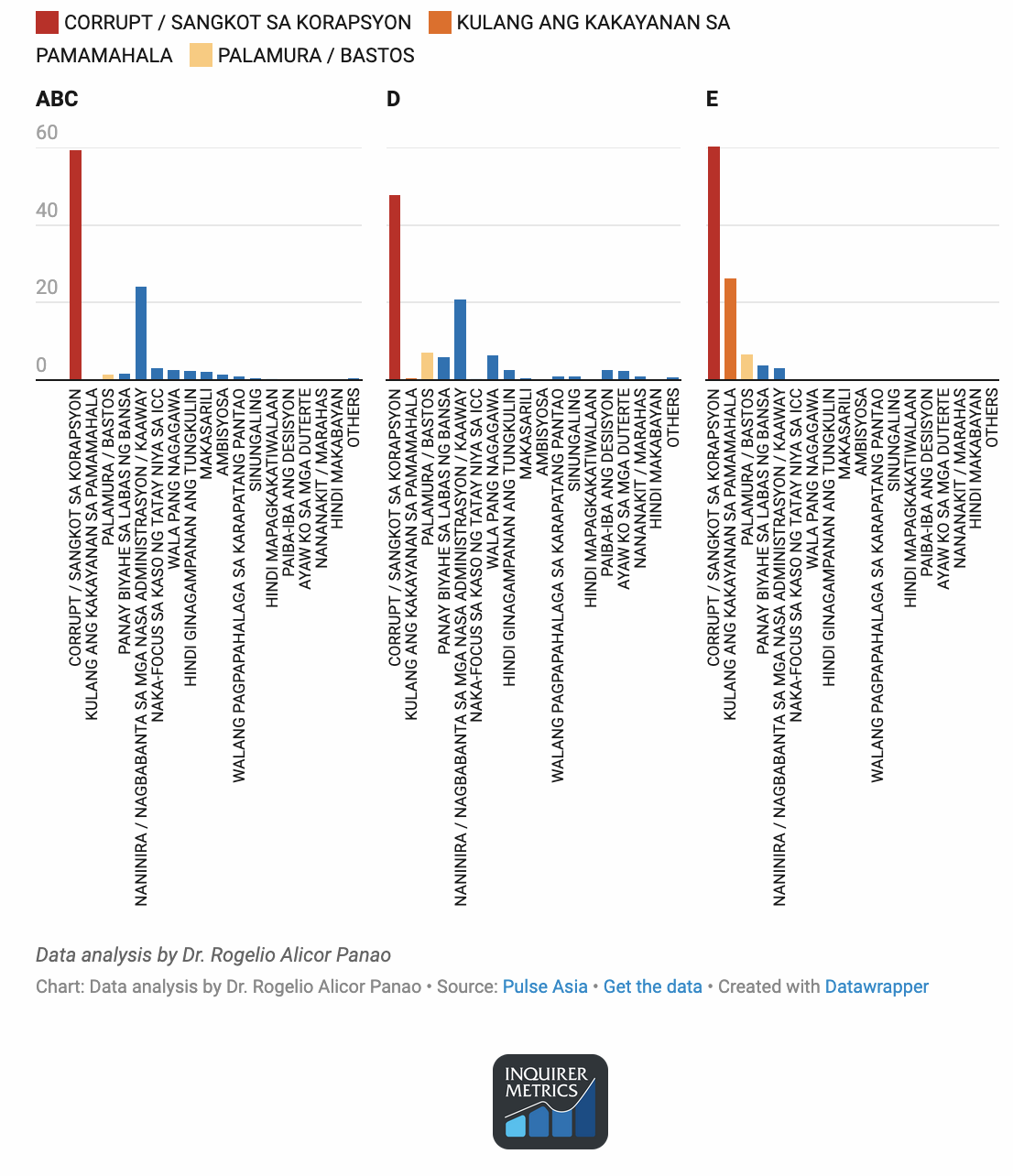
The survey showed that 59.4% of ABC respondents, 47.8% of D-level respondents and 60.3% of E-level respondents believed that corruption was the main reason for distrust of Duterte.
But beyond corruption, the pattern is starting to change, said Panao, a professor at the University of the Philippines Diliman.
“Among upper-middle-income respondents (ABC) and lower-middle class (D), the second most common reason for distrust was her hostility towards the government, such as attacking or threatening government officials (‘naninira/nagbabanta sa mga nasa administrasyon/kaaway’),” he said.
The survey showed that 24.2% of ABC respondents and 20.9% of Category D respondents expressed this concern.
Among low-income Filipinos, however, the problem is different.
“In contrast, among low-income respondents (Category E), the second most cited reason was the perceived lack of governance capacity (‘kulang ang kakayanan sa pamamahala’) at 26.3 percent,” Panao said.
The analysis also found that ABC and D category respondents had “almost no” concerns about Duterte’s ability to govern, while among E category respondents, there was also very little concern about the government’s political aggression, at only 3%.
Panau said the data showed that different political perspectives were determined in part by economic conditions.
“First, the narrative of Sara Duterte as a destabilizing political actor appears to be gaining traction primarily among middle- and upper-income groups, but far less popular among poorer Filipinos,” he said.
“Second, distrust among low-income respondents stems more from issues of administrative capacity than political conduct.”
Political tensions continued to rise after the House of Representatives forwarded articles of impeachment against Duterte to the Senate and the findings were released.
Despite facing impeachment proceedings, Duterte continues to maintain relatively high trust and approval ratings in recent national surveys.
Panao said class divisions in a pattern of distrust could have an impact on Duterte’s allies and critics as impeachment proceedings unfold.
“The middle class needs assurance that she is not a threat to stability. The poor need evidence that she can govern,” he said.
At the same time, he said critics seeking wider public attention may need to craft different arguments depending on the audience.
“To gain broader support, opponents must link corruption to incompetence, which is the language of assessment of the poor,” Panau said.
How these competing narratives shape public opinion may become more apparent as the Senate hears the impeachment trial.