The Tamesis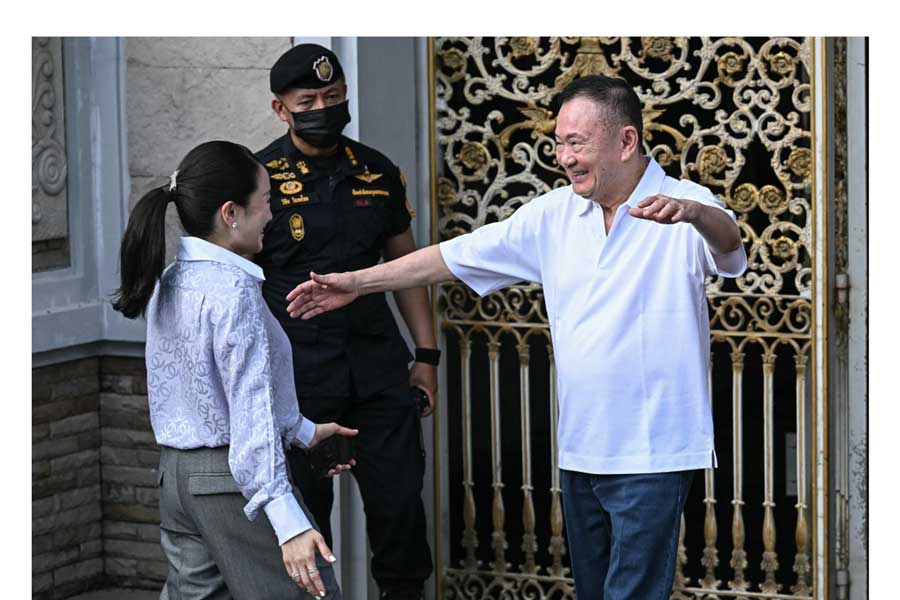
May 13, 2026
Bangkok – “I hibernated for eight months. Now I don’t remember anything.”
This was the answer former Prime Minister Thaksin Shinawatra gave to red shirt supporters gathered in front of his Chan Song La residence after he was paroled on May 11.
It sounds like the easy words of a newly freed man. But no one in Thai politics believes that Thaksin’s eight-month imprisonment means a complete cessation of all political activities.
On the contrary, this may be the period when he “thinks the most.” His so-called “political hibernation” may appear quiet and inactive, but Wei Tai insiders know that their “big boss” has not stopped or let go.
For a politician like Thaksin, even though his body is in prison and his freedoms are restricted, his networks, power, relationships and political games are not imprisoned with him.
While Thaksin also said he felt “relieved,” the truth is that Thai politics may now be entering a period when others are starting to feel less relaxed now that the man named Thaksin has regained his freedom—even if that freedom still comes with chains.
Over the past eight months he has still received messages, close associates have still been able to visit and, importantly, the former minister’s “not-so-secret figure” has continued to shuttle between both parties, constantly coordinating instructions and conveying the prison’s political direction.
The same applies to the people within Weitai, who continued to act in response to Chan Song La’s signals during this period.
Obviously, Thaksin’s freedom may have been limited, but he never left the game. This is just a pause to reset the board.
From now on, this may mark the beginning of a new chapter in Thaksin’s political life.
conditional freedom
Although Thaksin has been paroled, the reality is that the next four months will still be “freedom in chains.”
His freedom is not yet complete. The electronic monitoring bracelet remains in place. Conditions of probation still apply. The 112 cases that have been appealed have not yet been concluded. And the issue on the 14th floor of the Police General Hospital – a case where someone was found to have done something wrong – remains a political time bomb that has been sitting next to Thaksin, just waiting for someone to file a complaint accusing him of being a beneficiary.
Although Thaksin was released from prison, he has not escaped the “encirclement of the law.”
Therefore, every move he makes in the future must be calculated on multiple levels. A public, high-profile return to politics could create an opportunity for opponents to revive old cases and renew pressure. The risks will only increase.
This risk looms especially over his daughter Paetongtarn, who remains a core figure in the Pheu Thai party and has faced political risks many times since becoming prime minister.
We should not forget that Pheu Thai is no longer the largest party. With 78 seats in the House of Representatives, the party became the second largest coalition party under the Anutin government, with Bhumjaithai in the lead. This changes Pheu Thai’s status from a “game setter” to a party that must play other people’s games – which is completely different from the past.
Therefore, the most likely scenario for Thaksin’s political return may be to maintain a certain distance: not to advance too hard, not to go too strong, but not to disappear.
Thai Airways still orbits Thaksin’s gravity
Even so, for the Pheu Thai Party, Thaksin’s name remains the party’s focus.
According to reports, even the decision on whether Bangkok city council candidates will be included under the Pheu Thai party must wait for the “big boss” to come out first so that he can read the competition and assess the situation.
Symbolically, Thaksin remains the “spiritual leader” of the party and the red shirt masses. At a time when the Weitai brand is starting to lose power, the party needs “power builders” more than ever.
Another major challenge is that Weitai is currently in a period of transition as the brand declines. Its currents are not as strong as they were during the landslide. Part of its support base is beginning to waver, and the younger generation within the party has yet to establish the same level of “political prestige” as Thaksin.
While Pheu Pheu Thai has tried to reorganize and place younger figures in roles that will drive the party forward – especially prime ministerial candidate Dr Yodchanan Wongsawat, whose name is more frequently discussed as the next generation successor to hard work on the ground – the problem is that Thai politics is not just measured by hard work. It can also be measured by faith, charisma, and aura of power. In these respects, Thaksin still stands above almost everyone else in the party.
So if the party wants to promote a political heir apparent as a real replacement, that person must fit into the equation embraced by the old power center, Thaksin Shinawatra. In short: they may rise, but only as “game managers,” not “game owners.”
From starring to behind-the-scenes director?
Many people close to Thaksin would like to see him rest, spend time with his family, take care of his grandchildren as he once said he would, and pass the baton to a younger generation. But the truth is, Thaksin never let go and couldn’t bring himself to let go.
The lively scenes outside the prison and later in Chan Song La where red-shirted supporters gathered to welcome him may have been a phenomenon that reassured Thaksin that his brand could still sell, even if it wasn’t as strong as it was during the landslide. It’s also interesting that Pheu Thai politicians are still circling him.
Judging from Thaksin’s style – he must lead the game and not let it drift while others are playing – the political question from now on is not whether the former prime minister will return to political participation. The real question is: “What role will Thaksin play?”
The continued media attention, appeals from supporters and the steady flow of politicians to Chen Songla reflect that his influence will not end easily.
If we decipher the lessons of the past, then after eight months of “hibernation” and during the period before he has officially served his sentence, the key signal worth paying attention to is whether Thaksin will choose the role of “behind-the-scenes director”, reducing his front-stage role and increasing his behind-the-scenes influence.
There are also rumors within the Thai government that Thaksin may only speak on topics familiar to him, such as economic issues and policy advice, adopting the image of a senior figure providing advice rather than a full-time politician.
His real role, however, may lie in shaping electoral strategy, balancing power blocs within the party and quietly controlling political dealings – the “power without status” formula that Thaksin knows best.
Because in Thai politics, the people who are not in front of the stage can sometimes be the ones who decide how the whole story ends.
For Thaksin, this freedom may not mean a return to ordinary life. Rather, it could be the beginning of the “first chapter” of a new political action.
He may no longer be at the center of the spotlight, but he may still be the one who decides who the spotlight shines on.