The Tamesis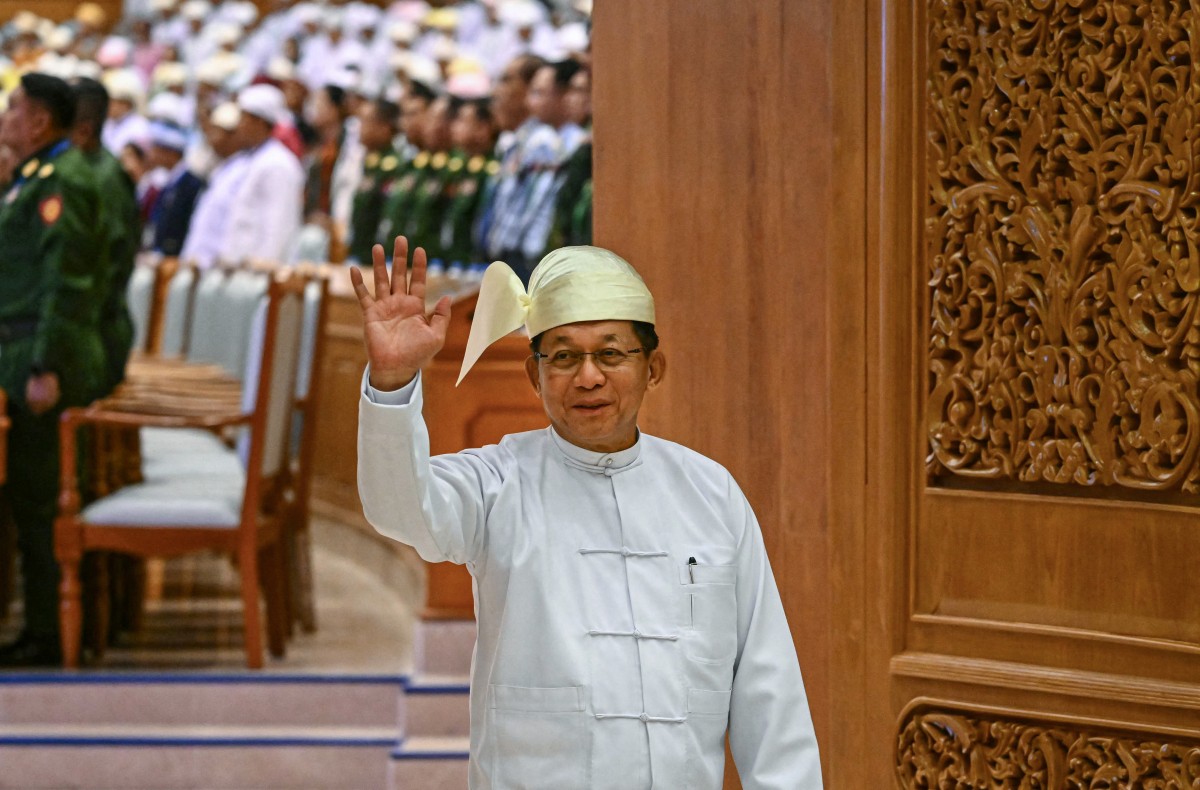
May 4, 2026
Tokyo – Myanmar’s military regime has consolidated its grip on power as former commander-in-chief Min Aung Hlaing takes office as president. Since the 2021 coup, the military junta has moved to further solidify its alliances with China and Russia, making monitoring developments in Myanmar critical not only for its democratic future but also for its growing influence on Indo-Pacific geopolitics.
The ultimate goal of the coup that ousted the National League for Democracy government and its leader Aung San Suu Kyi was to restore military control of parliament. Diplomatic sources noted that Min Aung Hlaing has long aspired to ascend to the presidential throne.
The current regime, composed of a coup-plotting president and a group of loyalists in the cabinet and military, is fundamentally different from Thein Sein’s government. Thein Sein’s government was formed in 2011 when the head of the military junta retired as part of a transition to civilian rule.
Driven by a desire to lift Western economic sanctions, Myanmar has shocked the world by undertaking democratic reforms at breakneck speed. This finally paved the way for the long-held dream of the government led by Aung San Suu Kyi.
“A dynasty was built around Min Aung Hlaing,” said Ichiro Maruyama, a former Japanese ambassador to Myanmar. “It won’t even get 0.1 percent better. The blow will only get harder.”
Although the new government pardoned Aung San Suu Kyi and Win Myint, chairman of the National League for Democracy government, on April 17, this had no real impact on the governance structure. The gesture was seen as performative and aimed at ensuring the new regime’s recognition by the Association of Southeast Asian Nations and the wider international community.
Given the huge political and military “debt” Myanmar owes to Beijing and Moscow since the coup, Myanmar’s dependence on these two countries and its subsequent influence on Myanmar is likely to grow in tandem.
Beijing’s strategic intervention
This situation arose due to the plight of the military during the Civil War. In October 2023, ethnic minority armed forces launched a coordinated offensive across the country. The army fell into chaos and lost the strategic town of Lashio in Shan State on the border with China. Although the groups gained momentum and advanced toward the capital, Naypyitaw, China eventually stepped in to halt their advance.
Although China showed consideration for the democratic forces, it decisively supported the military government at this critical moment. Beijing used the influence of its proxy, the United Wa State Army (UWSA), to cut off arms supplies to the two ethnic groups that dominated the battlefield in Shan State at the time.
Beijing has forced rebel forces to retreat from Lashio by closing its border gates and effectively starving ethnic minorities by cutting off daily necessities. China also often acts as a mediator in ceasefire negotiations.
After gaining a crucial reprieve, the junta began rebuilding its strength through forced conscription to fill its vacant ranks. It has further enhanced its offensive capabilities by adopting drone tactics that the rebels have deployed successfully against it.
A senior official from the Karen ethnic group, which controls the border with Thailand, noted last year that his troops were in trouble due to a sudden increase in suicide drone attacks.
Min Aung Hlaing reportedly thanked Chinese President Xi Jinping during a meeting in China last year and praised Beijing’s pressure on rebels in border areas for promoting peace.
Backed by a steady influx of Russian weapons, including fighter jets, Myanmar’s military regime has stepped up efforts to regain lost territory. Without the joint support of Beijing and Moscow, the regime likely would not have been able to hold last December’s general election as scheduled.
China’s support for the military regime is clearly driven by its own interests. Beijing has long envisioned a grand strategic corridor – a major resource and logistics artery – that would bypass the Strait of Malacca and reach directly into the Indian Ocean.
An oil and gas pipeline connecting Myanmar’s Kyaukphyu and China’s Yunnan province began operations in the 2010s, and will be connected to a railway along the same route. China is also expected to lead the development of special economic zones and deep-sea ports, a move orchestrated by Beijing to exploit Myanmar for its own strategic interests.
For China, stability in Myanmar is crucial to achieving these ambitions. Its support for the military junta is seen as a strategic attempt to prevent the collapse of governance structures and the fragmentation of the country.
Moscow’s growing naval presence
As for Russia, the agreement signed by the military junta has raised concerns about geopolitical risks.
A 2023 deal allows Russian warships to enter Thilawa naval base near Yangon to replenish fuel, food and water, diplomatic sources said. Since then, the two navies have expanded maritime cooperation and regularly held naval exercises in the Andaman Sea.
Myanmar and Russia have further cemented their strategic partnership through a series of long-term agreements covering nuclear energy, small modular reactor development and space technology. Myanmar’s influence has expanded beyond Moscow, and the junta has been quick to strengthen ties with Belarus, a key Russian ally.
In addition to its alliance with the authoritarian axis of China, Russia and Belarus, the military regime has also been openly critical of the Quad framework of Japan, the United States, Australia and India.
In an interview with Russian media in May last year, Min Aung Hlaing accused powerful countries such as India, Australia, Japan and the United States of trying to increase their influence in the Asia-Pacific region. He claimed that such an approach would only exacerbate regional conflicts.
***
Japan and the United States need a common strategy
Port development at Kyaukphyu and Dawei in Myanmar may become a geopolitical concern in the Indo-Pacific region in the future.
There are plans to develop Kyaukphyu as a trading port, but former Japanese ambassador to Myanmar Ichiro Maruyama has expressed doubts about the transparency of the implementation of the plan.
“The United States is extremely concerned that China may use the port for military purposes,” Maruyama said. “Without the coup, Japan and the United States could have considered cooperating with the Democratic League government to take measures to block China.”
A Thai company plans to develop a special economic zone in Dawei, facing the Andaman Sea. Japan participated in the project, but it ultimately failed. Myanmar’s military junta subsequently signed a memorandum of cooperation with Russia to build ports, power plants and refineries.
A media outlet in Myanmar with close ties to the military commented that the port will become Russia’s maritime entrance into Southeast Asia and will provide Moscow with strategic and military influence.
“If China and Russia had ports along the route to transport oil from the Middle East, that would be a major threat,” Maruyama said.
U.S. President Donald Trump’s administration has shown little interest in Myanmar, but in Congress, both Republicans and Democrats continue to take a tough stance against the junta. Lawmakers plan to pass a bipartisan bill that would expand sanctions against people with ties to Myanmar’s military.
Under the bill, Myanmar oil and gas companies and Myanmar Economic Bank will be sanctioned for the first time. This is expected to significantly limit military funding and the country’s ability to obtain foreign currency, as well as curb repressive airstrikes.
Reactions among members of the Association of Southeast Asian Nations to Myanmar’s new government have been mixed. Thailand is one of them and has always been friendly.
“The new government seems to be seeking to build close ties not only with China and Russia, but also with India and ASEAN,” said a local junta expert.
Japan must not recognize the government unless the country becomes a true democracy. Furthermore, Japan must work with the United States and like-minded countries in ASEAN to develop a new Myanmar policy to achieve stability in the Indo-Pacific region.