The Tamesis
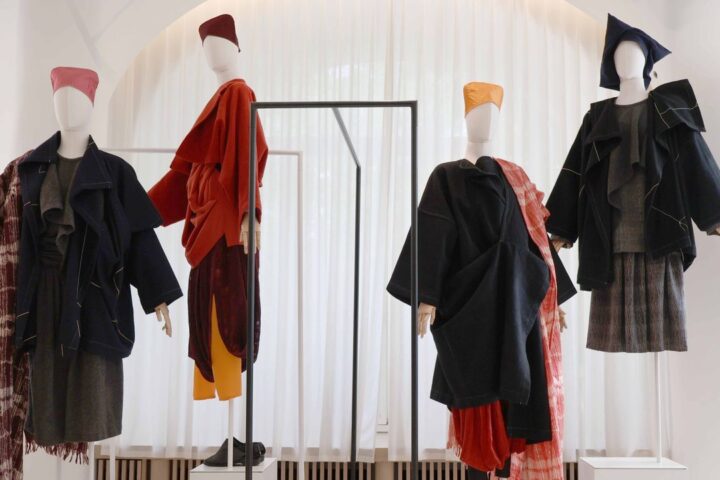
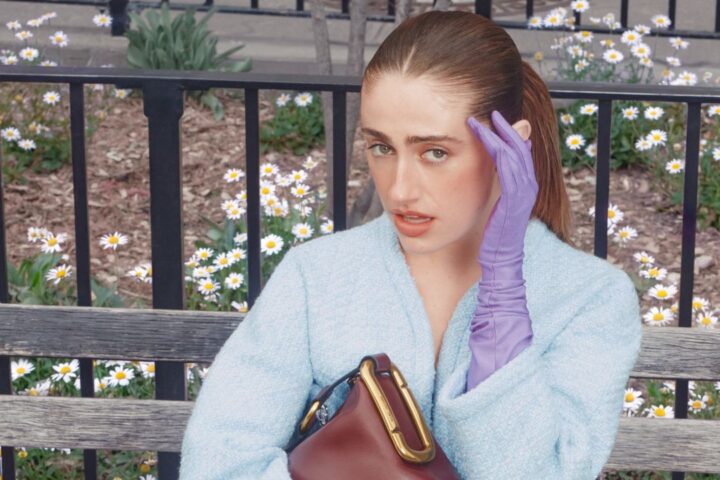
Here, fashion is almost like a punctuation mark and the spine of the visual narrative. You intentionally limited yourself to three designers when you could draw inspiration from many more. What draws you to Comme des Garçons, Ayham Hassam and Christian Lacroix?
Christian Lacroix had a sheer creativity that was, in the best sense, almost reckless. Working with him feels like watching the ideas come faster than the sewing can: always more layers, more embellishments, more life. A rare combination of an extraordinary talent and a very kind man. I still cherish the moments we spent working together; they were both generous and welcoming.
Then came Comme des Garçons, where Rei Kawakubo continued to push form into something closer to emotion than clothing. The pieces feel almost sculptural and poetic, especially when paired with Julien’s headpiece, hovering between the theoretical and the wearable, like an idea decided to take physical form. I’m not sure she’ll like that description, but I hope she’ll forgive me.
There is also Ayham Hassam, whose work has a completely different intensity: full of meaning, urgency and lived reality. Nothing is decorated for the sake of decoration, every movement has weight.
Lacroix also has a very personal dimension. His archive of approximately 2,000 haute couture pieces changed hands several times after his bankruptcy, first going through a more commercial phase and now, fortunately, under the stewardship of the owners, who are carefully restoring and reorganizing it. When I read this, it felt almost like a dream: the possibility of working with some of his most important works again, properly preserved, properly viewed.
There’s even a short film downstairs by Lisa Immordino Vreeland introducing Lacroix and its importance to haute couture. It felt important to include it because I owed him something. Our collaborative fashion show in Paris in 2019 never really took off because just as we were planning to bring it to Bergdorf Goodman in New York, COVID-19 intervened. It just disappears into postponement. So in a way, this moment finally happened. It’s a spotlight that’s long overdue, but necessary.
Also on display is a Lacroix haute couture jacket with quite a legendary history: it appeared on the cover of US in November 1988 Fashion, Anna Wintour’s first issue as editor-in-chief. Photographed by Peter Lindbergh, model Michaela Bercu wears a Christian Lacroix couture jacket with a beaded cross, casually paired with a pair of Guess jeans.
That cover marked a true turning point: it pulled haute couture out of the quiet salons and into global culture. Suddenly, a $10,000 jacket was no longer worn in a gilded room, but on a young woman with a real body, a visible midriff, and a pair of $50 jeans. In other words, haute couture meets everyday life without quite knowing what influences it. The beaded cross adds another layer of tension, and the religious symbol sits right at the center of a very modern visual contradiction, making the image even more dynamic. Here, the jacket, set against the composition of the Codognato Cross, quietly echoes the same dialogue: sacred symbols, fashion and reality all collide in the same frame, without asking permission.