The Tamesis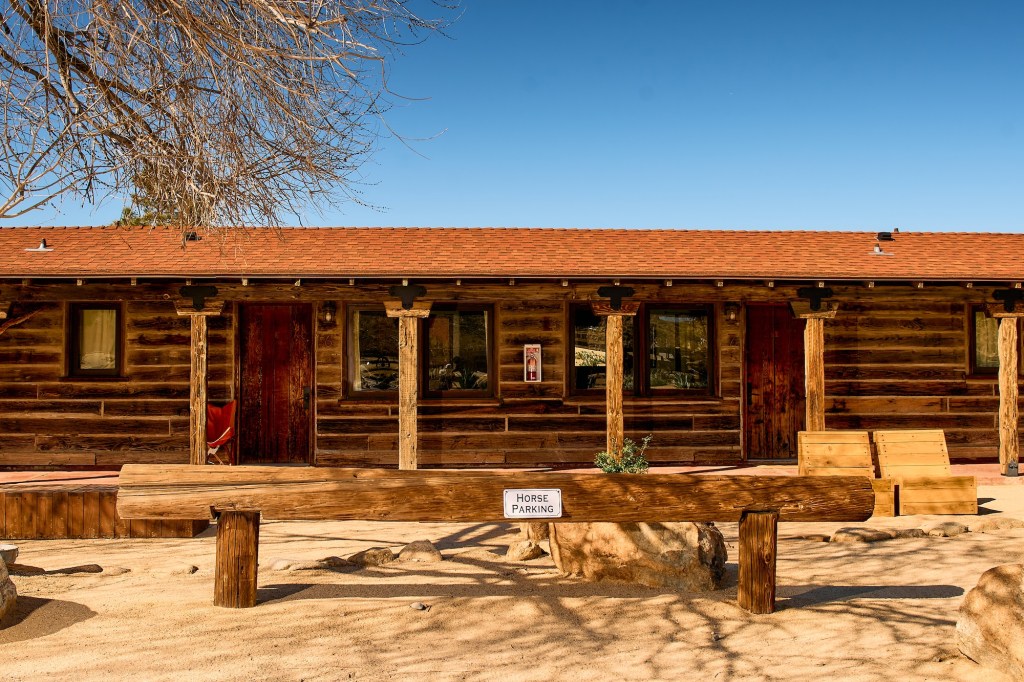
If you had the uncanny feeling that you were on a movie set while visiting the High Desert Art Fair (HDAF) last weekend, that’s because, in a way, you were. The event was held at the Pioneertown Motel in California’s high desert, which was built in 1946 by Gene Autry and Roy Rogers to simulate the small western town on the silver screen. It’s just a few hours’ drive from Los Angeles (if you time it right); about an hour from Palm Springs, which has a thriving art and design community; and 30 minutes from the magical Joshua Tree National Park. HDAF hosts 20 galleries, nonprofits, studios, and publishers and is in its fifth year and second year at the Pioneertown Motel (previously at various Airbnbs).
Related articles
It’s still a bit unreal to me that such a successful art fair, with a huge influx of visitors all day Saturday, could be held in such a remote location, but it’s not as remote as you might think.
HDAF, taking place March 28-29, is the brainchild of Nicholas Fahey, co-owner of Fahey/Klein Gallery in Los Angeles, and artist manager Candice Lawler, both of whom own real estate in the area. At a dinner, Fey told the crowd that it would be easier to get Angelenos to the high desert than to get them to travel from Malibu to see his gallery in Hancock Park, not far from the Los Angeles County Museum of Art. So, Fey and Lawler thought, why not hold an art fair there?
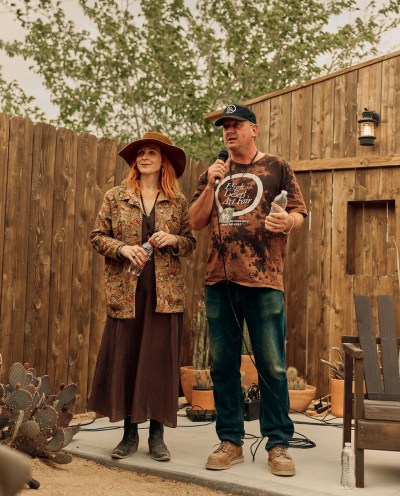
High Desert Art Fair co-founders Candice Lawler and Nicholas Fahey.
Many in the art world complain about art fair fatigue, and many in the art market acknowledge the need to educate a new generation of collectors. HDAF can provide a solution for both. (On the latter front, the show offers a busy educational public program, with one panel even devoted to “Collecting 101.”) HDAF was part of a recent event Wave after wave of shows focused on a handful of well-curated exhibitors, such as an invitation-only show that arrived in the Berkshire mountains of Massachusetts at a trendy tourist hotel; the Basel Social Club, a loose Art Basel satellite that took place in an open-air venue one year; and an intimate Frieze LA satellite show in a vacant post office in Santa Monica after the fair. These satellites are intended to offer a more commercial alternative to much larger international brands such as Art Basel and Frieze, often at lower prices (for collectors and exhibitors). Fahey told me over drinks that the HDAF dealer paid about $3,500 for two days for the rooms, including setup and teardown. That’s a bargain compared to the $125,000-plus for a large booth at Art Basel, or even smaller displays for statement or feature sections (starting at $13,000).
One of the strengths of this emerging fair is that it builds on an existing thriving cultural ecosystem. Hundreds of artists and art patrons flock to the area for its natural beauty. Besides the government, one of the area’s most significant landowners was artist Ed Ruscha, who visited friends in the 1970s and immediately began acquiring properties.
This past weekend, the VIP program included visits to several inspiring attractions, including an outdoor museum established by assemblage artist Noah Purifoy (on land donated by Ruscha). Andrea Zittel’s High Desert Test Sites are where she develops modular habitats and clever projects you may have seen in museums and galleries, but they come to life. Art collector Jerry Sohn invited architect Arata Isozaki to build four concrete pavilions on his property, one for each season, where people could sleep and enjoy the spectacular surroundings, along with art installations by Richard Long and others. Rachel Whiteread’s “Ghost Cottage” is also on Thorne’s property.
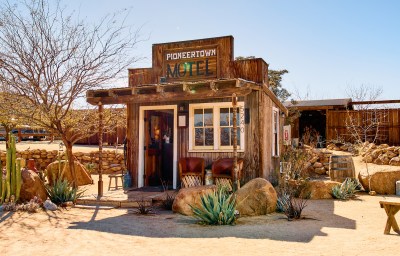
Pioneertown Motel.
Back at the show, art lovers enjoyed the sunshine and surrounding scenery while wandering among rooms named after Western figures such as Gene Autry, Hopalong Cassidy and Annie Oakley. Many people bring their dogs. Those with kids or those looking to do some shopping can head to the nearby Pioneer Town Petting Zoo and Souvenir Shop, which offers cowboy boots and hats that wouldn’t look out of place at the fair. Does this all sound a little cheesy? Maybe, but it sure beats visiting a windowless convention center again with uniform booths stretching from one end to the other.
Every time I mention to locals that I last visited the area 20 years ago, they say “Oh, a lot has changed since then!” San Francisco art dealer Jonathan Carver Moore bought a second home in Palm Springs in 2022; a lot has changed since then, he says. (Moore is showing work from a range of gallery artists, including striking colorful paintings by Carrie Anne Plank, which she tells me have to do with AI modeling of protein recipes in vaccines and are her own small protest against the current administration’s anti-vaccination stance.)
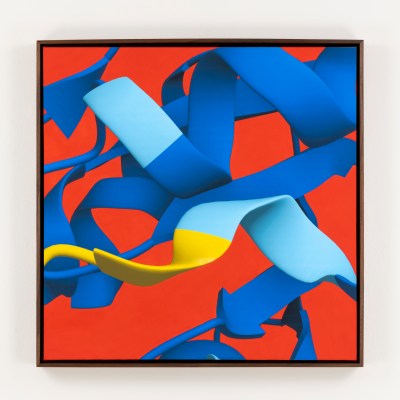
Kelly Ann Plank, Protean Constructs #5 (mRNA capping enzyme).
Francis Baker
As Clayton Baldwin, a real estate consultant and broker specializing in the High Desert, told me, the changes everyone is talking about are already happening throughout the region, and the area is not immune to gentrification. The area has experienced “meaningful cultural migration,” he said, increasingly attracting artists, makers, designers, architects, collectors and others from Los Angeles, New York and the Bay Area, making the area less marginalized.
“The bigger story is really the story of open lands, conservation and long-term management,” he said. That said, “prices have risen dramatically over the past decade, though not in a straight line, and not evenly across all parts of the market.” He rattles off a lengthy but not comprehensive list of artists who have purchased real estate in the area, including Iwan Baan, Edie Fake, Shepard Fairey, Jake Longstreth, Liza Lou, Jack Pierson, Rod Radziner, Cybele Row, Philip K. Smith III, Lily Stockman, and more.
One of the selling points of the HDAF is its ability to attract new collectors. Many exhibitors offered art ranging from hundreds to thousands of dollars with great success. Track 16 in Los Angeles sells works ranging from $300 to $8,000. The most expensive work they sold Saturday was a painting by Chris Ulivo that went for $4,500.
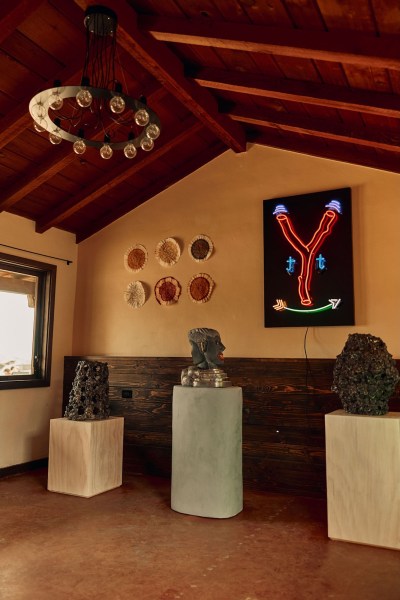
Yucca Valley Materials Lab presentation at High Desert Art Fair.
Victoria Posh, courtesy of High Desert Art Fair
Artist Heidi Schwegler, founder of Yucca Valley Material Labs, said Saturday at 2:30 p.m. that she has made money at the show that will help fund various events at the nonprofit, such as residencies for artists, musicians and writers. the organization’s “Business is booming,” she said, including pieces selling for as much as $3,200.
Filled with cowboy hats and boots and a strange group of arts supporters from Palm Springs, one of the highlights of the weekend was Striking Paintings of Western Homosexuals Created by Austin artist RF. Alvarez exhibits with Los Angeles gallery Megan Mulrooney. I was particularly drawn to the sexy, intense portraits of an artist friend, grave (2026). It sells for just $4,000.
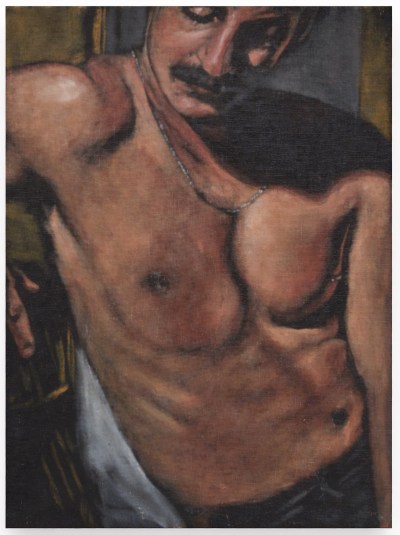
RF Alvarez, grave (2026).
Courtesy of the artist and Megan Morooney
But it’s not all entry-level pricing. The largest sale I’ve ever heard of was at Harrods Gallery in Los Angeles, which sold prints by John Baldessari, A refugee is a person who has been deprived of everything but suffering (1988), originally produced to raise funds following the famine in Biafra, sold for $41,000.
Baldessari’s work is an example of an artist’s engagement with the wider world and was seen on Saturday as millions of people around the world marched in the latest “No King” demonstrations against Donald Trump. No protesters marched through Pioneertown, but the outside world was not absent.
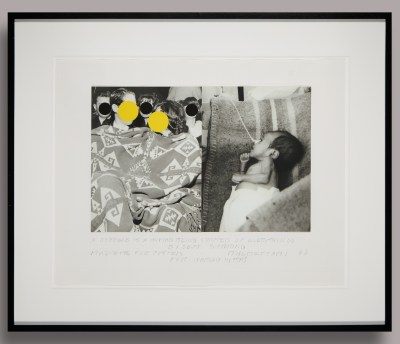
John Baldessari, A refugee is a person who has been deprived of everything but suffering (1988).
Harold Gallery
Artists Ry Rocklen and Ryan Schneider, who work out of rooms at Rocklen’s Quality Coins Gallery (named after the pawn shop that once occupied the gallery’s nearby Yucca Valley location), offer works mostly in the $250 to $2,500 range, with proceeds used for two purposes: one, to help people in areas affected by Immigration and Customs Enforcement, including sending money to deported neighbors (and their dogs to join them); and two, to organize against high-density real estate development in Joshua Tree. Schneider told me that as of Sunday afternoon, they had raised about $15,000, selling works by artists such as Claire Collette, Heather Day and Daniel Gibson, as well as works by Rocklund and Schneider.
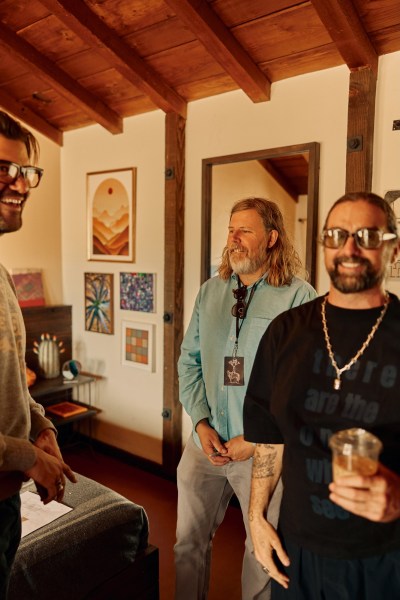
Artists Ry Rocklen and Ryan Schneider work at Rocklen’s Los Angeles gallery Quality Coins.
Victoria Posh, courtesy of High Desert Art Fair
Back at the Harold Gallery, an impressive large-scale painting by Laurie Lipton shows the grim interior of an ICE concentration camp, complete with armed guards and crying children. It comes straight from the studio to the show. Finally we checked with gallery owner Harold Huttas and it was still available.
Music plays throughout. Artist Shepard Fairey provided a DJ set for the opening night; some exhibitors brought record players or portable speakers and hung them in their rooms, whether playing thrift store finds or soothing ambient music at Los Angeles’ Gross Gallery on Sunday. Gallery founder Julian Gross is selling art from musicians including TV On the Radio’s Tunde Adebimpe, Yeah Yeah Yeahs’ Karen O and Interpol’s Paul Banks, who showed off C-prints of iPhone architectural photos taken while the band was on tour. Gross paid within hours.
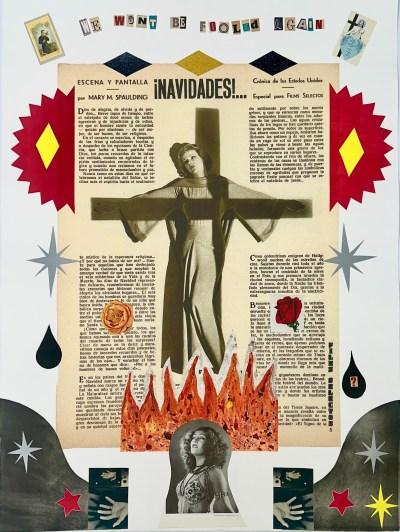
Kathy Nicoli, We won’t be fooled again (2026).
Farrington Press
Another musical connection: At Farrington Press (“an off-grid print shop and collaborative space nestled in the mountains in a secret location between the San Bernardino National Forest and Joshua Tree National Park”), the room features gorgeous large prints by artist Casey Niccoli, We won’t be fooled again (2026). Even if they don’t know her name, music fans likely know one of her works; she collaborated with ’90s alt-rock giants Jane’s Addiction, co-creating the sculpture that appeared on the cover of their 1990 smash album customary rituals. As she writes, she found herself erased from the band’s history. Now she is working again after a long hiatus.
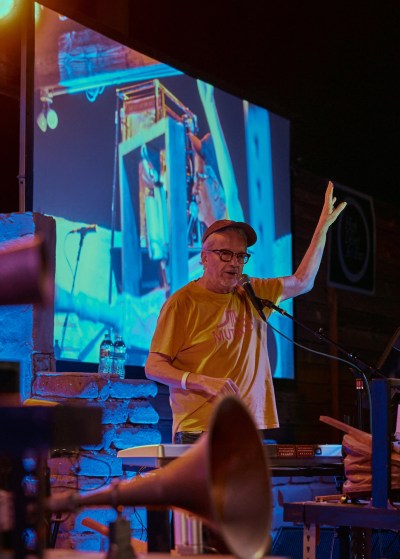
Devo frontman Mark Mothersbaugh headlines a musical performance at honky-tonk Pappy & Harriet’s.
Victoria Posh, courtesy of High Desert Art Fair
A music icon also made an appearance during the weekend’s festivities. Devo frontman Mark Mothersbaugh headlined a concert at Pappy & Harriet’s, a honky-tonk bar next door to the market, playing DJ sets and using an impressive artifact, “The General,” which he described as half instrument, half sculpture; as he played, pieces he had drawn and written flashed on the big screen. MutMuz Gallery in Los Angeles is selling Mothersbaugh’s handmade prints from his 1980s heyday, along with CDs of his music and art books, for just $750. (At the concert, the cowboy hat appeared alongside several examples of the conical, stepped “power dome” headgear Devo was famous for.) Mothersbaugh’s rousing set ended with an updated version of “Uncontrollable Urge,” the first track from his old band’s first record (Question: Aren’t we men? Answer: We are Devo!), with a stuttering but anthemic chorus (“Yeah, yeah, yeah, yeah, yyyyyy-Yes! “).
Will enough collectors and dealers say “yes” to High Desert Art Fair to make it a lasting part of the art market? Only time will tell. For me, I definitely won’t wait another 20 years to come back.