The Tamesis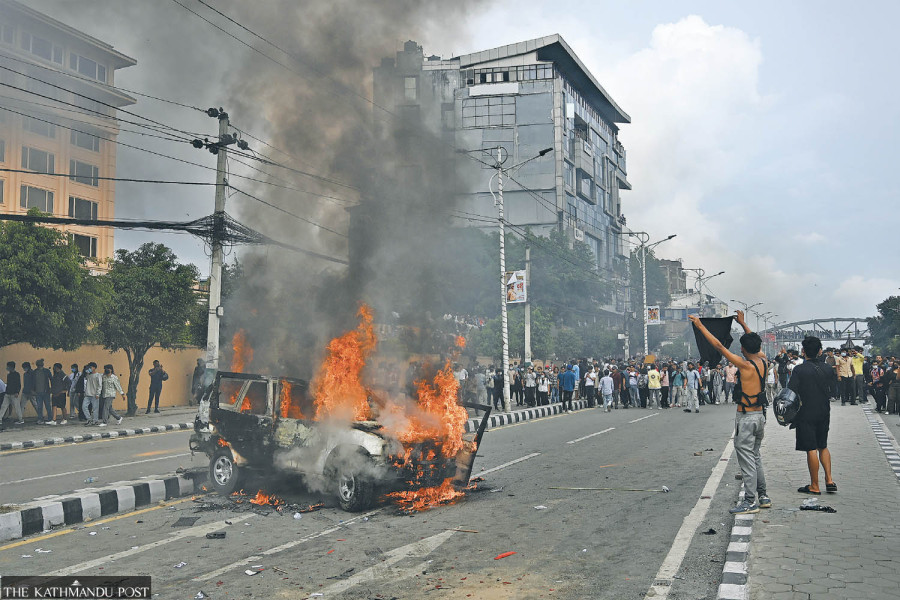
March 27, 2026
kathmandu – The report of the Judicial Commission established to investigate the Gen Z protests in September stated that the Nepal Army was informed in advance that the demonstrations on September 8 could take a dangerous escalation.
Although the report submitted by former special court judge Gauri Bahadur Karki was to be made public by the Sushila Karki-led interim government, it came to light on Wednesday through multiple media outlets.
Following the unauthorized release of the report, the government on Wednesday evening decided to release not only the findings of the Kalki Commission but also the reports of the Nepal Children’s Organization and the Balmandir High Commission of Inquiry, 2020, as well as the Good Governance Roadmap 2025 prepared by the Prime Minister’s Office and the Council of Ministers.
A three-member committee headed by Karki is probing the incident by questioning a wide range of key figures. These include then Prime Minister KP Sharma Oli, Home Minister Ramesh Lekhak, Nepal Army Chief Ashok Raj Sigdel, former Nepal Police Inspector General Chandra Kuber Khapung, Armed Police Force Commander Raju Aryal, as well as Nepal Congress Chairman Sher Bahadur Deuba, main opposition leader Pushpa Kamal Dahal, Rastriya Swatantra Party Chairman Rabi Lamichhane and then Kathmandu Mayor Balendra Shah who will be sworn in as Prime Minister on Friday.
Asked by the committee, Army Chief of Staff General Sigdel said he had received information the day before the protests that the movement was likely to intensify. According to reports, at a Central Security Council meeting on September 7, they learned from the National Investigation Department and other security agencies that the protests may escalate.
However, Sigurdl also pointed out in the statement that the National Security Council had not yet convened a meeting at that time, which meant that strategic-level discussions could not be held.
Responsibility for convening the National Security Council rests with the Prime Minister.
Meanwhile, when Oli was summoned by the committee months later, he was asked why the National Security Council was not summoned and directed to deploy troops to immediately bring the situation under control. According to reports, Oli responded that he had no intention of mobilizing the army and therefore no such meeting was held.
“As chairman of the National Security Council, the prime minister has the power to convene meetings and issue directives. However, the government’s first priority is to ensure that the use of force is minimized and human casualties are avoided. This step was not taken as the government had no intention of deploying troops,” Oli said in a statement on the summons.
The Nepal Army’s recommendations are consistent with this approach, he added.
Oli also said he believed the arson attacks and attacks against all three branches of the country – executive, legislative and judicial – were premeditated.
Arson attacks on key government institutions, including the Supreme Court, Parliament House and the Royal Palace, came a day after he resigned as prime minister amid Gen Z protests. On September 8, a total of 19 demonstrators were killed, 17 in Kathmandu and 2 in Jhapa. The next day, September 9, angry protesters launched an attack.
A total of 77 people were killed and billions of dollars worth of government and private property were destroyed during the youth-led protests.
In response to the incident, the report recommended that Ollie, Lecak and then police chief Capone be charged with negligence under Articles 181 and 182 of the Criminal Code, which carries a maximum penalty of 10 years in prison.
The report also recommended action against the then home minister Gokarna Mani Dawadi; Armed Police Force commander Raju Aryal; former head of the National Investigation Department Hutaraj Thapa; and then Kathmandu chief district officer Chhabi Rijal. It is recommended that they be prosecuted under Article 182 of the National Criminal Code.
The report also recommended that other government officials found responsible for the incident should be dealt with in accordance with the laws of their respective organizations.
In the case of the Nepal Police AIG and current Inspector General of Police Dan Bahadur Karki, the report recommended that he be formally reprimanded. Legal experts note that such reprimands can have consequences for promotions within an organization.
Likewise, the soon-to-be future commissioner of the Armed Police Force, Narayan Dutta Poudel, has also been singled out for such condemnation. While this may no longer have any significant impact on Kalki, if the report is implemented, it could pose a challenge to Podel’s promotion.
According to a member of the investigative committee, public concerns could infiltrate the protests. He said the committee worked hard to address the issue as it prepared its report. However, he claimed their investigation found no evidence to support the kind of organized infiltration publicly alleged.
Still, he noted a striking pattern in arson incidents targeting institutions and individuals. In interviews with The Washington Post, committee members explained that investigators observed protesters in different locations using similar modus operandi.
“The pattern included first turning off the CCTV cameras of the target house, then draining the water from the water tank of the house, burning documents, entering the kitchen to cut off the gas pipe and setting fire to the house, and finally burning the vehicles inside the house before leaving,” the committee member said.
However, the government maintains that it intended to release the report but was unable to do so for various reasons.
The interim government formed a three-member committee on September 21, whose members include former Nepal Police AIG Bigyan Raj Sharma and senior lawyer Bishweshwar Prasad Bhandari. The committee took longer than the three months originally stipulated and submitted its report to the government on March 8 after multiple extensions. Subsequently, the cabinet meeting on March 15 decided to make the report public after deliberation.
Following that cabinet meeting, Home Minister Om Prakash Aryal, who is also the government spokesperson, told the media on March 16 that more details about the report would be shared.
Cabinet decisions are usually announced after approval by the Chief Secretary. However, a press conference scheduled to release the report on March 15 was not held as the chief secretary was yet to confirm the decision. A source familiar with the developments also noted that the government faces other difficulties in making the report public.
The unnamed source further said that security agency chiefs met Prime Minister Karki a few days ago and warned that if the report was released and implemented, it could trigger unrest within the security agencies. They reportedly believed this put additional pressure on the government not to make the report public.
In addition, sources pointed out that the release of the summary report of the Gen Z protest report by the National Human Rights Commission caused serious unrest within the bureaucracy and security forces, further increasing pressure on the government to withhold the commission’s report.