The Tamesis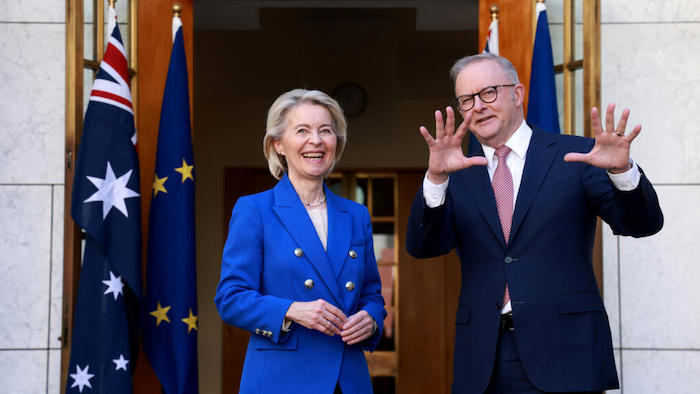
Australia on Tuesday struck a free trade deal with the European Union, along with other deals on defense and rare earth minerals.
The agreements come amid growing tensions over global trade, tariffs and U.S.-China economic coercion, forcing both sides to diversify and expand their trading partners.
European Commission President Ursula von der Leyen flew to Canberra on Monday to sign the deal on behalf of the 27-nation bloc amid rising energy and economic insecurity. Persian Gulf War.
See also: Iran mocks Trump for concessions on crackdown on its oil and power plants
The EU is Australia’s third largest trading partner; total bilateral transactions in 2024 will be close to US$77 billion (A$110 billion).
Tensions over tariffs imposed by the Trump administration have triggered a “fever” to expand trade since April last year.
This is the sixth agreement signed by the EU during this period. last month, EU and India sign ‘massive’ trade deal It follows similar deals with South American bloc Mercosur, as well as Switzerland, Indonesia and Mexico.
Agence France-Presse said that after eight years of negotiations, key sticking points over Australia’s use of European place names and how much beef it can export to the continent have been overcome to reach the agreement.
Another compromise would allow Australian winemakers to use the word “prosecco” domestically but must stop using the term in exports after ten years.
Australia will also be allowed to continue using some geographical names, such as feta and gruyere, if the producer has used the name for at least five years.
EU cars exempt from luxury tax
Meanwhile, European carmakers will benefit from Australia’s increase in the luxury car tax threshold for electric vehicles – with three quarters now set to be exempt.
The two sides also agreed to strengthen cooperation in defense and critical minerals.
When von der Leyen addressed Australia’s parliament on Tuesday, she described a world that was “cruel, harsh and unforgiving”.
In this context, she said the EU and Australia are bound by shared values and must work together to reduce overreliance on rare earth minerals from countries such as China.
“We cannot be overly reliant on any one supplier for such an important ingredient, which is why we need each other,” she said.
“Our security is your security and through our new security and defense partnership we can support each other.”
Beijing’s Foreign Ministry on Tuesday urged the European Union to abandon “zero-sum thinking”.
“We hope that the European side… will not take protectionist measures and look at China’s development rationally and objectively,” spokesman Lin Jian said when asked about von der Leyen’s remarks at a regular news conference.
Carmakers happy, farmers angry
Von der Leyen told Australian lawmakers the trade deal was a “fair deal that brings benefits to your businesses and benefits to our businesses”.
Under the deal, the EU said it expected exports to Australia to grow by a third within a decade.
Over the next decade, the European Union’s allowed quotas for Australian beef will increase to more than ten times current levels.
That upset both Australian farmers who had hoped for more and European farmers who objected.
The National Farmers’ Union of Australia said it was “extremely disappointed” with a deal that European agriculture lobby group Copa-Cogeca said contained “unacceptable” concessions.
Others were even happier. European carmaker group ACEA welcomed the deal, and the EU’s top business lobby BusinessEurope hailed it as a “geopolitical and economic victory for both parties.”
Last year, EU companies exported 37 billion euros ($42.9 billion) of goods to Australia, and by 2024, 31 billion euros of services will be exported to Australia.
Australia said the deal could add A$7.8 billion ($5.4 billion) to its gross domestic product by 2030.
Australia’s largest export market is China, and the United States is its largest source of investment.
new partnerships, wars
Since last year, however, Canberra has redoubled its efforts to diversify export markets for farmers. The dispute with Beijing in 2020 The shipment of agricultural products has been blocked for several years, and the United States last year imposed tariffs around the world.
As mentioned earlier, the EU has also been working hard to build new partnerships in the face of U.S. tariffs and Chinese export controls.
Von der Leyen’s visit was overshadowed by soaring oil prices caused by war in the Middle East.
The EU president said this month that the conflict was a “stark reminder” of Europe’s fragility.
On Tuesday, she called for an immediate end to hostilities in the face of a “critical” situation in global energy supply chains.
Australia, which relies heavily on foreign fuel, is also feeling the pressure of the global energy crunch.
See also:
India races to secure supplies as new attacks threaten ‘energy war’
Iran war sends gas prices soaring, Asia ramps up coal power generation
China opposes U.S. trade probe and says it will fight back
China exploits Trump’s ‘uncertainty’ to dominate global trade, report says
Australia and EU eye next trade deal, possibly this month
Amid U.S. tensions, Canada eyes ties with India, Japan, Australia
India delays talks, China says ‘cancel tariffs’ after US ruling
Australia is China’s biggest target for trade restrictions, study shows
Beijing seen launching shadow trade war against Australia